
Essays · Contemporary Art
Jun Nguyen-Hatsushiba. Memorial Project Nha Trang, Vietnam.
Some memories can only be reached by holding your breath.
Cyclos on the seabed
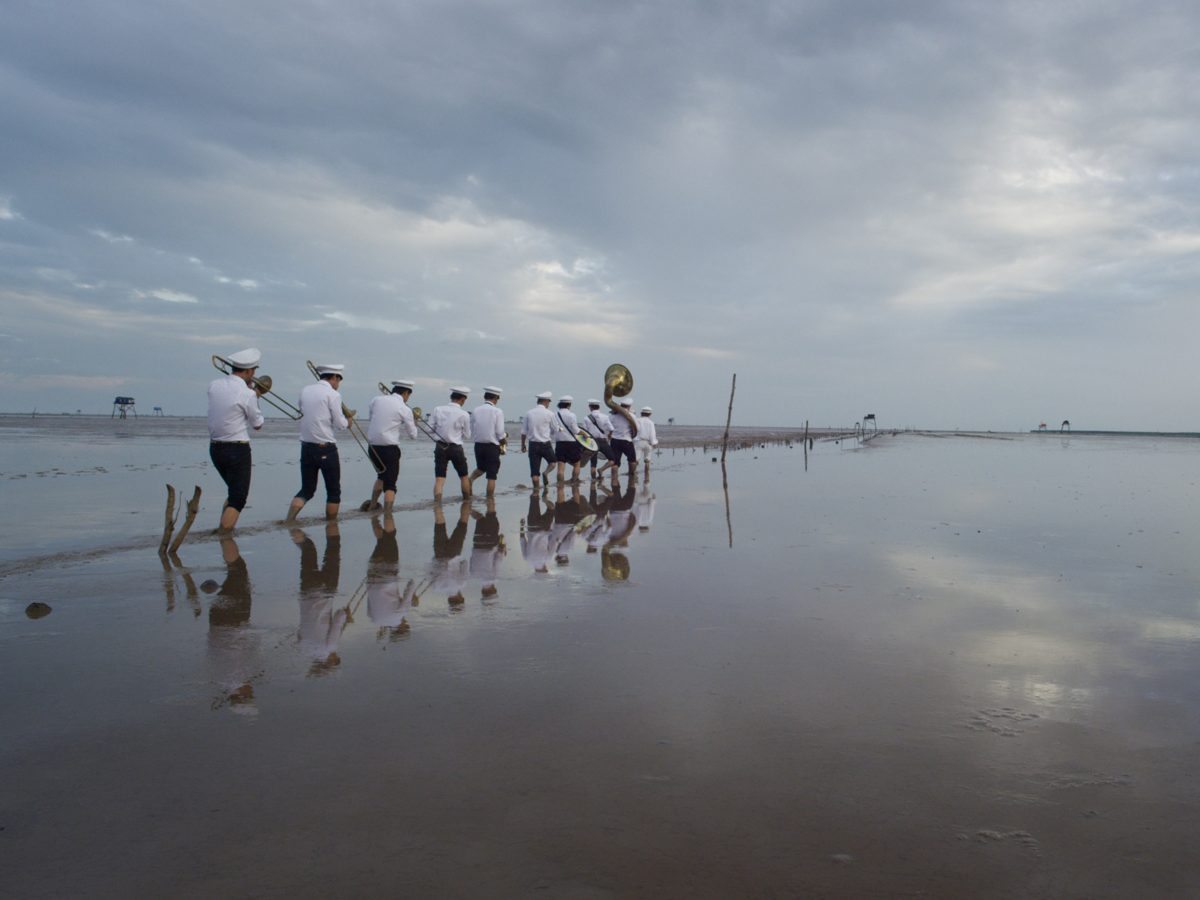
The sea off Nha Trang is clear and blue. On the sandy bottom, a group of men pull cyclos. They are local fishermen. They carry no air tanks. Each man pulls for a stretch, lets go, swims up to breathe, then dives back down to pull again.
The cyclos move slowly, sinking into the sand. The wheels do not turn as they would on a street. They are dragged, bit by bit, in one direction. There stand mosquito nets, set up in clusters, swaying in the water like a thin forest.
The work is a 13 minute video in colour with sound, completed in 2001. Its full title is long: Memorial Project Nha Trang, Vietnam: Towards the Complex, For the Courageous, the Curious and the Cowards.
Viewers watch from under the water, at the same depth as the men. Light from the surface falls in shifting bands. Every movement is slower than on land, heavier, as if the water were holding back each step. Something ordinary in the street, pulling a vehicle, becomes down here an effort of the whole body.
There is no narration. Only the sound of water, the shapes of men, and vehicles being hauled along.
Objects that carry memory
Jun Nguyen-Hatsushiba was born in 1968 in Tokyo and lives and works between Ho Chi Minh City and Houston. He chooses the most ordinary objects of Vietnam and places them where they do not belong.
The cyclo was once a vehicle of the streets, of manual labour, of an era. As the city changed, it slowly receded. Pulling it to the seabed places it among the things sinking out of daily life.
The mosquito net belongs to sleep, to shelter inside the home. Underwater it becomes a fragile refuge, with shape but no walls. The men pulling the cyclos head toward it, as toward a safe place they are not sure they will reach.
And the sea. For many Vietnamese, the sea is tied to the departures after the war, to people who left the mainland by boat. The work does not say this outright. But a man holding his breath under water, dragging something heavy, is an image enough for viewers to think of it themselves.
A memorial that moves
The usual memorial is stone or bronze, a still object that people come to stand before. Nguyen-Hatsushiba does the opposite. His memorial is an action that has to be repeated, and exists only as long as the body can bear it.
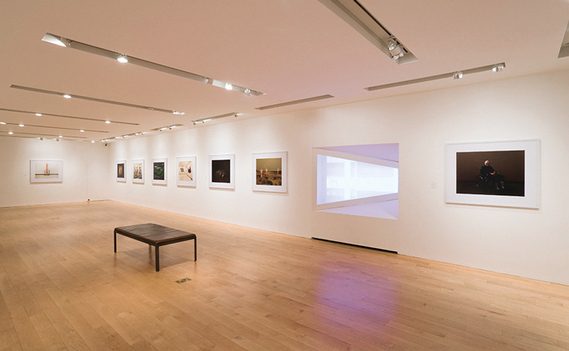
The work was commissioned by the Yokohama Triennale and shown there in 2001. The Whitney Museum in New York later acquired an edition for its collection, with funds from its Contemporary Painting and Sculpture Committee.
The title names several kinds of people: the courageous, the curious, the cowards. No one is judged. Those who left, those who stayed, those who only watched all have a place in a shared memory. The underwater haul has no clear destination. It is only an effort, repeated again and again.
In the same years, other Vietnamese artists were finding ways to set war memory into images of the present, such as An-My Lê's Small Wars, where the war is replayed in the woods of Virginia. Nguyen-Hatsushiba chose the sea. There, memory is heavier and slower, and every step costs a breath.
Contemporary Art