
Essays · Contemporary Art
Nguyen Trinh Thi. Letters from Panduranga.
To look at someone without speaking for them.
© Nguyen Trinh Thi · M+ Museum
Two people, a chain of letters
Letters from Panduranga is a 35 minute essay film that Nguyễn Trinh Thi completed in 2015. It is in colour, with sound, spoken in Vietnamese. There are no characters in the fiction sense. Only two voices.
One belongs to a woman, voiced by Nguyễn Trinh Thi herself. She is in Ninh Thuận. The other belongs to a man travelling through the landscapes of central Vietnam. Neither has a name. They write to each other, and those letters are the thread of the film.
They do not tell a story in order. They exchange thoughts, questions, things seen during the day. Sometimes one letter answers the last. Sometimes it goes off somewhere else entirely.
Images run alongside the letters: people, temples, open ground. Viewers are never quite sure who is looking through the lens at any moment. That uncertainty is part of the film.
Panduranga, land of the Cham
Present day Ninh Thuận was once called Panduranga. It is a region of historical and spiritual weight for the Cham, a minority community in Vietnam with its own heritage of temples, rituals, and a memory far older than today's administrative borders.
The film was made while Vietnam was preparing to build two nuclear power plants in Ninh Thuận. The letters mention the plan as something imminent, a threat to the Cham sites that remain nearby. There is no declaration. Only worry, spoken softly, among other things.
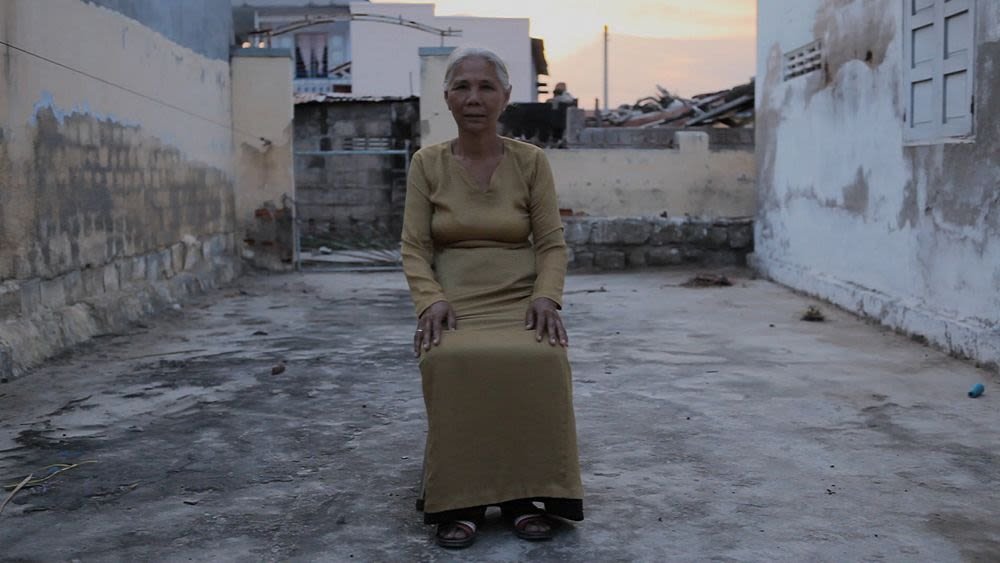
Nguyễn Trinh Thi films Cham people in long, portrait like shots. The people in the frame stand still and look back. The camera does not hurry. It lets them be fully present, not cut down into illustrations of an argument.
At sites such as the Hindu temples of Mỹ Sơn, she also sets images side by side in pairs, recalling the stereographic pictures made by nineteenth century photographers. That kind of image belongs to the outsider's gaze, to the colonial period, to the urge to record and classify. By placing it in the film, she shows viewers the history of looking itself.
Avoiding speaking for others
Perhaps the film's key line comes from the woman: she is trying to avoid speaking on behalf of others. It is the question facing anyone who holds a camera before a community not their own. What right do I have? What am I taking away?
Letters from Panduranga does not resolve that question. It keeps it open for 35 minutes. The woman films, then writes letters doubting the filming. The man travels further and sees more widely, but cannot stand outside either. Both are latecomers, standing at the edge.
The essay film form allows that hesitation. A documentary usually has to assert. An essay film can think aloud, be wrong, turn back. Nguyễn Trinh Thi uses that freedom to make a modest film about its own power.
Today the film is in the collection of M+ in Hong Kong, and it has been screened at the Jeu de Paume in Paris. It belongs to a line of work by Vietnamese artists who look again at how images make history, such as Dinh Q. Lê's From Vietnam to Hollywood. But the voice of Letters from Panduranga is quieter, more private. It is closer to a letter than to a manifesto.
Contemporary Art