
Essays · Contemporary Art
Dinh Q. Lê. From Vietnam to Hollywood.
Private memory and public image, woven too tight to pull apart.
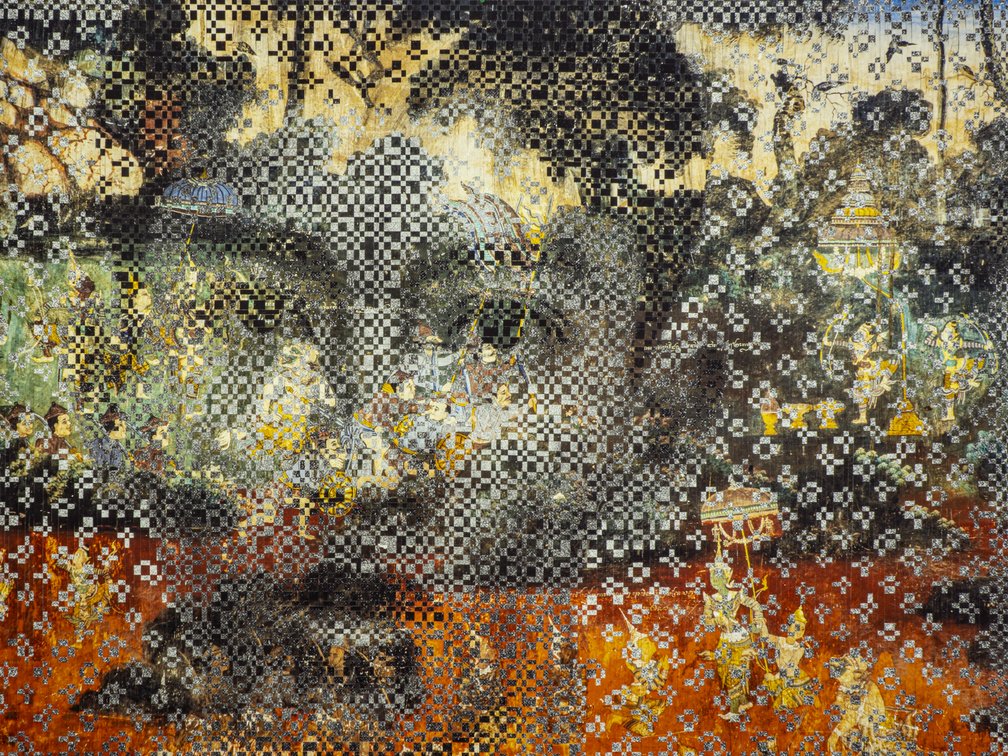
P·P·O·W Gallery · P·P·O·W Gallery
Cut into strips, woven back
Photo weaving is the method tied to Dinh Q. Lê's name. He takes two or more photographs, cuts each into long strips, then weaves the strips together, warp and weft, the way a mat is woven. The result is a new image in which the old ones both appear and hide, glimpsed square by square.
Up close, a viewer sees an eye, part of a helicopter, a patch of jungle. Stepping back, the images overlap into a vibrating surface where none takes over. A weaving makes the viewer move and change distance to piece together what they are seeing.
Lê learned weaving from his aunt as a child in Hà Tiên, a town on the Cambodian border. It was the traditional craft of sedge mats. He carried it over to photographic paper.
Hollywood and the nameless
In From Vietnam to Hollywood, Lê wove stills from well known Hollywood films about the Vietnam War, such as Apocalypse Now and Platoon, with found photographs of unidentified Vietnamese people from that time and wartime press images. In Immolation in Color, from 2002, the horizontal axis of the weave lines up images from those big films.
These three kinds of image had never shared a place. Press photographs recorded events. Hollywood rebuilt the war for American audiences. Vietnamese family photographs sat in albums and boxes, and some drifted away from their owners, becoming nameless. Lê laid them on one plane, cut them up and wove them so none could stand apart.
Lê said that growing up in America, his personal memory of the war, public memory and Hollywood's fictional memory had merged, and the film images took over. The weavings are his way of untangling that knot and tying it again by hand.
Venice, then New York
Weavings from the series were shown at the 50th Venice Biennale in 2003, in Delays and Revolutions. The following spring, from 18 March to 17 April 2004, P·P·O·W gallery in New York showed From Vietnam to Hollywood, including works from Venice and newly finished pieces.
The New York show also had a wall installation combining war documentary photographs, formal Vietnamese portraits, images of contemporary Vietnam and unexposed photographic paper. Those blank sheets stood beside the finished images, like room left for what has not been recorded.
The Museum of Modern Art in New York and the San Francisco Museum of Modern Art have both acquired his work.
A man between two shores
Dinh Q. Lê was born in 1968 in Hà Tiên. After Vietnam invaded Cambodia in 1978, his family left and eventually settled in Los Angeles. He studied art at the University of California, Santa Barbara, then took an MFA at the School of Visual Arts in New York. Later he lived and worked between Vietnam and Los Angeles. He died in 2024.
That position explains much about the weavings. He grew up with the war as seen by Americans, on screen, while his own origins lay on the other side of those frames. The weave is where both sides are forced to touch.
In the same generation, the photographer An-My Lê also entered the gap between real war and its images, photographing Americans who reenact battles in the woods. They work differently, but ask the same thing: whose Vietnam War is it that we remember?
Contemporary Art