
Essays · Contemporary Art
Anselm Kiefer. Lilith.
Ash is what remains once fire has passed.
Tate · Tate
A city under ash
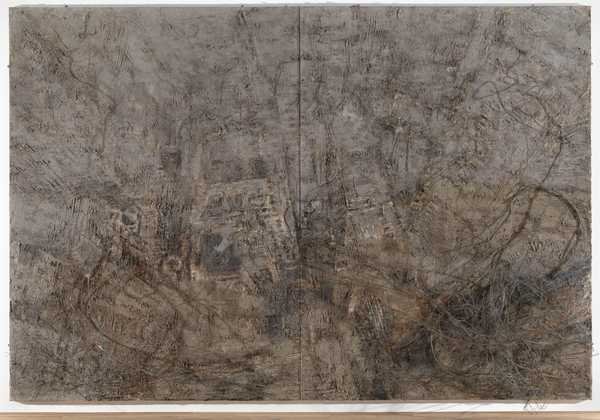
Lilith is a very large painting. According to Tate's record, it is over three point eight metres high and more than five point six metres wide, made of two canvases. Kiefer worked on it from 1987 to 1989. Tate bought it in 1990.
The materials are listed plainly: oil paint, ash and copper wire on canvas. No layer is decorative. The oil paint lays down greys, browns, blacks. Ash clings in dry powdery patches. Copper wire is attached to the surface and stands out from it, enough to give the painting the depth of an object.
The image is a city seen from above. Tate files the work under views of São Paulo, Brazil's largest city, seen from a distance. Dense blocks of buildings, streets like incisions. But the ash makes the city look unlike a living place. It looks freshly burned, or long abandoned.
The word Lilith, the title itself, is written on the surface. Kiefer often writes names on his canvases by hand, so that the words become part of the surface.
The name of a demon
In Jewish legend, Lilith is a figure of the night. Some stories make her Adam's first wife, who left Eden and became a spirit, a demon. She is linked to desolate places, ruined cities, places people have fled.
Placing that name on a modern metropolis is a heavy gesture. The city is not painted as a symbol of progress. It is painted as a place where Lilith might settle: a future ruin, or a ruin already waiting under the towers.
Tate lists the work under decay, pollution and social comment. A great city covered in ash can be read as a warning about the price of growth. It can also be read as a memory of war, something Kiefer carried from very early on.
The painter who works in ash
Anselm Kiefer was born in Germany in 1945, the year the Second World War ended. He grew up among cities being rebuilt from rubble. Much of his career has been a confrontation with German history, with what the previous generation preferred to leave unspoken.
In the early 1970s Kiefer studied for a time with Joseph Beuys, who also worked with materials that carry memory, such as fat, felt and stone. From then on, Kiefer's paintings grew thick with things that do not belong to painting: straw, lead, sand, dried plants, ash. Each material brings its own story before it reaches the canvas.
Ash is the clearest of them. It is the result of fire, and fire in the history of the twentieth century carries very dark meanings. Kiefer does not need to explain. The ash lying there is enough for the viewer to know that something once burned.
Copper is different. It carries electricity and signals; it is the wiring of the modern city. On the canvas, the strands of copper look like what survives a fire, the things that would not burn.
Why it stays
Lilith gives no answer about history. It gives a surface, heavy and grey, to stand before for a long time. The closer one stands, the more the ash turns uneven, the wire crooked, the paint irregular. The city dissolves into matter.
Next to Beuys's basalt blocks in The End of the Twentieth Century, Lilith shows the same conviction: materials remember. A pinch of ash remembers fire. A strand of copper remembers current. And a city, seen through ash, remembers that it too could disappear.
Contemporary Art