
Essays · Contemporary Art
Cao Fei. RMB City: A Second Life City Planning by China Tracy.
A virtual city can hold everything except smell.
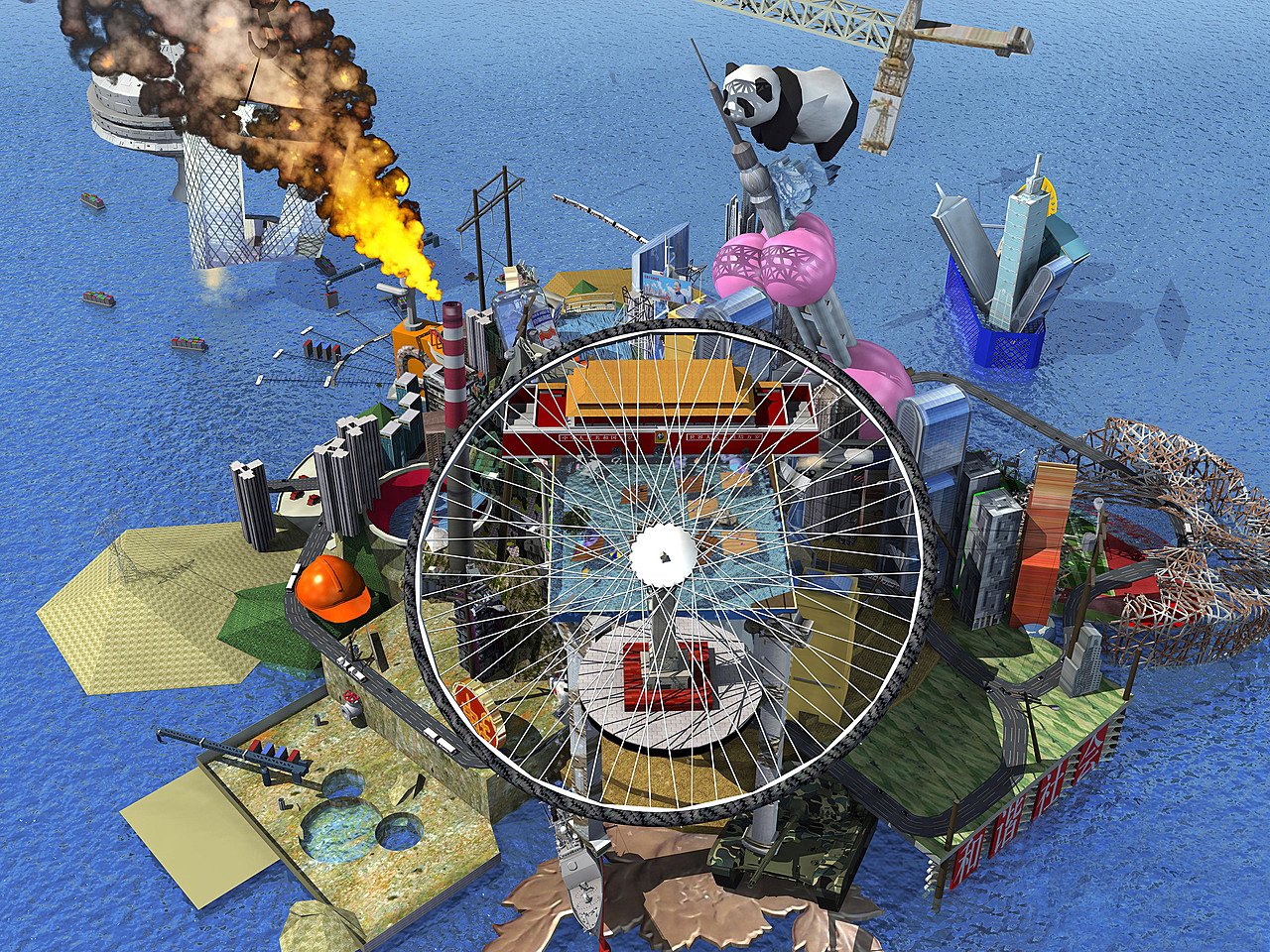
Solomon R. Guggenheim Museum · Solomon R. Guggenheim Museum
A plan for a virtual city
In 2007 Cao Fei completed a six minute colour video with sound under a long title: RMB City: A Second Life City Planning by China Tracy. In other words, a plan for a city in Second Life, drawn up by China Tracy.
China Tracy is Cao Fei's avatar, the figure that stands for her in Second Life, an online virtual world where users create characters, buy land, build houses and live another life. In the mid 2000s Second Life drew huge numbers of people, from ordinary players to companies and universities.
The video is a first look at RMB City. A virtual camera glides around an island in the water, crowded with buildings stacked on one another, dense, without the usual order of a city. The name comes from RMB, the abbreviation for the renminbi. A city named after a currency.
The Guggenheim acquired the video in 2008, with support from the museum's group of young collectors.
A city of symbols
According to the project's own website, RMB City is an online art community in the virtual world of Second Life. It is described as an experiment in the creative relationship between real and virtual space, and a reflection of China's urban and cultural explosion.
The city is assembled from images anyone following China in those years would recognise: landmark structures, new towers on the rise, images of politics, sport and consumption. They are not in their real places. They are lifted out of context and set close together on one island, like a mental map of a country changing very fast.
The first gate onto the island is the City Hall, called the People's Palace. It is both the city's main administrative body and its venue for events, with a concierge, a map, a place to leave suggestions and learn the city's history. Visitors can also dance to DJs by the swimming pool.
Who built RMB City
RMB City was never a one person project. It was developed by Cao Fei, as China Tracy, together with Vitamin Creative Space, an art space in Guangzhou. The collector Uli Sigg acted as facilitator, with his own Second Life avatar. The Serpentine Gallery in London presented the project.
The project site lists real world events from 2007 onward: the Venice Biennale, the Istanbul Biennale, the Shenzhen Biennale, Art Basel Miami Beach, the Astrup Fearnley Museum in Oslo. In 2008 it was shown in New York, Paris, Beijing, London and Bristol.
Inside Second Life, the city's ground breaking took place in July 2008, followed by the opening of its preview centre on 25 July that year. The city then held its own events: parties, a skimboard game, even an opera project, RMB City Opera, later presented at the Nelson-Atkins Museum of Art. A virtual city, yet with a social life and an events calendar like a real one.
Why it matters
Cao Fei made RMB City while China was building at a speed the world had never seen. Old neighbourhoods vanished, new towers rose within months. A virtual city where any building can appear with one click was not so far from that reality.
The work neither mocks nor celebrates. It asks: if a city can be raised this fast, whom does it belong to, and what will its residents remember of it? The question sits close to the game world of Hito Steyerl's Factory of the Sun, where real and virtual life also slide into each other.
Seen today, as people spend more and more time in digital space, RMB City looks like an early draft. It tested what many only began to think about later: living, meeting and making art in a city with no real ground underfoot.
Contemporary Art