
Essays · Contemporary Art
teamLab Borderless: MORI Building DIGITAL ART MUSEUM.
A place with no map, only paths.
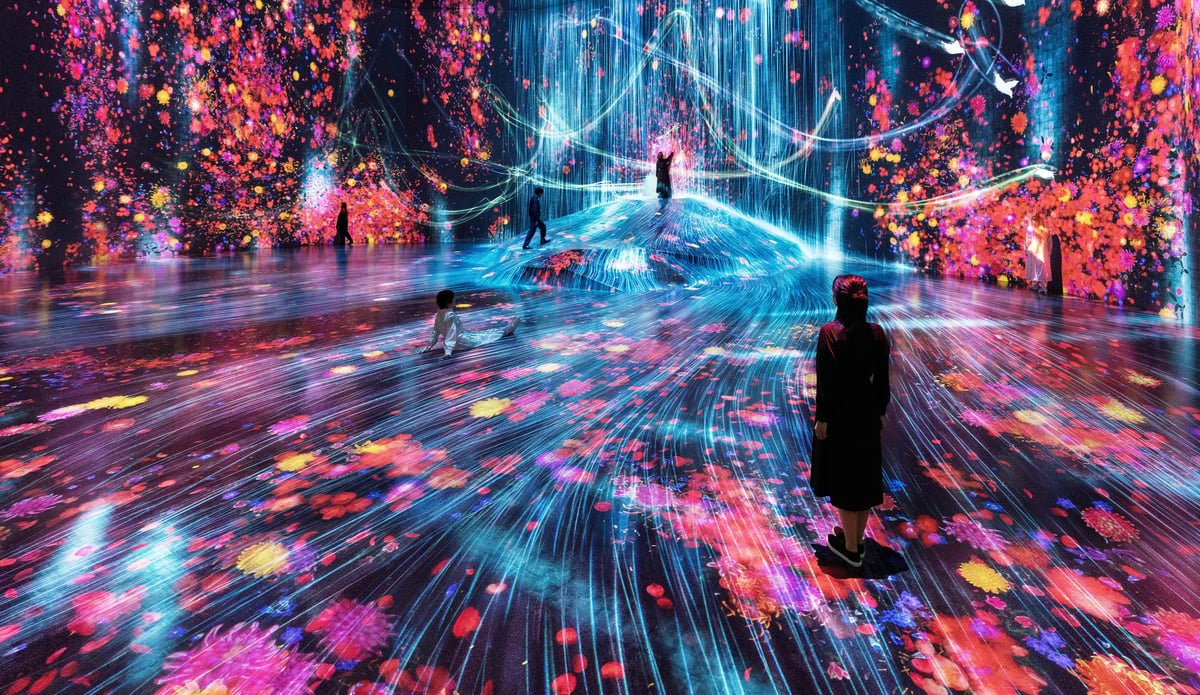
© teamLab · teamLab (official site)
A museum without a map
teamLab is an art collective based in Tokyo, made up of artists, programmers, engineers and architects. In 2018 they opened teamLab Borderless in Odaiba, Tokyo, with the developer Mori Building. Its full name is MORI Building DIGITAL ART MUSEUM: teamLab Borderless.
teamLab describes the place briefly: a world of artworks without boundaries, a museum without a map. Visitors are given no numbered route. There are no arrows. They step into a dark corridor and choose from there.
It drew attention from the start. According to press material gathered by teamLab, in 2021 it received a Guinness World Record as the most visited museum in the world dedicated to a single group or artist. The Odaiba museum later closed. On 9 February 2024, teamLab Borderless reopened at Azabudai Hills, a new complex in central Tokyo.
Works that leave the room
In an ordinary museum, each work has its place. The painting hangs, the sculpture stands, the visitor moves from one to the next. teamLab Borderless does the reverse. The works are projected light, run by software, and the software lets them move.
A stream of flowers may begin in one room and spread into the corridor. A flock of birds made of light may cross another work and change its colour. teamLab says the works communicate, influence each other, and sometimes intermingle. Visitors are part of the system too: touching, standing still, walking past, all alter the image.
At Azabudai Hills there are named areas: Bubble Universe with its spheres of light, Future Park where children draw creatures and watch them come alive on the walls, and EN TEA HOUSE, where flowers bloom in the tea bowl. Each season new works appear and withdraw.
Because the images are generated in real time, no two visits are alike. The work does not repeat. It only continues. Whoever returns will not find exactly what they remember, only another version, the same family in a different shape. Some come back for that reason, as one returns to a garden in different seasons.
The body as a way of reading
teamLab writes that people understand the world through their bodies, moving freely and forming relationships with others, and that the body has its own sense of time. Borderless is built on that idea. Not looking from a distance, but entering, standing inside, letting light run across you.
That is also why it divides opinion. Some see art for crowds, better for photographs than for thought. Others see a new kind of museum, where the lines between work, viewer and space blur. Both have a point.
It is close to Yayoi Kusama's mirror rooms, such as The Souls of Millions of Light Years Away, where viewers stand among countless points of light and lose the sense of walls. But Kusama keeps the viewer in a closed room. teamLab opens every door.
By teamLab's own figures, the Azabudai Hills museum welcomed around 1.69 million visitors in 2025. Each takes home a different route, since no one follows the same map.
Contemporary Art