
Essays · Photography
Takashi Homma. Tokyo Obscura.
The room looks out at the city by itself.
Aperture · Aperture
A hotel room as a dark chamber
Takashi Homma has photographed Tokyo for a long time. Before this series he had published several books on the city: Tokyo Suburbia in 1998, Tokyo Children in 2001, Tokyo and My Daughter in 2006, Tokyo in 2008. He knew its flat suburbs, its children, its walls, the ordinary things of a large city.
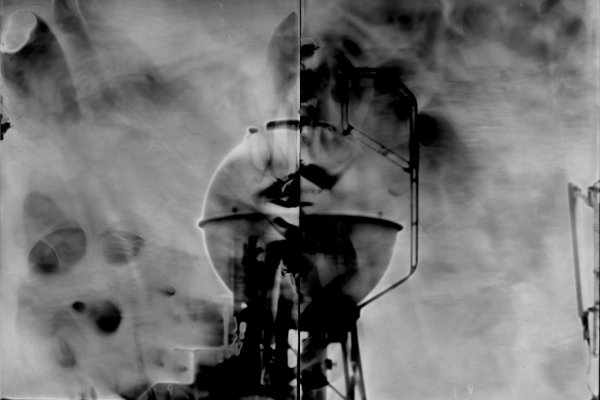
With Tokyo Obscura he changed method. He took hotel rooms in the city, covered the windows with dark paper and taped every gap where light might leak in. Only a small opening remained. The whole room became a pinhole camera.
The city's natural light passed through that opening and cast an image on the opposite wall, upside down, as the camera obscura has done for centuries. Homma placed colour film there and let the light record.
He put the idea in one plain line: use architecture to photograph architecture. The room is a piece of a building. What it captures are the buildings outside.
Water towers, streets, skylines
What appears in the pictures is ordinary: water towers on rooftops, a street corner, the skyline. No famous landmark chosen as a focal point. Only what anyone standing at that hotel window would see.
Passing through the pinhole, though, the view stops being ordinary. The image blurs here and sharpens there. Colour drifts from the real into tones Homma says he had never seen. In some pictures a large dot covers part of the scene, like a mark of the opening itself.
Here the photographer almost steps out of the work. Homma chooses the room, the direction of the window, seals the light, then waits. The rest is decided by weather, the hour and the room itself. A cloudy afternoon gives a very different picture from a sunny morning. He cannot direct the city. He only lets it print itself into the dark.
The series appeared in Aperture issue 219, the summer 2015 issue devoted to Tokyo. There, among other views of the same city, Homma's pictures differ in that no one holds the camera: only the room, the small opening and time.
Predecessors in the dark
Homma was not the first to turn a Tokyo room into a camera. In the 1970s the conceptual artist Nobuo Yamanaka did it with his own apartment. Homma names him as a direct inspiration.
Further back is Nicéphore Niépce, who made the first photographs in history, also with a dark box and a great deal of time. And one source lies outside photography: Junichiro Tanizaki's 1933 essay In Praise of Shadows, on the beauty of dim Japanese interiors, where things are seen in shade rather than under harsh light.
Beside Tanizaki, Tokyo Obscura gains another layer. Tokyo today is a bright city of night lights, screens and glass. Homma pulls it back into a dark room and looks at it with weak, slow light that is never enough to see everything.
The city in these pictures resembles a memory more than a map. We recognise shapes but are unsure where we stand. And because the projection is always inverted, each picture carries a small trace of where it was born: a hotel room with the lights off, looking out.
Photography