
Essays · Photography
Vera Lutter. Museum in the Camera.
A building needs months to print its image.
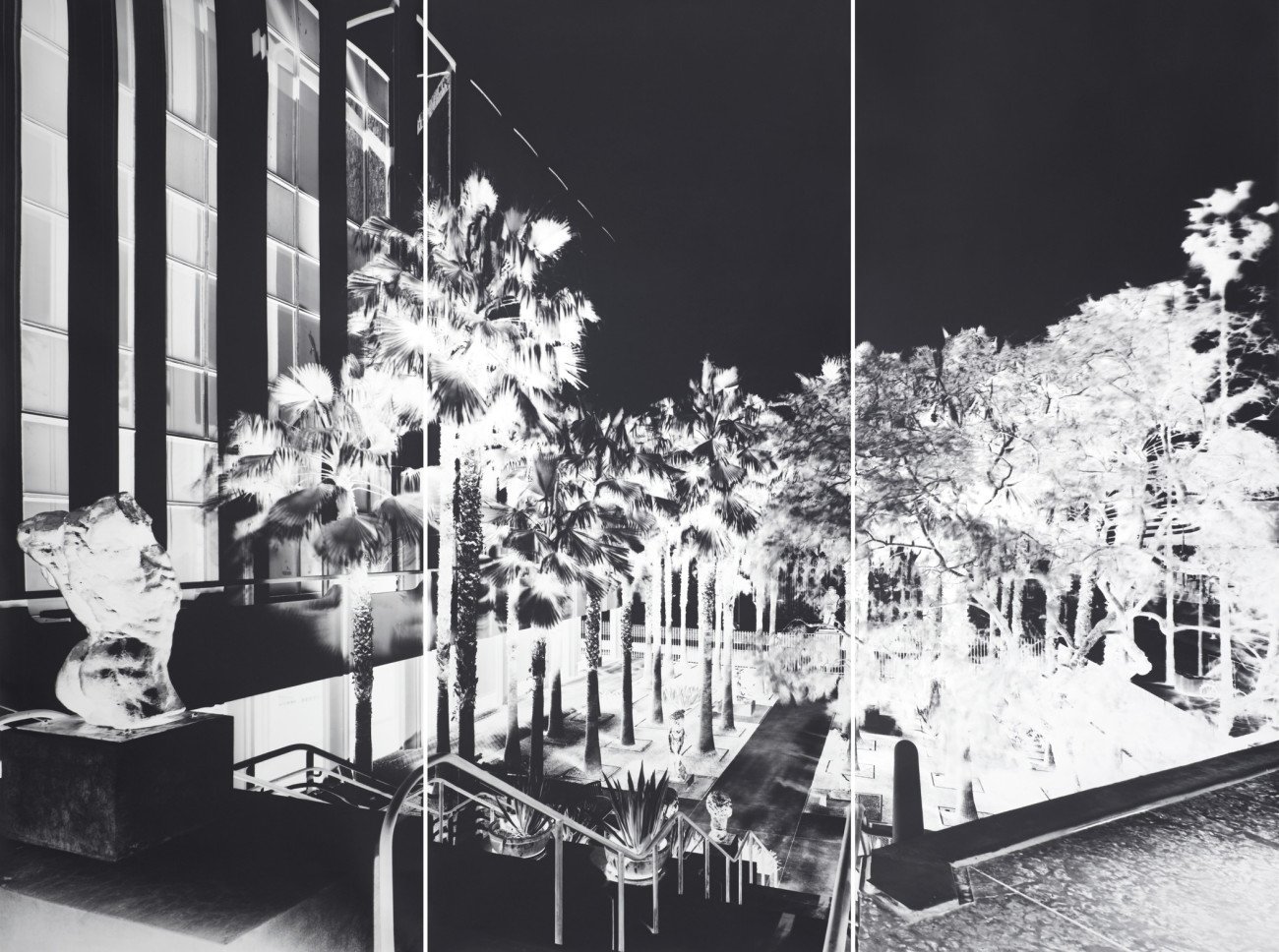
© Vera Lutter, photo courtesy of the artist · LACMA
A museum inside a camera
From February 2017 to January 2019, Vera Lutter, an artist based in New York, was invited by the Los Angeles County Museum of Art, LACMA, to work in residence. Her task was to record the museum's architecture, galleries and collection.
Lutter does not use a camera in the usual sense. For a long time she has worked with a single method: the camera obscura, the dark chamber. She builds cameras the size of a room. One wall has a small hole. The opposite wall holds unexposed photographic paper.
Light from outside passes through the hole and draws an upside down image of the scene on the paper. It is a very old optical phenomenon, known long before photography. Lutter adds only one thing: a surface sensitive enough to keep that image.
The results are large, unique negatives. Light turns dark, dark turns light. The sky is black. Windows are black. Walls glow as if lit from within.
Seven months for one room
A camera obscura needs time. Light through a small hole is faint, so the paper must stay in place for a long while. Some exposures lasted days or weeks. One image of LACMA's European paintings gallery is the result of an exposure lasting seven months.
During those seven months, the museum stayed open. Visitors came, stopped before paintings, moved on. None of them appears in the picture. They moved too fast for the paper. Only what stood still long enough was recorded: walls, frames, floors, sculpture.
The light kept changing. Morning to afternoon, sun to cloud, season to season. All of it accumulated on one sheet. The picture does not show the room at a given moment. It shows the room across a span longer than a season.
A crowded place becomes an empty one. Not because no one was there, but because no one stayed long enough.
Recording what is about to go
The project had a specific setting. The buildings on LACMA's east campus, among them the Ahmanson, the Hammer, the Art of the Americas building and the Leo S. Bing Center, were planned for demolition to make room for a new building designed by Peter Zumthor.
So Lutter worked against a deadline. The rooms she turned into cameras would disappear. The walls receiving light would be torn down. Her pictures became among the last records of those spaces, and unusual ones: the museum printing its own image with its own light.
The exhibition Vera Lutter: Museum in the Camera was shown in LACMA's Resnick Pavilion from April to September 2021. Visitors stood before huge negatives of rooms that no longer existed.
There is a strange circle here. A museum is a place that keeps the past. Here, the museum itself becomes the past that needs keeping.
Why it stays
Museum in the Camera is a lesson in speed. Modern photography is used to a thousandth of a second. Lutter pulls it the other way: weeks, months. At that pace the fleeting disappears and only the lasting remains.
With the same principle of the dark chamber, Abelardo Morell brings the street into the bedroom and lets two worlds overlap. Lutter turns the room itself into the subject. One is inside meeting outside. The other is a space looking at itself.
The building can be lost. But the light that once passed through it still lies there, on paper.
Photography