
Essays · Photography
Hiroshi Sugimoto. Theaters.
A whole film, and only light remains.
Fraenkel Gallery · Fraenkel Gallery
Two hours, one exposure
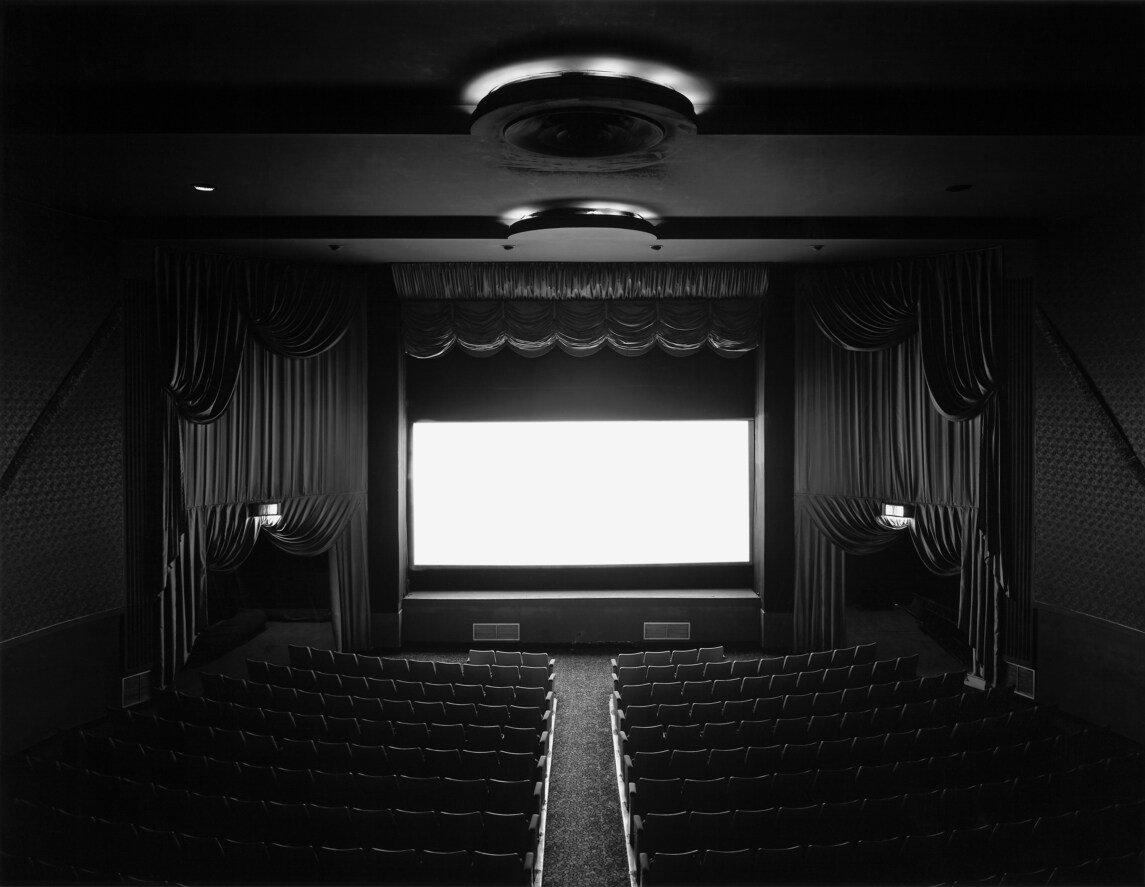
In 1976, in New York, Hiroshi Sugimoto carried a large format camera into a cinema. When the film began, he opened the shutter wide. When the film ended, about two hours later, he closed it. The entire film was recorded on a single sheet of negative.
The result is a strange image. The screen held no picture. It was a bright white rectangle, flat and still, like a doorway opening onto light. The room around it, sunk in darkness throughout the screening, appeared clearly: patterns on the walls, carved mouldings, velvet curtains, empty rows of seats.
There are no people in the pictures. The audience came, sat, got up and left, but moved too much for the negative to hold them. Only what stayed still for two hours remains. The room remains. The people vanish.
There is a paradox here. The light from the screen is the only thing lighting the room. Every bright scene casts a little onto the ceiling, the walls, the seats. Two hours of this add up to enough for the room to appear on the negative. The film disappears, yet it leaves its trace on every surface around it.
The first pictures were made in New York theatres: U.A. Fox in 1976, Trylon and U.A. Belle Beau in 1977.
From movie palaces to drive ins
Sugimoto continued Theaters for decades and widened it to many kinds of screening space. There are American movie palaces from the early twentieth century, their interiors as dense with ornament as an opera house. There are drive in cinemas, where a white screen stands under the night sky, and the sky around it records whatever moves across it during the exposure.
The list of titles is a map in itself. Royal, San Francisco, 1992. Carpenter Center, Richmond, 1993. Metropolitan Palace, Los Angeles, 1993. The Stadium Drive In at Orange, the Studio Drive In at Culver City, the Azusa Drive In, all 1993. Imax Tempozan, Osaka, 1998. Then Europe and Japan: Cinema Odeon in Florence and the Palais de Tokyo in Paris in 2013, Cinema Teatro Nuovo in San Gimignano in 2014, Sogetsu Hall in Tokyo in 2017.
All are black and white gelatin silver prints, mounted at 20 by 24 inches, each in an edition of 25. The method has not changed in four decades. Only the room changes. And the room, lit by the film itself, becomes the true subject of each picture.
The sum of every moment
A film is tens of thousands of frames in a row. Each has its own light and dark. Theaters adds all of them onto one surface. The result is not any particular film but what all films share: light passing through.
It is a question about time that Sugimoto returns to throughout his career. Photography is usually understood as catching a moment. Sugimoto does the opposite: he lets the camera look too long, so long that every moment overlays and erases the others. What remains is not an instant. It is a span of time, compressed into an image.
Viewers often sense a strange silence before these pictures. A cinema is a loud place, full of music, dialogue, people. The photograph keeps no sound. It keeps only light, and that light, pure white, says nothing at all.
The series began almost alongside Dioramas, when Sugimoto was a young photographer newly arrived in New York. Both ask the same thing: what does the camera see that the human eye does not?
Photography