
Essays · Photography
Hiroshi Sugimoto. Lightning Fields.
The spark is not photographed. It writes itself on the film.
Fraenkel Gallery · Fraenkel Gallery
A photograph without a camera
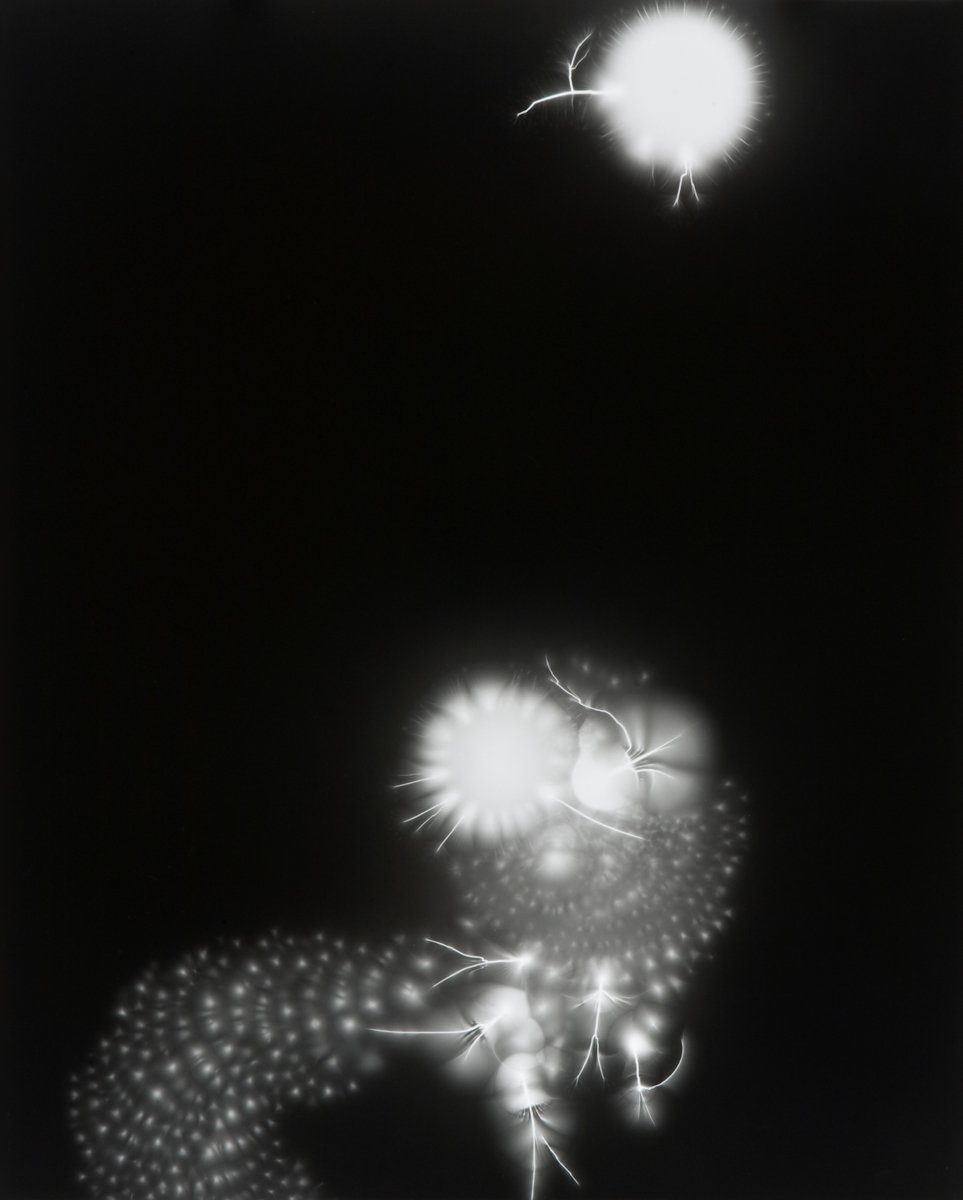
Lightning Fields is a series Hiroshi Sugimoto makes in the darkroom, with no camera. He lays a large sheet of film on a metal plate. Then, using a Van de Graaff generator capable of 400,000 volts, he discharges a spark directly onto the film.
The current touches the emulsion for a fraction of a second. It leaves branching lines of light: some like a meteor shower, some like roots, veins, a creature in the middle of growing. Each discharge gives one image. It cannot be repeated.
The film is then developed and printed as a gelatin silver print. When Fraenkel Gallery in San Francisco showed the series in autumn 2009, some prints stood close to two metres high. At that size, a spark lasting an instant becomes something to stand in front of for a long time.
Sugimoto works with high voltage, in the dark, with light sensitive film. There is danger, and there is chance. He controls the tools, the distance, the touch. He does not control which branch will grow.
A flaw turned into a subject
For photographers using large format film, static electricity was once a nuisance. When a sheet was pulled or rubbed in dry air, small discharges could leave tree shaped streaks on the negative. Many good sheets were lost that way.
Sugimoto turns the problem around. The mark once seen as damage becomes the only subject of the picture. No landscape, no portrait, only the trace electricity leaves as it crosses a material.
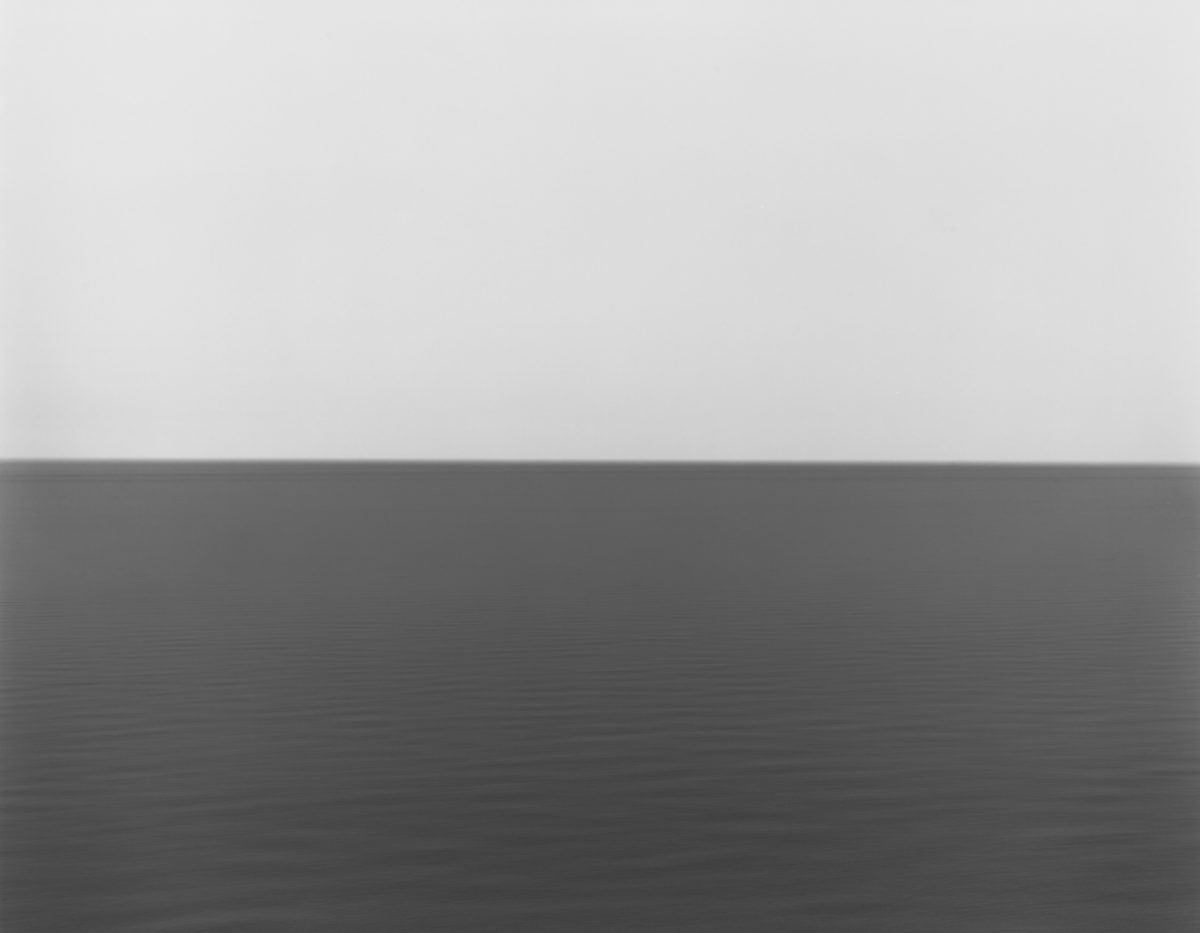
This is a habit in his work. In earlier series he left the shutter open for the length of a film in a cinema until the screen became a white block. He photographed the sea with the horizon cutting the frame in two. He keeps pushing photography towards its most basic conditions: light, time, a sensitive surface.
Back to the roots of photography
Lightning Fields has a partner in the nineteenth century: William Henry Fox Talbot, one of the inventors of photography in England. Talbot was also drawn to electricity and experiments with static. In the same period Michael Faraday set out the law of electromagnetic induction in 1831, the basis for later generators.
Sugimoto wanted to restage, in his own darkroom, the moment when science and image had not yet separated. Then, a sheet of sensitised paper was a laboratory instrument, not yet an art photograph.
In the 2009 exhibition, beside the Lightning Fields prints, Fraenkel hung two works from a parallel series: toned gelatin silver prints Sugimoto made from Talbot's own original negatives. The two series side by side read like two ends of one thread.
The photograph as a mark
Most photographs are pictures of something else: a face, a street, an afternoon. Lightning Fields has no something else. What is recorded is exactly what touched the film.
So the series is closer to a footprint than to a painting. It is the trace of a physical event. Looking at it, we do not see lightning. We see where lightning has been.
Sugimoto's work is held by many major collections, among them MoMA, the Metropolitan Museum of Art, Tate and the National Museum of Modern Art, Tokyo. What Lightning Fields keeps is very small: a fraction of a second, held far longer than it ever lasted.
Photography