
Essays · Photography
Hiroshi Sugimoto. Opticks.
A colour is most itself where it is about to become another.
Fraenkel Gallery · Fraenkel Gallery
Photographing the colour of light
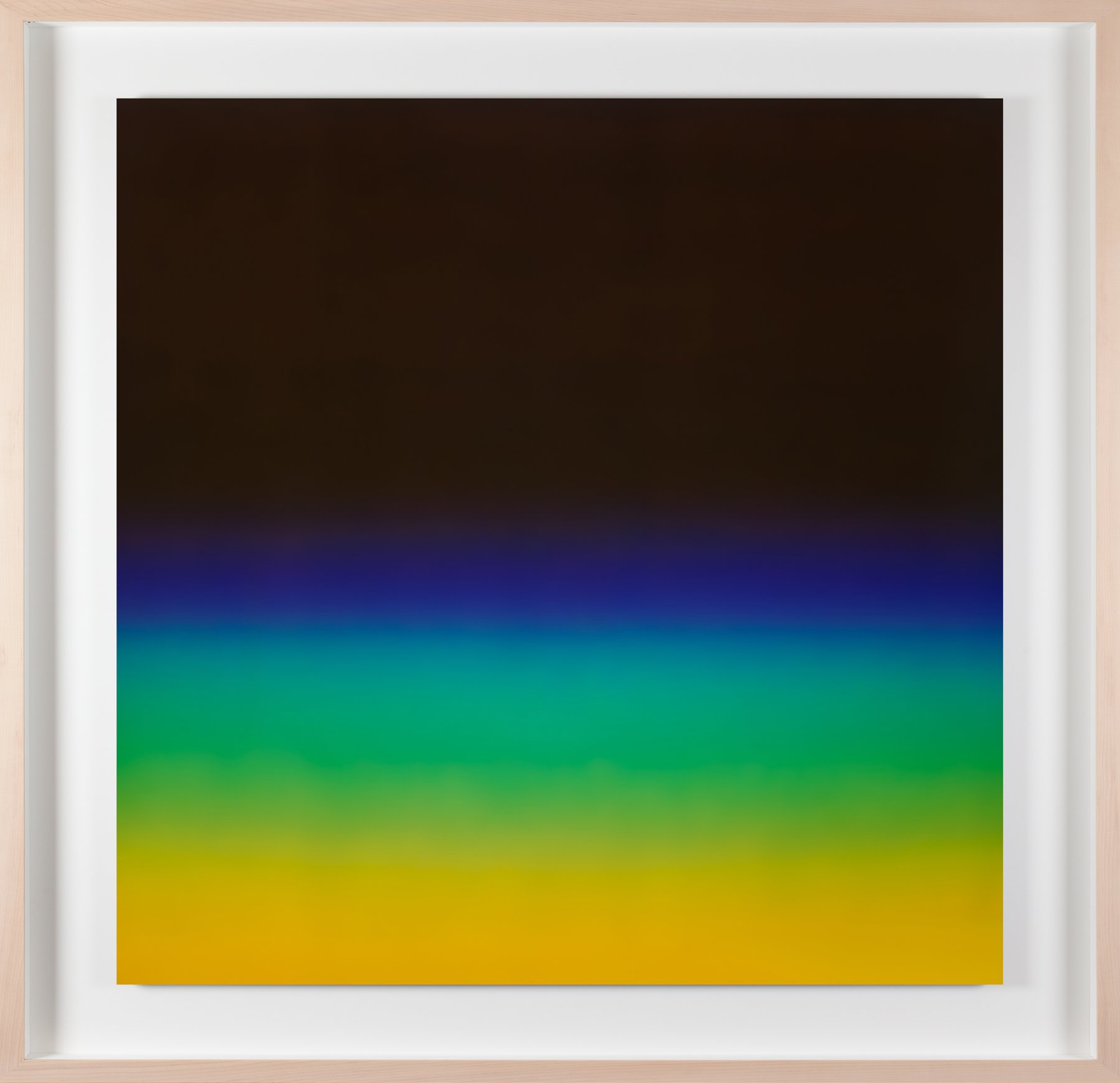
Opticks is a series Hiroshi Sugimoto began showing in 2018. There are no objects in the pictures, no landscape, no people. Only dense fields of colour shading softly into one another, as if the surface of the photograph were made of light itself.
He made them in his studio in Tokyo. Sunlight passes through a prism and splits into a spectrum. Sugimoto directs that spectrum onto a mirror fitted with a finely adjustable tilting mechanism, then projects it into a darkened chamber. By turning the mirror little by little, he can isolate single regions of the spectrum.
The colour is recorded on Polaroid film. The small Polaroids are then enlarged into colour prints of about 152 by 152 cm. Each carries a number, such as Opticks 053 or Opticks 216, and most exist as a single print.
According to Fraenkel Gallery, Sugimoto paid particular attention to the gaps and transitions between hues. So a picture is rarely one colour. It is usually the stretch of road between two.
Newton, Goethe and a prism
The title comes from Opticks, Isaac Newton's book on light, published in the early eighteenth century. Newton used a prism to show that white light is the sum of many colours. For him, colour was a physical phenomenon that could be measured and ordered.
About a century later, Goethe wrote his Theory of Colours and argued against that view. For Goethe, colour was also what the human eye perceives, and it acts on feeling.
Sugimoto stands between them. He restages Newton's prism experiment precisely, with instruments, mirror and darkroom. Yet what he keeps on the print is what interested Goethe: colour as something that acts on the viewer. Colour is both physics and sensation, and Opticks does not ask us to choose.
Waiting for a clear morning
The work depends on real sunlight, so it depends on the sky. Sugimoto has described starting before sunrise, in winter, when the air is driest and clearest.
If the day promised to be fair, he would look for the morning star above and to the right of the brightening horizon. How brightly Venus shone told him how clear the air was that day. Only then would he take out his old Polaroid camera and warm the film pack after the cold night.
That detail shows how slow the series is. An artist measures the clarity of the air by a star before deciding whether to work at all. Opticks is not the result of one press of a shutter. It comes from many mornings of waiting, some that worked and some that did not.
Light without an object
For most of photography's history, light has been a means: it falls on things and lets us see them. In Opticks there is nothing left for it to fall on. Light becomes the subject.
Sugimoto has worked at this edge many times. His other series strip away detail until only the basic conditions remain: light, time, a sensitive surface. Opticks goes a step further. Here even shape has almost gone.
Opticks can be set beside Lightning Fields, the series he made by discharging electricity straight onto film. One is energy flaring in a fraction of a second. The other is sunlight waited for across many mornings. Neither needs any object in front of the lens.
Standing before a large Opticks print, the viewer has nothing to recognise, nothing to read. There is only colour, and the eye goes looking for the place where it changes. It is an exercise in slow looking.
Photography