
Essays · Photography
Richard Learoyd. Nature Morte.
A cut flower is still alive, only leaving.
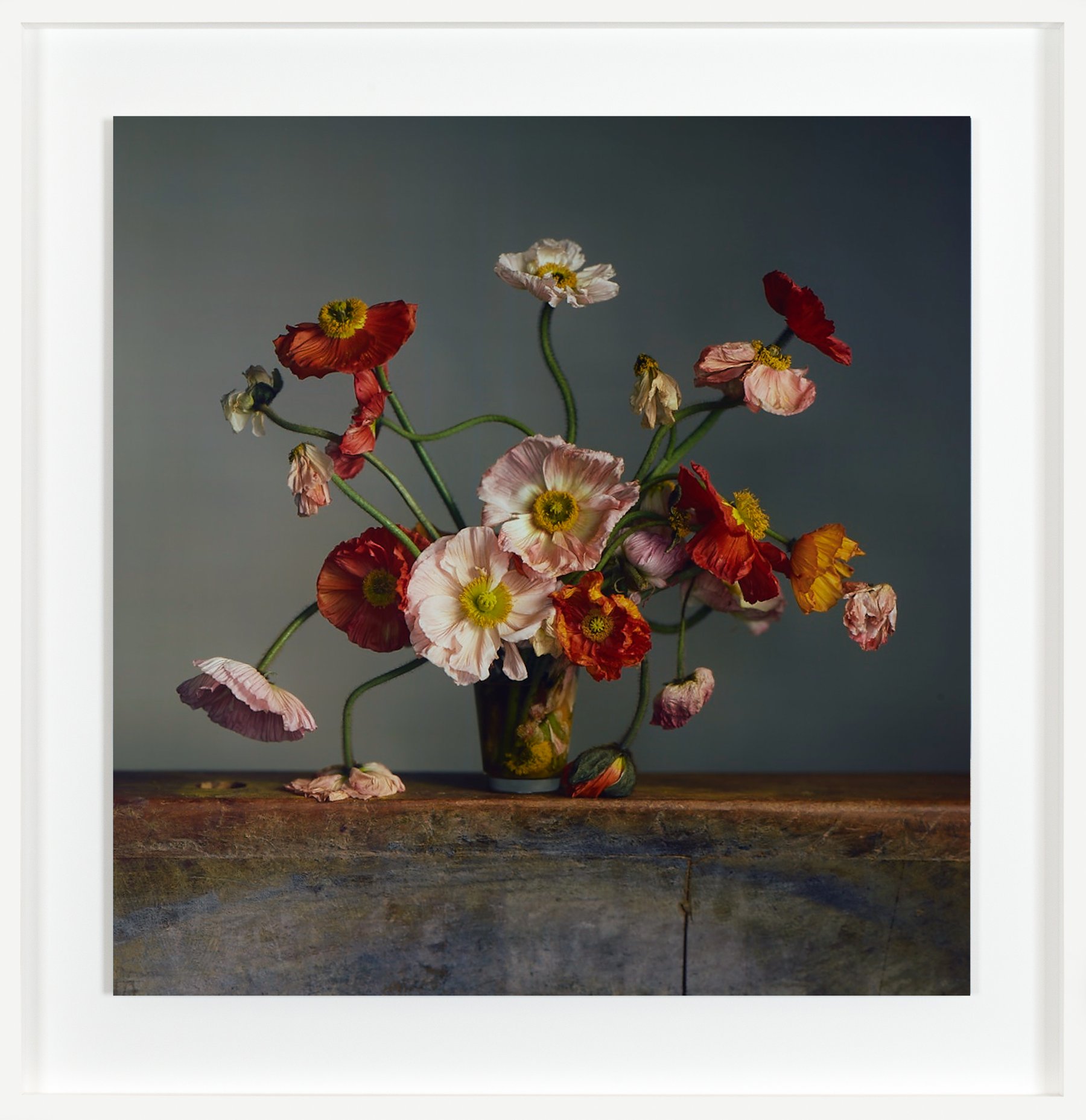
Fraenkel Gallery · Fraenkel Gallery
A camera the size of a room
Richard Learoyd does not hold a camera. He works inside one. Since 2003 he has used a room-sized camera obscura in his studio: two chambers joined by a bellows fitted with a lens. The subject sits in one chamber. The photographic paper waits in the other, in darkness.
The camera obscura is an old principle. Light entering a dark room through a small opening draws the outside world on the opposite wall. Painters used it for centuries before photography existed. Learoyd keeps the principle and replaces the wall with a sheet of light-sensitive paper.
The paper is Ilfochrome, a direct-positive colour paper. Light from the subject strikes it and becomes the image there. There is no negative in between, no digital file, no way to print an identical second copy. Each picture is a single object.
The results are grainless, with detail so sharp it is almost hard to believe. A vein on a petal appears as if held close to the eye. Yet that clarity is not cold. It has the depth of an old oil painting.
Flowers in the dark chamber
Learoyd photographs people, and things too. The flower pictures Fraenkel Gallery presents under the title Nature Morte include works made between 2018 and 2026. Poppies, tulips, pink lilies, sunflowers. Some titles say plainly what we will see: Live and dead poppies, the living and the dead in one frame.
In one picture flowers rest on an armature, propped up like a patient. In another, poppies sit beside a dark mirror that gives back no light. In another, large sunflowers hang heavy headed. Framed, each print is about a metre across, big enough to show the flower at or beyond life size.
Some works exist in two or three variants. They are not copies. Each exposure meets a flower that has changed a little, and the paper records that moment only.
Alive, but fading
The gallery's text sums up what Learoyd is after: a cut flower is alive, yet already decaying, and his studio pictures try to carry that understanding, the fragile beauty of life and the certainty of its end.
It sounds like a familiar theme. What changes it is the process. The flower stands alone in the lit chamber, before the lens, while the paper waits in the dark one. Even as it holds still, it wilts. The print records a flower between two states, not a flower frozen.
With no negative, the picture cannot be made again. That flower has faded. That day's light is gone. What remains is the sheet that once lay in the dark facing it. The photograph shares the fate of its subject: it happens only once.
Perhaps that is why Learoyd's flowers do not feel mournful. They ask for attention. Standing before a large print, watching a poppy petal begin to crease at its edge, we realise we rarely look at a flower this long in life. The picture does not slow the fading. It gives us time enough to see it.
Photography