
Essays · Photography
Abelardo Morell. Camera Obscura.
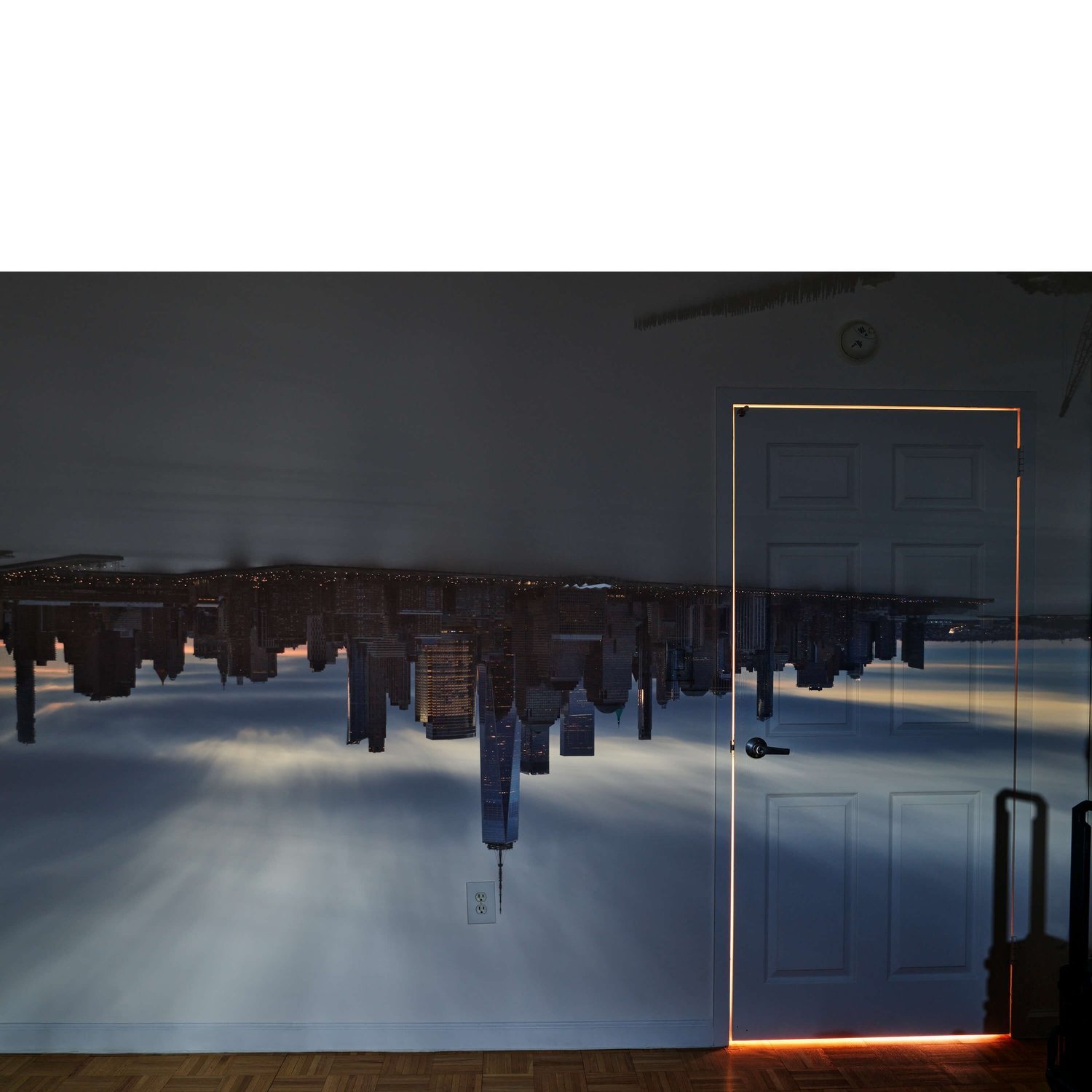
The outside comes in through a small hole.
Smithsonian American Art Museum · Smithsonian American Art Museum
A room becomes a camera
Camera obscura, Latin for dark room, is a simple phenomenon. When a room is completely dark and one wall has a small hole, light from outside passes through and projects onto the opposite wall an image of the scene outside, upside down and reversed. It is the founding principle of every camera.
Abelardo Morell began making pictures with this principle in 1991, in his own home in Massachusetts. He covered the windows with dark plastic. He cut a small opening. Then he waited for his eyes to adjust, and watched the outside world appear on the wall.
But Morell did not stop at watching. He set up a large format camera in the room and photographed both the room and the projection on its walls. The projection is faint, so the exposure has to be long. The result is a photograph holding two worlds at once.
Manhattan in an empty room
One of the best known pictures in the series is Camera Obscura Image of Manhattan View Looking West in Empty Room, from 1996, now in the collection of the Smithsonian American Art Museum. It is a black and white gelatin silver print.
It shows an empty room in Manhattan. No furniture, no people. Across the walls, ceiling and floor lie the buildings of the city looking west, upside down. Towers hang toward the ground. The sky lies underfoot.
Look long enough and the eye begins to confuse things. Which is the real wall, which the projected building? A corner of the room cuts through a facade. One real window sits beside hundreds of projected ones. Inside and outside lose their edge.
The museum notes that this blending of interior and exterior can evoke dreams, fragmented memories, or the feeling of standing between two cultures at once.
Someone standing between two places
That last description has a reason. Morell was born in Havana, Cuba, in 1948. In 1962 he came to the United States with his family. He studied photography, earned an MFA at Yale, and taught photography for many years at the Massachusetts College of Art and Design in Boston.
The Manhattan picture was shown in the Smithsonian exhibition Our America: The Latino Presence in American Art. In that setting, a room overlaid with a city becomes an image of migration: living in one place, carrying another, both present on the same wall.
Morell did not make these pictures to tell his biography. But his way of seeing may carry its trace. He is used to a world turned upside down. He knows a room can hold more than what sits within its four walls.
In the years that followed he took the dark chamber into hotel rooms, offices, rooms facing many cities and landscapes. Each time, the same ancient projection produced a new image.
Why it stays
Morell's Camera Obscura series puts the viewer back inside the camera. We usually look at photographs from outside, as finished images. Here we stand in the very box where the image is made.
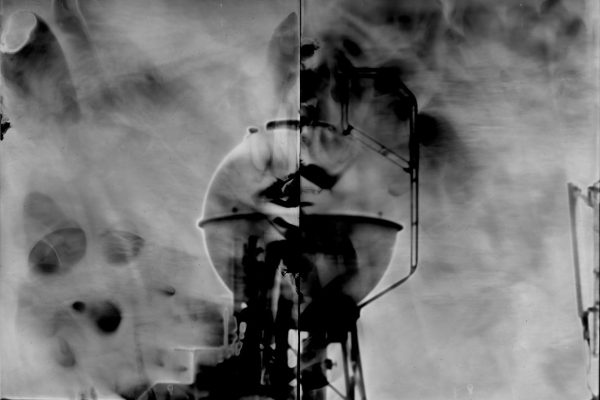
With the same principle, Vera Lutter turned LACMA's galleries into cameras and let paper record directly for months. Lutter keeps the negative. Morell keeps the room along with its projection.
Both show that a photograph begins in darkness. And that a small hole is enough for the world to find its way in.
Photography