
Essays · Olfactory Art
Charlotte Eta Mumm. Pulse.
A sculpture that breathes to the rhythm of water.
© Charlotte Eta Mumm · Charlotte Eta Mumm (official site)
A dripping machine
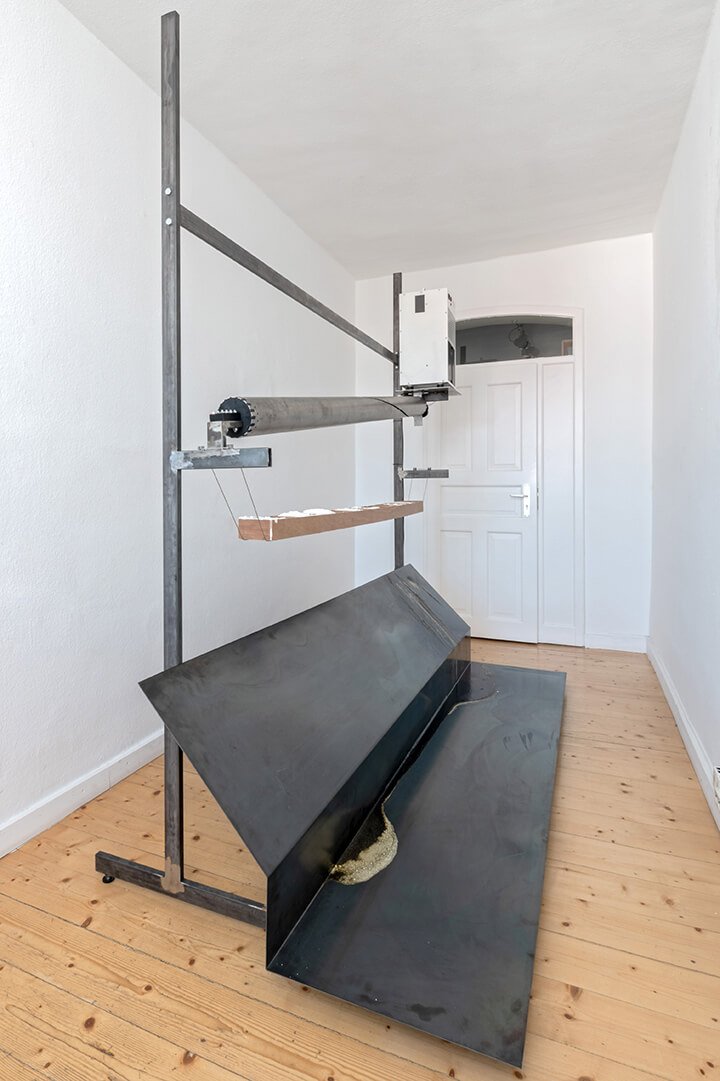
In 2021 Charlotte Eta Mumm held a solo exhibition, Pulse, at Galerie Tanit in Munich. At its centre stood a work of the same name: a large sculpture of steel and wood, 242 cm high, 120 cm wide and 252 cm long.
Its list of materials reads more like a technical sheet than a sculptor's: steel, wood, a dehumidifier, fizzing powder, eighteen scents, water. Each has a job.
The dehumidifier pulls moisture out of the room's air. That water runs into a circular tube system, where it meets scented fizzing powder. The powder fizzes, and the smell is released. No switch, no operator. The work runs on whatever water it collects.
As the artist describes it, the piece is never the same and always in flux. Today's smell is not yesterday's. The sculpture stands still, while its scent lives in time.
Eighteen smells of a city
The eighteen scents in Pulse evoke the city. They are fleeting smells, the kind met on a walk down a street and forgotten a moment later. They are not displayed side by side like samples. They move through the space in waves, as they do outdoors.
The scent was developed with the olfactory artist Frank Bloem, and the sculpture's technical side with Lefki Mevissen. Mumm does not treat smell as an add on to form. Smell is a sculptural element, on a level with steel and wood, except that it occupies space as air instead of mass.
This changes the visitor's role. You do not look once and leave. You walk around, pause, come back a while later, and notice the room smells different. The work asks for time, the way a city asks for time before it can be understood.
Living together at one's own pace
Alongside the sculpture hung the series Phases and Parallels: mixed media on fabric stretched over wooden reliefs, showing imagined cities.
The thread linking paintings and sculpture comes from Roland Barthes's 1976 to 1977 lectures at the Collège de France on living together. Barthes asked whether a community could exist in which everyone lives by their own rhythm and still respects the rhythms of others.
Pulse puts that question into matter. Eighteen scents, eighteen rhythms. None holds the room for good. Each arrives, then steps back for another. The dripping water is the shared beat; each smell keeps its own tempo.
A city works like this. Thousands of lives cross on the same street, each leaving a streak of smell before moving on. No one coordinates it. Yet the whole has a pulse.
Why Pulse stays with you
In 2022 the Institute for Art and Olfaction named Pulse a finalist for the Sadakichi Award for experimental work with scent. What sets it apart is that it lets the environment run the smell. The room's humidity, the number of people breathing in it, the weather outside: all affect the amount of water, and so the amount of scent.
The work promises no finished smell. It promises a process. Each visitor leaves with a fragment of it, the few scents they happened to catch while there. Someone who comes later takes home different fragments.
Olfactory Art