
Essays · Contemporary Art
Christian Boltanski. The Reserve of Dead Swiss.
To be looked at closely is a way of being remembered.
Tate · Tate
Three shelves, forty two faces
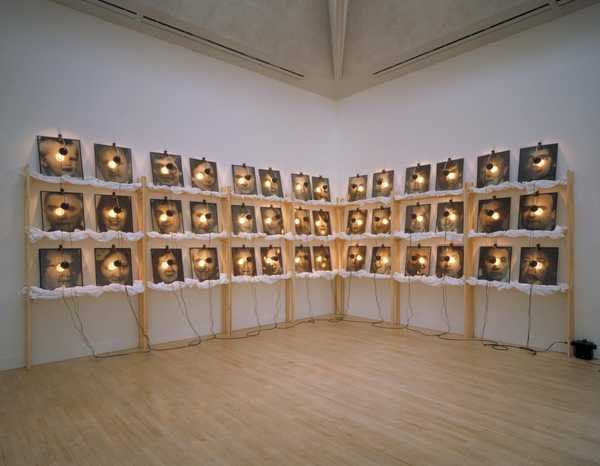
The Reserve of Dead Swiss, in French La Réserve des Suisses morts, is an installation Christian Boltanski made in 1990. It is made of forty two portrait photographs: men, women and children of all ages.
Each photograph is framed, set on a wooden shelf and leaned against the wall. The shelves run in three evenly spaced rows. Along each row are bunched lengths of pale fabric, some patterned, some embroidered.
A lamp is clipped to the top edge of every frame and bent down to shine straight onto the face. The cables hang slack from each clip to the floor, trailing across the image below and across the photographs on the lower rows.
The work is installed without room lighting. The only light is those forty two small lamps. The room is dark; only the faces glow.
People from the obituary page
Boltanski did not take the photographs. He cut them from the obituaries of Le Nouvelliste du Valais, a provincial Swiss newspaper. He collected the clippings over several years, then picked the portraits at random.
He rephotographed the already grainy images and enlarged them so the heads are slightly bigger than life. Each generation lost detail. Eyes became dark spots, mouths became smudges. The memorial text was dropped entirely. No names, no dates, no line about how anyone had lived.
What remains is only the face: enough to know this was a particular person, not enough to know who.
In a 1993 conversation at Tate, Boltanski said that part of the work was the strange fascination of looking at someone handsome and imagining their ashes. The remark is not mournful. It is simply direct: every face here has already turned to ash.
Why the Swiss
Boltanski was born in Paris in 1944, just after the city was freed from German occupation, to a Catholic mother and a Jewish father. Much of his work has been read as an inquiry into history and memory, often with reference to the Holocaust.
The fabric on the shelves recalls a shroud, and also the curtain of a crematorium. The harsh lamps aimed at each face recall an interrogation room. The number of faces and their repeated arrangement lead many viewers to think of mass death.
But Boltanski chose the Swiss, a neutral people. Tate's gallery label notes that this choice mutes the historical association and opens space for reflection that is both more personal and wider. These were not victims of an event. They died as most people die: ordinarily, and then they were forgotten.
That ordinariness is what makes the work hard to forget. There is no story to hold on to. Only the fact that everyone will one day be in an obituary column.
An archive with no floor
The work was first built in Nagoya, Japan, for a solo exhibition of Boltanski's work at the Institute of Contemporary Arts Nagoya, from September to November 1990. In 1992 the Fondation Cartier gave it to Tate.
Boltanski made several works with similar titles and parts, such as 364 Dead Swiss, also from 1990. The repeated arrangement of identical elements makes the installation look like a small section of an almost endless archive. Forty two is the number this time. It could be four hundred, four thousand.
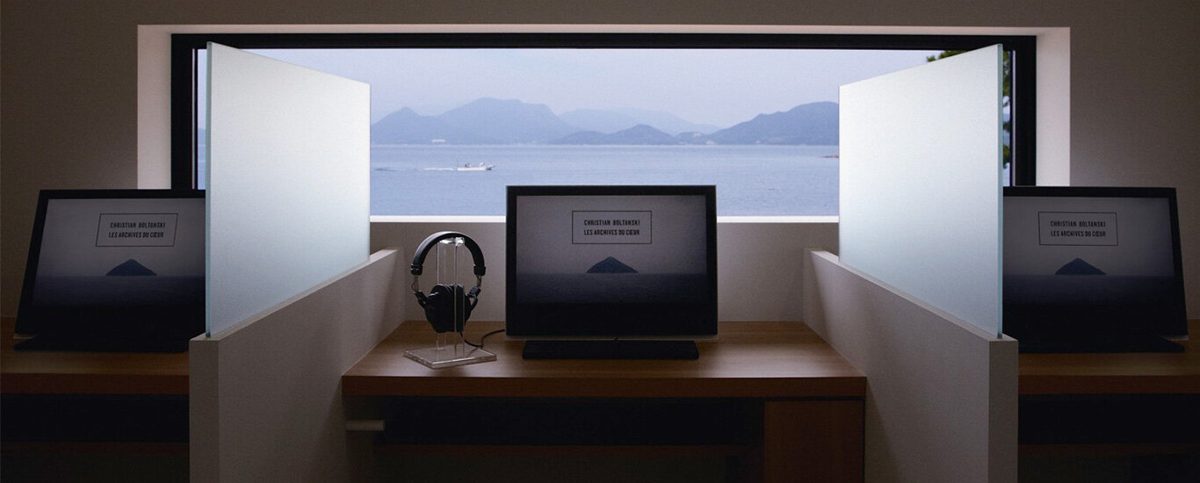
The word reserve means a stock, and also something set aside. These faces are set aside, the way one keeps something without knowing its use, only knowing it should not be thrown away. In later work, such as an archive of heartbeats on a Japanese island, Boltanski pursued the same idea with sound instead of photographs.
Standing before forty two faces, the viewer can do nothing for them. Only look. Perhaps that is all the work asks.
Contemporary Art