
Essays · Contemporary Art
Christian Marclay. The Clock.
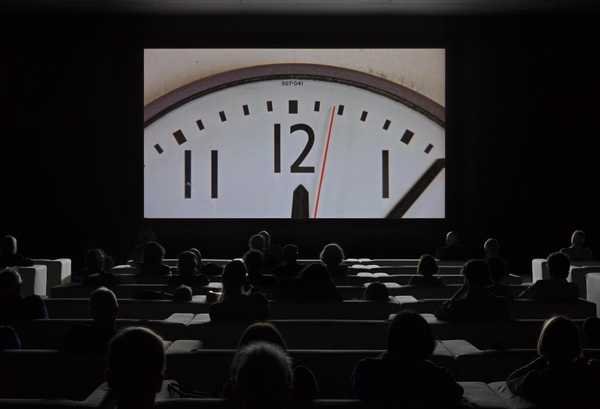
Every minute on screen is a real minute.
Tate · Tate
A film exactly one day long
The Clock is a single-channel video Christian Marclay completed in 2010. It lasts twenty four hours. It is built from thousands of clips cut from films and television, each showing a clock, someone checking the time, or a line of dialogue naming the hour.
The key is that the clips are placed at the very moment they show. When a wall clock on screen reads 3:12 in the afternoon, it is 3:12 in the afternoon outside the room too. The work is synchronised to local time wherever it is shown.
So The Clock is a film and also a working clock. Viewers can look at the screen to know what time it is.
Assembling what exists
Marclay is a Swiss American artist. He began in music, working with records and turntables, cutting and mixing existing recordings into new sound. He later made video the same way: shooting nothing, finding, cutting and joining images that already exist.
Before The Clock he made Video Quartet in 2002: four screens side by side, each full of film clips of people playing music or making noise, edited into one piece. Tate holds both works.
The Clock demanded far more. Every minute of a day had to be found, midnight to midnight. The cuts had to flow, sound from one scene spilling into the next, a door opening in one film leading into a room in another. Marclay worked with assistants over several years to finish it.
The result does not feel like a string of excerpts. It feels like a single film with hundreds of actors taking turns as one character: someone waiting, someone rushing, someone checking the time.
Time in film, time outside
Cinema usually compresses or stretches time. A life fits in two hours. A second of gunfire lasts a minute. We accept this and forget the hour outside.
The Clock does the opposite. It will not let us forget. Every minute on screen is a real minute, and viewers in the dark feel each one pass, something we rarely notice even looking at a watch.
The pace follows the day. Mornings bring waking, alarms, breakfast. Midday brings appointments and trains. Evenings thicken with suspense and waiting. After midnight it slows: insomniacs, dark rooms. Watch long enough and the line between the film's hour and ours grows thin.
A work shared by museums
Accounts of the work record that The Clock won the Golden Lion at the 2011 Venice Biennale. It was made in a small edition, and one is jointly owned by Tate, the Centre Pompidou in Paris and the Israel Museum in Jerusalem. Museums showing it often stay open through the night at least a few times, so visitors can see hours few people see.
The Clock belongs to a line of art that uses time as material. On Kawara stamped the time he woke on postcards every day. Marclay gathers the hours of film history. One records a single person's time; the other joins the time of many into one day.
Leaving the room, people often check their own watch. It is still running. Only now they remember it was running all along.
Contemporary Art