
Essays · Contemporary Art
Cildo Meireles. Babel.
When everything speaks at once, nothing is heard.
Tate · Tate
A tower of radios
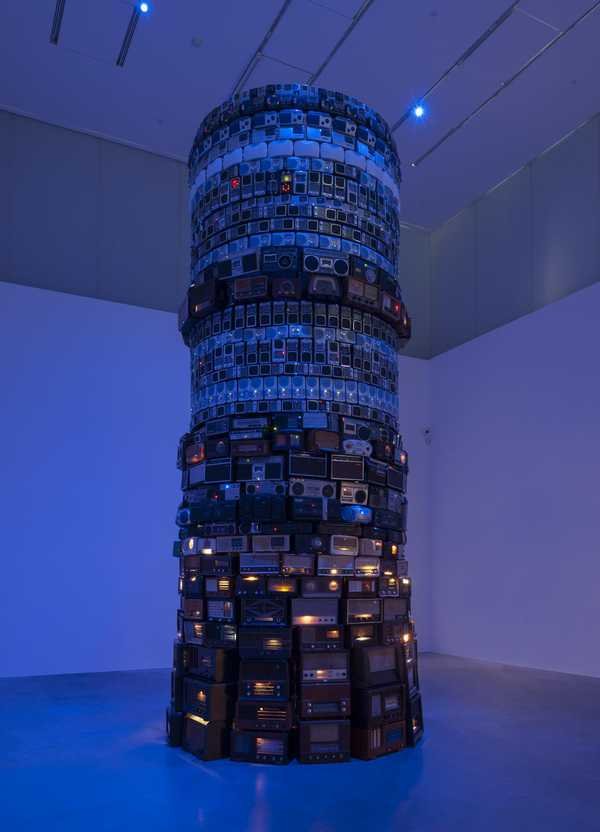
Imagine a round mass taller than a person, rising straight like a tower. It is not made of brick or stone. It is made of radios. Hundreds of them, older and newer, large and small, stacked ring upon ring.
All of them are on. Each is tuned to a different station. News, music, sometimes only static. The volume of each is kept low, just audible when you stand close.
This is Babel, a 2001 work by Cildo Meireles, the Brazilian artist born in 1948. It is now in the collection of Tate in London.
The title needs little explanation. In the Bible, people build a tower to reach heaven and are punished by losing a common language. Meireles rebuilds that tower out of machines that speak.
Walking around the noise
From a distance, the viewer hears only a continuous murmur, like a crowd in the next room. No clear sentence, no whole song.
Step closer and the noise separates. Put an ear to one radio and there is a newsreader, a piece of music, someone speaking a language you may not know. Move to the next and the story changes entirely.
Walking around the tower is like tuning a radio with your own body. Each step is another frequency. The work has no single correct viewpoint. It has countless listening points.
And wherever you stand, the shared noise remains, the ground beneath every voice.
Some stand a long time before a single radio because they caught a familiar song. Some walk quickly and let the noise blur into one mass. The same tower, and each person leaves with a different recording of it.
An artist of systems
Cildo Meireles is known as one of the leading figures of conceptual art in Brazil. Tate describes his work as sculpture and installation that involves participation, often drawing attention to the body in space and time.
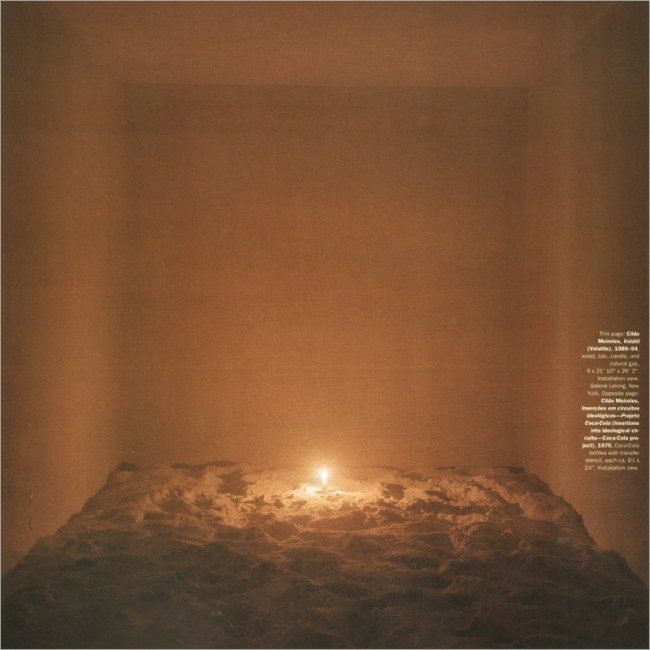
He often works with systems we use every day without thinking: banknotes, soft drink bottles, broadcast signals. In Insertions into Ideological Circuits he stamped messages on banknotes and put them back into circulation. He also made Volátil, a room in which smell is part of the work.
Radio is such a system. It broadcasts constantly, to many people, in many languages. Every station wants to be heard. Meireles chooses none. He lets them all play, and lets the viewer see what happens when there is more information than there is capacity to listen.
In 2001 the internet was spreading fast. Looking back, Babel reads like a forecast of a time when every voice can broadcast, and none can be sure of being heard.
Why Babel still stands
Many works about noise exhaust the viewer. Babel does not quite. Because each radio speaks softly, the whole is almost gentle. People can stand before it for a long time, as before running water.
That gentleness makes it more unsettling. The noise does not attack. It simply covers. Each voice still means something, but together the meaning dissolves.
The radios will age, break down, the stations will change. The tower keeps doing its work: reminding us that listening is a choice.
Contemporary Art