
Essays · Contemporary Art
Bruce Nauman. Raw Materials.
An empty room is not a room with nothing in it.
A hall with nothing to look at
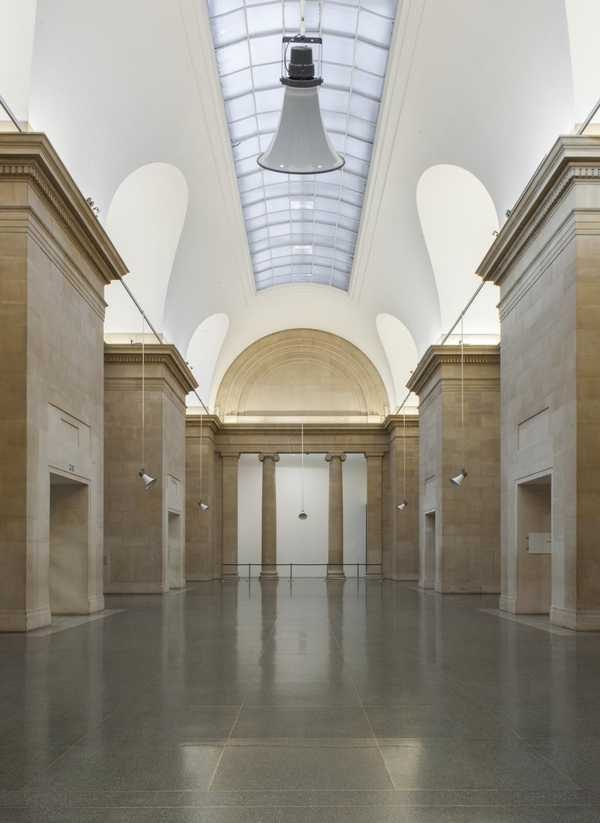
The Turbine Hall at Tate Modern in London is a very long, very tall space, once the turbine room of a power station. Each year, as part of The Unilever Series, an artist was invited to make a work for this space alone. Earlier artists tended to fill it with something enormous. Only the year before, Olafur Eliasson hung an artificial sun at the far end, and people lay on the floor to look at it.
In 2004 it was Bruce Nauman's turn. He left the hall empty.
No object was built. There were loudspeakers. From them came voices: short passages of words taken from Nauman's own earlier works. Tate lists the medium in a few words: audio, 21 channels, mono. The work is now in Tate's collection.
People walking in tended to pause. They looked for something to see. There was nothing. Then they began to listen.
Listening with your feet
Each speaker carries its own voice. Stand near one and a sentence is clear. Take a few steps and it fades while another grows. In between, two or three voices overlap and none is heard whole.
So each visitor hears a different work. Someone walking fast hears a string of fragments. Someone standing still hears one phrase repeated. Someone circling the hall assembles a version of their own.
There is no main viewpoint, no best place to stand as there is before a painting. There is only a path. The visitor, now more a listener than a viewer, arranges the work with their own body.
The hall does its part. Concrete and steel throw sound back. A voice in a small room is close and clear. In a hall this size it spreads, echoes, blurs at the edges. The architecture becomes part of the sound.
Words as raw material
Nauman worked with language from early on. In many of his works words appear as neon, as recorded voices, as short phrases repeated until they grate. He tends to care less about what words say than about what they do to the listener.
Raw Materials gathers those pieces together. The title shows how he sees them: raw material. Not quotations, not an anthology of good lines. Matter, like clay on a sculptor's table, taken from old works to build a new one.
Lifted from their original setting, the phrases change. A line that once belonged to a video or a performance now floats free in the air. It has no frame and no speaker in the room. Only a voice, and the distance between that voice and an ear.
Repeat a sentence enough and its meaning wears thin. The listener starts to notice rhythm, pitch, the breath between words. Language returns to its raw state: sound coming out of a body.
A work you cannot photograph
There is a paradox here. The Turbine Hall is where people expect something big, something to photograph. Nauman answered with a work that cannot be photographed. A picture of Raw Materials shows an empty hall, a few people walking, some speakers.
That emptiness makes people notice what is always in the hall and usually hidden: its length, footsteps, whispering, light falling from above. When nothing takes up the space, the space shows itself.
Raw Materials also asks something about listening. We live among voices every day: phones, announcements, conversations nearby. We rarely hear them as matter. In Nauman's hall a voice has direction, distance, a place. It takes up room, like an object.
People leave without an image. They leave with a few half heard sentences that keep sounding in their heads for a while before they fade.
Contemporary Art