
Essays · Olfactory Art
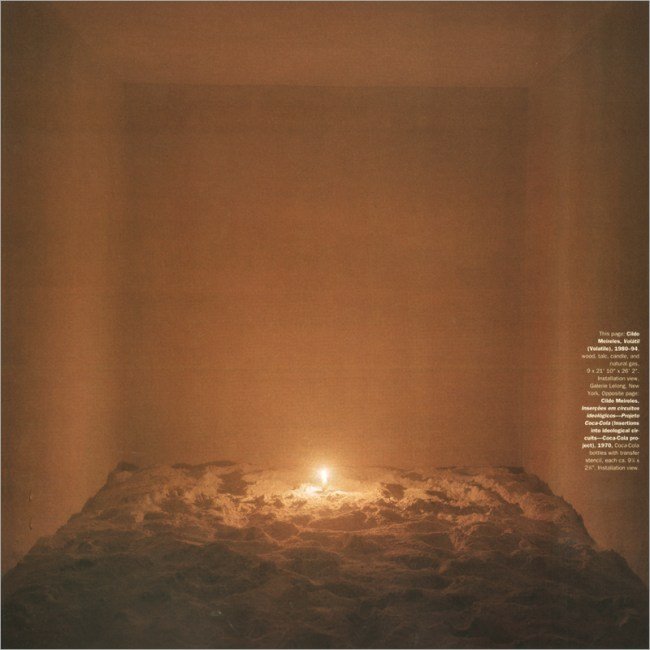
Cildo Meireles. Volátil.
The nose learns fear before the eye can see.
Artforum · Artforum
Entering barefoot
Volátil is a room built for the purpose, with its own walls, ceiling and entrance. Visitors take off their shoes before going in. The floor is covered in pale grey talc, several tons of it, reaching mid calf. Feet sink as if into fine sand. A light dust hangs in the air.
The room is shaped like a J. From the entrance you cannot see the end. You follow the curve slowly, because the powder holds your feet back.
The deeper you go, the clearer a smell becomes: gas. With it comes a faint hiss. Then, at the last bend, you see a candle burning against the far wall.
Nothing happens. The candle keeps burning. The smell stays. The visitor stands between the two and works out alone what could happen.
The smell of something absent
Natural gas has almost no smell. What we call the smell of gas is a sulphur compound added so that people notice a leak. It is a smell designed to make us uneasy.
Meireles used that same compound. There is no flammable gas in the room, only its warning smell. The explosion never comes. But visitors cannot be sure of that while they stand in the talc, looking at the flame in front of them.
The list of materials is short: wood, talc, a candle, an odorant. Dimensions change with each installation. Everything else is produced by the visitor's own body.
Fear as material
Cildo Meireles was born in 1948 in Rio de Janeiro. He began making art in the years Brazil lived under military rule, which lasted from 1964 to 1985. Many of his early works slipped into the gaps of everyday life, such as printing messages on Coca Cola bottles and returning them to circulation.
Volátil was conceived in 1980 and only realised in 1994. Meireles has said that fear is the material of many of his works. In Volátil, when you see the candle and smell the gas, you fear the room will explode. But fear, in his account, sharpens the senses. You pay closer attention to everything around you.
Each person carries a different memory into the room. Many visitors have thought of the gas chambers of the Holocaust. Some think of life under dictatorship, when the air always smelled of something about to happen. Meireles himself has described walking on the talc as walking on clouds. One room, readings that lie very far apart.
A room that travels
In 1994 Volátil was built at Capp Street Project in San Francisco. In early 1995 it was shown at Galerie Lelong in New York. From November 1999 to March 2000 it was part of Meireles's solo exhibition at the New Museum in New York, which then travelled to São Paulo and Rio de Janeiro. In 2003 it appeared in Uneasy Space at SITE Santa Fe.
Each time, the room has to be made again. New talc is poured, a new candle lit, the smell introduced afresh. The work does not exist as an object in storage. It exists as a set of instructions, and as a memory in the bodies of those who walked through it.
Meireles has built other rooms that place visitors among the senses, such as the radio tower Babel, where sound takes the place of smell. But Volátil remains the work in which the nose, not the eye, decides what the visitor feels.
Olfactory Art