
Essays · Olfactory Art
Cristian Marianciuc. Olfactory Peregrinations.
A paper crane holds a single act of smelling.
Institute for Art and Olfaction · Institute for Art and Olfaction
The crane maker
Cristian Marianciuc is a paper artist from Romania. Since 2014 his work has revolved around a single form: the paper crane, the most familiar figure in Japanese origami. For years he folded a crane a day, and gradually developed a personal style: wings cut through with patterns, paper flowers, folkloric motifs, small decorative details.
The traditional origami crane is a restrained form, folded from one square sheet, with no cutting and no glue. Marianciuc keeps that frame but adds everything the strictest tradition leaves out: the blade, the glue, paper layered on paper. The result looks closer to jewellery than to folding.
He grew up in northeast Romania, one of eleven children. His childhood involved farm work and wandering outdoors, which he credits as the foundation of how he perceives through the senses, smell among them.
From cranes to scent
In 2020 Marianciuc turned his attention to perfume and began the series Olfactory Peregrinations. A peregrination is a long wandering journey, something close to a pilgrimage. The title suggests that each scent is a place to travel to.
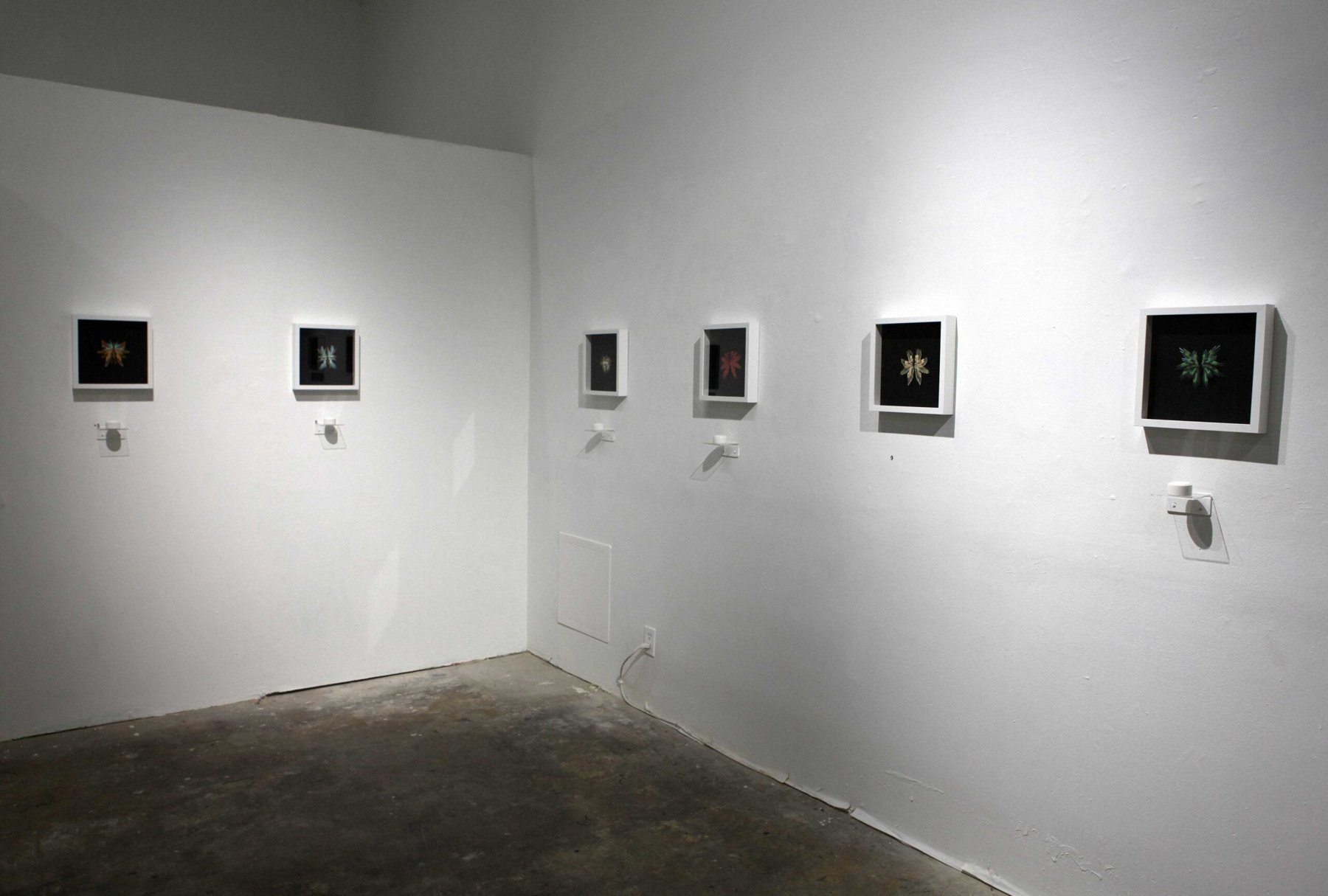
Each work is a paper bird, carefully cut, folded and glued, giving material form to his impression of a perfume, some contemporary, some vintage. He has said that through his paper sculptures he tries to give smells a physical shape. And each crane reflects how he felt about a scent at one particular moment, not a fixed definition of it.
That last point matters. The crane does not say what the perfume is. It says what he smelled, on a given day. Smell it again another day and there might be another crane. The work is closer to a diary than to a taxonomy.
Before a crane, the eye goes ahead of the nose. Visitors see colour, the weight of the paper, the cuts in the wings, and only then imagine the smell behind them. Like reading a translation before hearing the original.
Paper, and a long history
Olfactory Peregrinations was shown at the IAO Gallery of the Institute for Art and Olfaction, on Chung King Road in Los Angeles's Chinatown, from May 3 to June 5, 2023. A private view took place on May 9, and the show closed with an evening event on June 2.
IAO did not simply hang the cranes. The exhibition text set them within a long history of writing and folding materials: from clay tablets around 3100 to 3000 BC, through the arrival of paper, to developments in Japan around the seventh century, where the art of folding gradually took form. Framed this way, a small paper crane becomes the latest point in thousands of years of people trying to record their thoughts on a surface.
And what Marianciuc records is the hardest thing to write down: a smell. Writing once helped people keep speech. His cranes try to keep something that has no words.
Olfactory Peregrinations also shows how broadly IAO understands olfactory art. The focus here is not on releasing scent but on translating it into another material. As with OAK@IAO, what interests IAO is how smell is thought about, translated and exchanged, in whatever material.
Olfactory Art