
Essays · Olfactory Art
Persephenie. Praying to the Gods.
To smell, you have to bow.
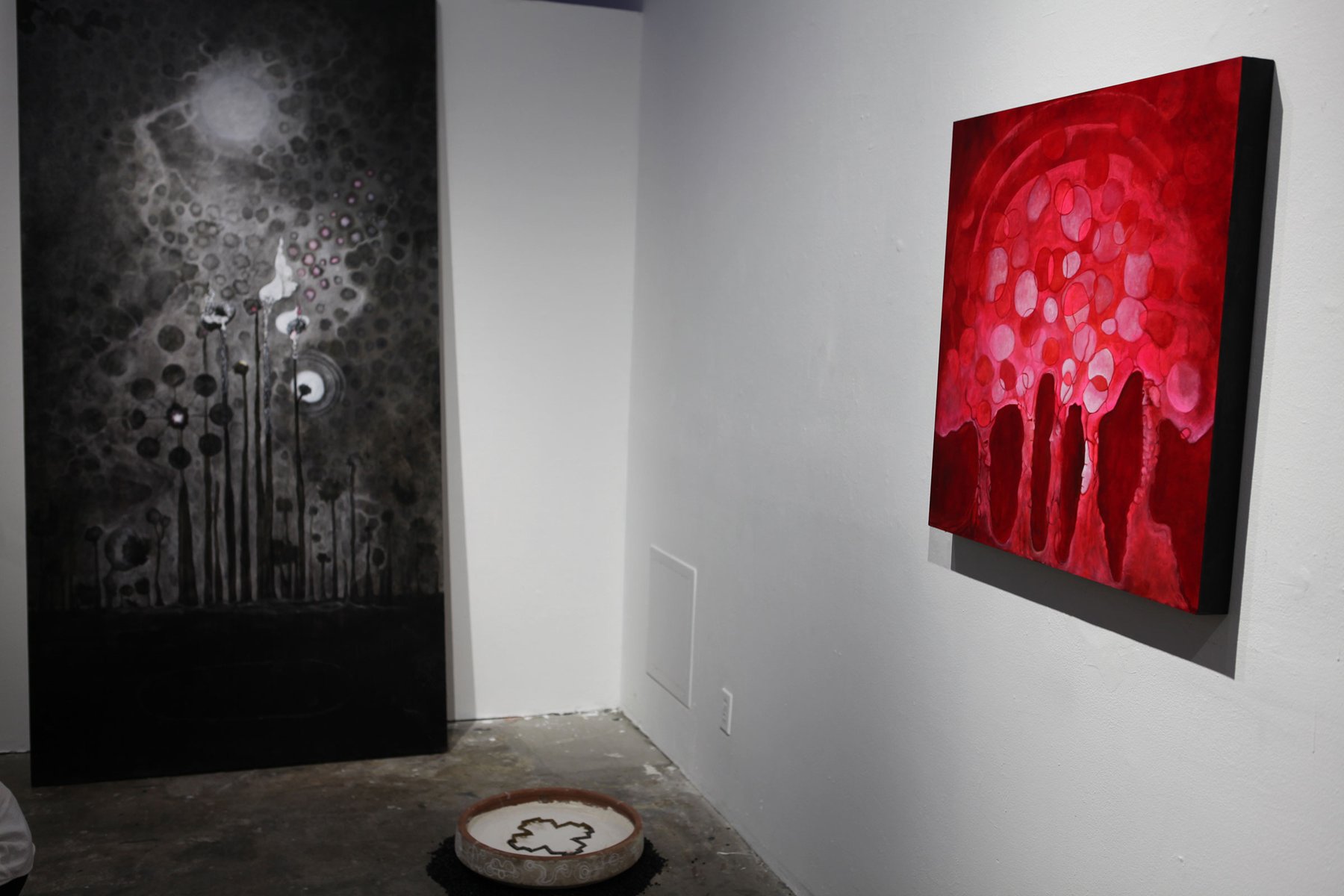
The Institute for Art and Olfaction · The Institute for Art and Olfaction
A second show on Chung King Road
Praying to the Gods is Persephenie's second solo exhibition at the gallery of the Institute for Art and Olfaction, 932 Chung King Road, Los Angeles. It ran from March 28 to April 24, 2026, opening on the evening of Saturday, March 28.
Her first show there was in March 2024, Talisman: Meditations. Two years later she returned with a larger subject: reverence, and where it lives in the body.
The materials are four: plants, scent, incense and self portraits. The first three belong to smell. The last belongs to sight, and to the artist herself. Placed together, they suggest that the one who prays is part of the prayer.
A perfumer since 2004
Persephenie lives and works in Los Angeles as an artist and perfumer. She opened her aromatic studio in 2004 and has taught classes on scent since 2006.
According to IAO, her practice draws on medieval Middle Eastern perfumery, the history of incense, West Coast natural perfumery and the attar tradition of Kannauj in India. Her perfumes lean toward natural materials, complexity and an earthy character.
These sources share something. Each treats scent as tied to ritual, to place, to slow time. Attar is a distilled scented oil of India. Incense is wood and resin burned so that smoke rises. Everywhere, scent was something people offered up before it was something they wore.
Placing everything low
The key decision of the exhibition is height. Elements are placed low, near the ground and along the walls. No plinths at eye level, no vitrine in the middle of the room.
So the visitor has to come down. To see clearly, bend. To smell, kneel. In the artist's words on the exhibition page, kneeling, looking and smelling become acts of attention and vulnerability, so that reverence is something the body does rather than an abstract idea.
It is a rare use of gallery space. Museums usually raise objects, set them on pedestals, light them, and let the visitor stand and look. Persephenie does the opposite. She lowers the object and makes the visitor follow.
Visitors are not told what to feel. They are only put into a posture. The nose and the knees do the rest.
Plants as beings to be smelled
In Praying to the Gods, plants are not decoration. They are living beings, met through smell. A potted plant can be passed with a one second glance. Kneeling beside it to smell, the visitor stays longer, closer, and sees it differently.
Incense works in another direction. Smoke rises while the visitor bows. Two opposite movements in one room: the material grows light and climbs, the person grows heavy and descends. It can be read as the oldest picture of prayer.
The self portraits remind us that all this passes through a particular body. Not an abstract believer, but a woman in Los Angeles who has worked with scent for over twenty years. For incense as a trade on the other side of the Pacific, Arianna Petrich's The Water and the Wind, also at IAO, offers a counterpoint.
Olfactory Art