
Essays · Olfactory Art
Koo Jeong A. Odorama (Charing Cross).
The deeper you go, the thicker the wood.
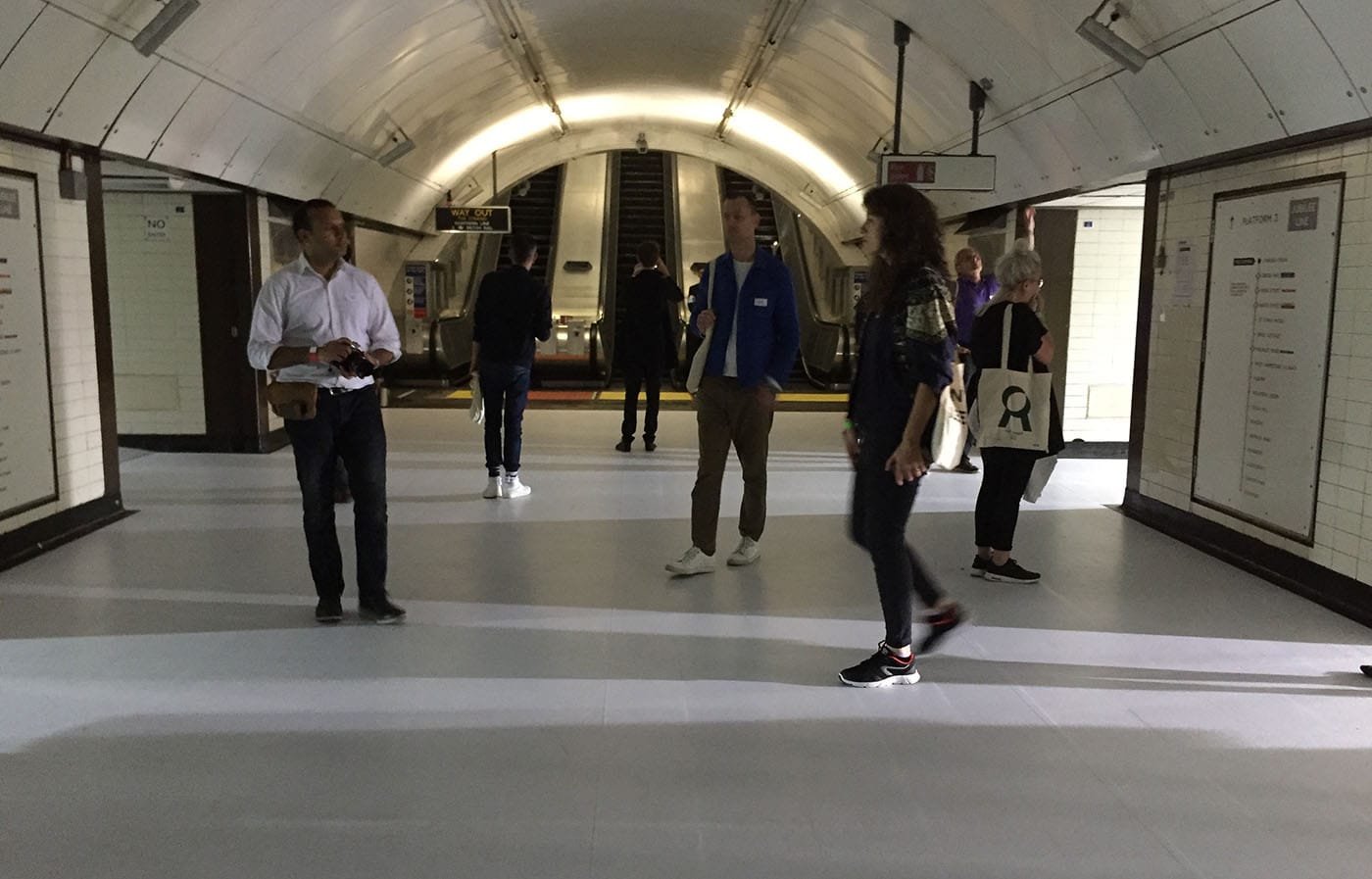
Photo for Hyperallergic · Hyperallergic
A platform without trains
On 2 July 2016 London held the first Art Night, a night of art that placed works in spaces not usually meant for art. That year the programme was guest curated by the Institute of Contemporary Arts, the ICA, with Kathy Noble.
One of the sites was a disused platform at Charing Cross Underground station, the same place where a scene from Skyfall was filmed. No trains pass. There are only rails, tiles, old signs and the dark of the tunnel.
The Korean artist Koo Jeong A placed Odorama there. She brought no sculpture, painting or screen. According to Hyperallergic, she used nothing more than light and a particular smell, with the aim of altering the public's sense of reality.
Visitors walked down the stairs to the platform. The further they went, the stronger a sweet, warm, earthy smell became. By the platform it had thickened and taken over the air.
Agarwood, a wound turned into smell
The smell came from agarwood, the resinous wood of Asian agar trees. The resin forms when the tree defends itself against fungus and mould. In other words, agarwood smells of a tree resisting injury. What people treasure is the trace of a survival response.
In her notes on the work, Koo explains that wild agar trees are protected by law as an endangered species and may not be felled. As she describes it, only wood that has fallen after lightning strikes, carried by wind and rivers over the years, can be gathered.
That detail gives the smell in the tunnel a journey far longer than a few flights of stairs. Before reaching London the wood had met lightning, wind and water. The visitor's nose stands at the end of that road. Visitors see no lightning, no river. They only smell what these left behind.
The smell was not gentle for everyone. The Hyperallergic writer describes sneezing and symptoms like hay fever, and noticed other visitors reacting the same way. The writer liked the story of the wood but struggled to connect it to the abandoned platform itself.
Light and air as material
The name Odorama recalls scented cinema experiments, where smell was an accessory to the image. At Charing Cross the order is reversed. There is almost no image. The light is just enough to see the way. Smell is the main thing.
Koo Jeong A has long worked with small, nearly invisible interventions in existing spaces. Odorama at Charing Cross goes close to the far end of that approach. She has carried the name into other projects too, such as ODORAMA CITIES. There is nothing to look at. Visitors carry the work home in their clothes, their hair, their breath.
An Underground platform is a place people pass through as fast as they can. Nobody stops to smell one. Odorama makes visitors slow down, because the body needs time to understand a smell that is growing denser. A place for passing through becomes a place to stay.
The work stays in memory because it shows that smell can overlay architecture. The concrete, tiles and rails remain. But those who came out of that night remember a forest, a tree struck by lightning, and a smell of wood they could not name.

Olfactory Art