
Essays · Modern Art
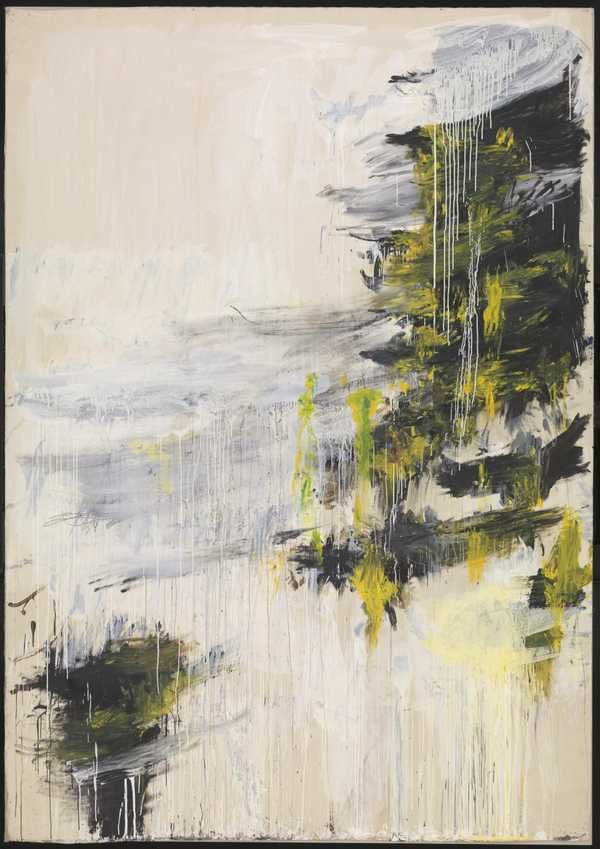
Cy Twombly. Quattro Stagioni (A Painting in Four Parts).
A year painted by hand, and the hand grows older.
Tate · Tate
Four canvases, one year
Quattro Stagioni means four seasons in Italian. The full title adds a line of explanation: A Painting in Four Parts. Tate dates the work 1993 to 1995.
Four upright canvases, taller than the viewer, hang side by side in the order of a year: Primavera, Estate, Autunno, Inverno. Spring, summer, autumn, winter.
Each has its own temper. One is crowded with colour, paint laid on paint until it runs down to the lower edge. Another is sparser, with open space and a few strokes that look wiped on by hand. Between them sits handwriting, sometimes legible, sometimes smeared, sometimes half covered in paint.
From a distance the four read as a row of doorways. Up close each dissolves into small gestures: a pencil line, a drip that dried halfway down, a word left unfinished.
Painting by gesture
Cy Twombly was born in the United States in 1928 and began painting at the height of Abstract Expressionism. In 1957 he left for Italy and spent most of his life there. From Italy he read European literature and Greek and Roman myth, and let them enter his paintings as words.
His work is often called scribble. It does look like that. But it is deliberate scribble: fast marks, uncorrected, keeping the speed of the moment they were made. The viewer does not see a finished image. They see the trace of a hand that moved.
In Quattro Stagioni this way of painting fits the subject. A season is not something that holds still to be copied. It is movement: days lengthen and shorten, leaves grow and fall. Twombly does not paint seasonal scenery. He paints the feeling of a season turning.
The writing works the same way. Twombly often copied lines of poetry, mythic names, the names of seasons into his canvases. Handwriting has a rhythm, like a brushstroke. Half is read, half is guessed. It resembles how we remember a past season: a few clear words, the rest a sensation.
Cycle and age
The four seasons is one of painting's oldest subjects. Painters of every period have treated it as the turning of heaven and earth, of sowing and harvest, of youth and old age. Twombly knew that tradition well and entered it in his sixties.
The painter's age changes the subject. For a young person, four seasons are a year. For someone who has lived through sixty springs and winters, four seasons are a countdown. Each returning season is familiar, but the number left grows smaller.
The paintings never say this in words. They let colour say it. Some areas are bright and overflowing, others grey and thin. The viewer can read their order as one year, or as one life, or both at once.
In 2008 Tate Modern opened Cy Twombly: Cycles and Seasons, built around his work on the cycles of seasons, nature and time. Tate's four seasons hung for the first time alongside the set held by the Museum of Modern Art in New York. Two years side by side, by the same painter, different in every gesture.
Why it stays
Quattro Stagioni does not give the viewer a landscape. It gives a way of standing before time: no counting of days, no dates, only the recognition that everything is changing.
Where Jackson Pollock's Summertime records one summer in small lines along a long canvas, Twombly spreads a whole year across four parts and lets the gaps between them stand for the months left unpainted. Twombly died in 2011. The four canvases still hang side by side, still in the order of spring to winter, and still begin again whenever someone stands before the first.
Modern Art