
Essays · Contemporary Art
Joseph Kosuth. Clock (One and Five), English/Latin Version.
The thing, its picture, and its name are not the same.
Tate · Tate
A horizontal line on the wall
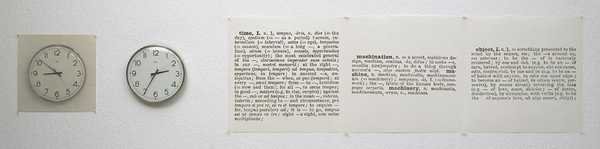
The work is nearly three metres long and about sixty centimetres high. According to Tate's record, it consists of a clock, a colour photograph on paper, and printed papers. Everything is set out in one horizontal line, like a sentence written across a wall.
At one point hangs a real clock, the kind found in an office or a classroom. Beside it is a photograph of that same clock. Then come enlarged dictionary definitions. The subtitle English/Latin Version tells us the text appears in both English and Latin.
Nothing is painted. Nothing is modelled. There is no trace of the artist's hand. Every part of the work is something that can be bought, photographed or looked up.
Joseph Kosuth made the work in 1965, when he was about twenty. Tate bought it in 1974. The museum also holds an exhibition version dated 1965 and 1997. It is a small detail that says a lot: the work can be rebuilt, because what matters does not live in any single object.
Which clock is the clock?
Standing before the line, the viewer is pushed to choose. The real clock is a clock, of course. But the photograph is also a clock, in the way we point at a picture and say: that is the clock. And the definition is a clock in a third sense, the clock inside everyone's head, with no colour and no size.
The title counts: one, and five. One object, and the ways it can be presented. Kosuth does not rank them. He never says which version is more real. He simply sets them side by side and lets the gaps appear.
In the same year he made One and Three Chairs with the same structure: a wooden chair, a photograph of it, and the definition of the word. The chair is better known. But choosing a clock adds a layer. A chair just stands there. A clock exists to show time.
The photograph holds the clock at a single hour, the hour the shutter clicked. The dictionary definition belongs to no hour. Only the real clock ages with the room, gathers dust, shares the afternoon in which the viewer stands. Three versions of one object, three different relations to time.
When the idea is the work
Kosuth was one of the figures who shaped conceptual art in the late 1960s. In 1969 he wrote the essay Art after Philosophy, arguing that art should question itself: what art is, and how it makes meaning.
Clock (One and Five) is a question built from objects. It does not want to be found beautiful. It wants the viewer to think about how we recognise a thing. Do we know the clock through our eyes, through a photograph, or through a word? Without the word clock, would we still see a clock?
The Latin deepens the question. Most viewers today cannot read Latin. The definition is there, complete, yet for them it becomes only the shape of letters. Language, which we assume is transparent, turns into an object to be decoded.
More than half a century later, the work reads easily in an odd way. We now look at pictures of things more often than at things. We read descriptions before we touch anything. Kosuth's line is no longer a philosophy exercise. It resembles an ordinary day: trusting the picture and the word, and forgetting the real object hanging right beside them.
Why a clock still hangs there
Works of this family are often called dry. No colour, no feeling, only argument. Yet in front of it, viewers do something very physical: their eyes move back and forth between the clock and the photograph, hunting for the difference.
That movement is the work. Kosuth does not tell a story about time. He makes the viewer spend time comparing, reading, doubting. Another clock, Christian Marclay's The Clock, builds twenty four hours of film to match real time. Kosuth does the opposite: he pulls real time apart from its image and its name, then hangs the three side by side.
Contemporary Art