
Essays · Photography
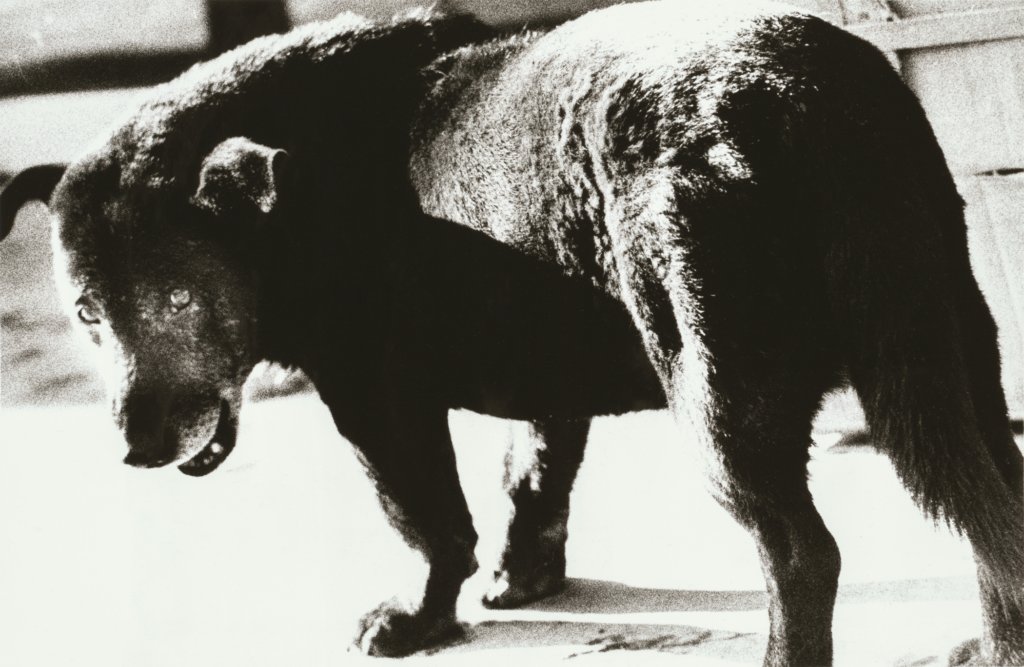
Daido Moriyama. Stray Dog, Misawa.
The wanderer looks back at the one looking.
© Daido Moriyama · SFMOMA
A morning early in 1971
Just after New Year 1971, Daido Moriyama was in Misawa, a town in northern Japan and home to a large United States Air Force base. He had gone there on a trip for a series he was shooting for Asahi Camera magazine.
As he later recalled, he stepped out of his hotel one morning, camera in hand, and saw a stray dog wandering about in the sun. He took the picture. It became the image most associated with his whole career.
The dog is shaggy, a little wolfish. It stands side on, head turned to look straight into the lens, wary, with a hint of aggression. The print is black and white, high contrast, coarse grained. The eye has nowhere else to go. There is only that gaze.
A self portrait
Moriyama has often spoken of the dog as a kind of self portrait. He describes himself as wandering too, glaring at things, barking now and then. Something in the dog is close to how he looks at things, and perhaps to how he appears walking the street.
He has also said that since becoming a photographer he has always felt he had strayed. Belonging nowhere, staying nowhere long. The camera was a way to move through a city without stopping.
Misawa gives the picture more weight. A Japanese town living beside the military base of the country that won the war. Bars, English signs, American servicemen in the streets. The stray dog stands there between two worlds, belonging to neither. Moriyama does not say this, but it is hard not to think it.
Grainy, blurred, out of focus
Daido Moriyama was born in 1938. In the late 1960s he joined Provoke, a small magazine made by young photographers and poets in Tokyo. They wanted to break with the clean, legible, composed pictures of photojournalism and advertising.
Their way of shooting is summed up in three Japanese words: are, bure, boke. Grainy, shaky, out of focus. Pictures taken fast, often without the viewfinder, the camera tilted, the horizon askew. The results read more like sensation than information.
Stray Dog, Misawa has all of this, yet is sharp where it matters most: the eyes. The grain is coarse and the shadows heavy, yet the dog's gaze reads at once, clear and still. Perhaps that is why the picture stays so long in memory.
From Tokyo to San Francisco
In 1999 the San Francisco Museum of Modern Art opened Daido Moriyama: Stray Dog, organised by its curator of photography Sandra S. Phillips. The museum called it the first exhibition to survey Moriyama's work, with nearly two hundred black and white images and a major Polaroid piece.
The show took its name from the dog, and focused on postwar Japan's ambiguous relationship with Western, above all American, influence. A 1971 print of Misawa is in SFMOMA's collection, a gift of Van Deren Coke.
More than fifty years after that morning, the dog still looks back. It has been reprinted in books, catalogues, on posters. The picture has kept its weight, because its question remains: who is watching whom? Decades later another photographer, Lieko Shiga, went to Japan's northeast and also photographed a place standing between worlds.

Photography