
Essays · Contemporary Art
Lieko Shiga. Rasen Kaigan (Spiral Shore).
The sea takes, then returns in pieces.
© Shiga Lieko · Getty Museum
The village photographer
In 2008 Lieko Shiga moved to Kitakama, a coastal village in the Tōhoku region of northeastern Japan. A small place, about three hundred and seventy people. She did not arrive as a reporter or an artist hunting for subjects. She became the village photographer.
That meant photographing what a village needs photographed: festivals, events, daily life, people. She lived there, knew each household, and her pictures slowly became a chronicle of the place.
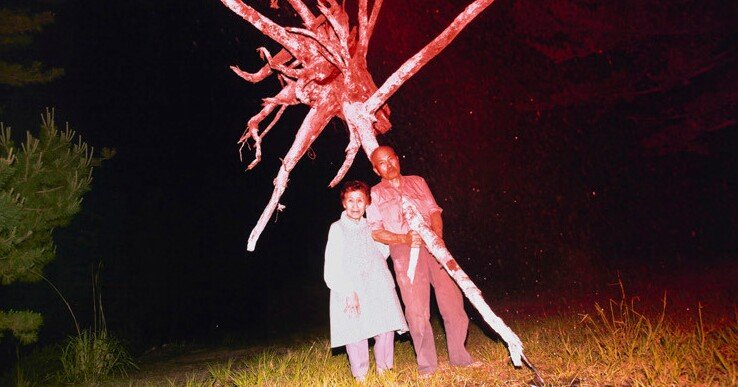
But Shiga's pictures are nothing like ordinary keepsakes. She often shot at night, with strong flash, harsh colour, staged compositions. Residents took part in making the images: where to stand, what to hold, how to move. The results are both real and dreamlike, a village seen through restless sleep.
The Getty Museum holds a work from this period, Portrait of Cultivation, from 2009.
11 March 2011
On 11 March 2011 a magnitude 9.0 earthquake struck off the Tōhoku coast and set off a tsunami. In Kitakama more than fifty people died. Many houses were swept away. The village Shiga had photographed for three years barely kept its old shape.
After the disaster Shiga did not leave. She began something else: gathering photographs the waves had carried ashore. According to the Getty, she collected, cleaned and sorted more than thirty thousand of them.
Wedding pictures, birthdays, school portraits, snapshots in front of houses. Many were badly damaged, emulsion lifting, colour bleeding, faces half gone. Yet even damaged, they were all some families had left. Washing and keeping them for relatives to reclaim was quiet work, not art, but it changed how Shiga understood photography.
The spiral shore
Rasen Kaigan, Spiral Shore, is the name of the series Shiga made from her time in Kitakama, spanning the years before the tsunami and the period after. The Getty showed six works from it and holds one in its collection, bought with funds from the museum's Photographs Council.
The word spiral suggests time that does not run straight. Before and after wind into each other. Staged pictures of villagers made before the disaster, seen again after it, mean something else entirely. Some of the people in them are gone. Some of the places are gone.
Shiga's flash makes people and things leap out of the dark, as if summoned. Before 2011 that was an aesthetic choice. After 2011 it feels like a rite: a brief light, enough to see by, before everything sinks back into night.
Photography as shared memory
We usually think of photography as one person's act: the photographer looks, chooses, signs. Rasen Kaigan asks something else. Whose pictures are these? Shiga's, the villagers' who helped stage them, or the vanished place's own?
The thirty thousand photographs from the shore are not Shiga's. They belong to anonymous photographers, ordinary families. But her keeping of them, alongside her own work, shows a way of seeing: photography as part of a community's memory, not only an artist's output.
Kitakama lies in the northeast, the same region where decades earlier Daido Moriyama met a stray dog in Misawa. Two photographers, two generations, one region. Moriyama passed through. Shiga stayed. And staying let her see what a passerby cannot: a place survives through the pictures people keep for one another.

Contemporary Art