
Essays · Olfactory Art
Daniel Spoerri. Restaurant Spoerri.
The meal is over. The table remains.
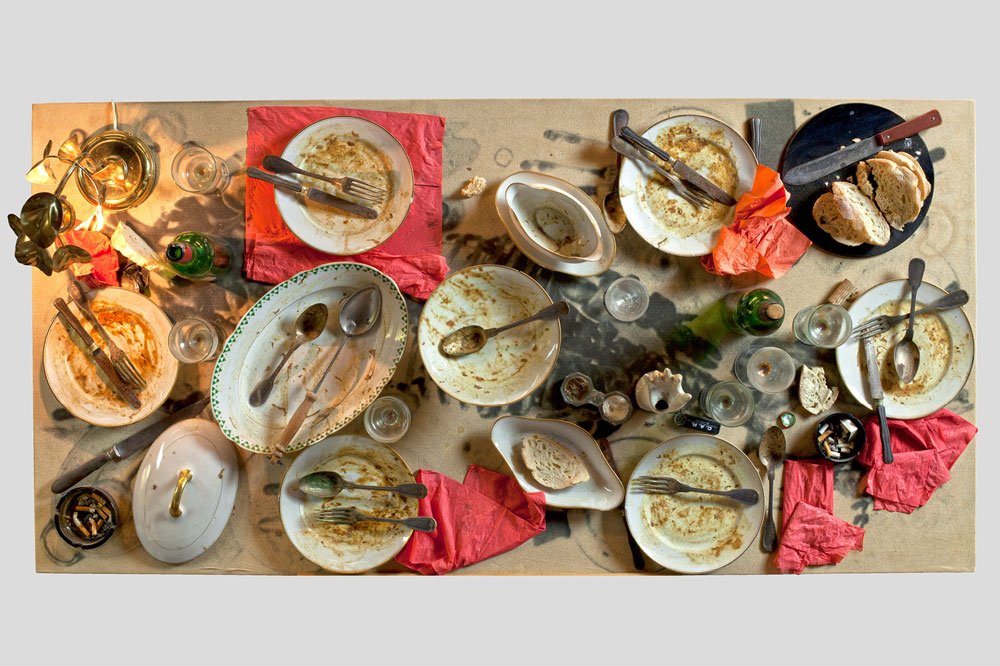
Apollo Magazine; © Daniel Spoerri / ADAGP · Apollo Magazine
Gluing down a moment
Daniel Spoerri began gluing objects to surfaces in 1960. That same year he was among the founding members of Nouveau Réalisme in Paris, a group of artists who wanted to bring the real objects of modern life into art rather than depict them.
His method was simple. After a meal, he kept everything left on the table: dirty plates, used napkins, empty bottles, coffee cups, ashtrays. He glued them to the tabletop exactly where they lay. Then he stood the tabletop on end and hung it on the wall like a painting.
He called them tableaux pièges, snare pictures. What is trapped is not the objects. It is a moment: the chance arrangement a group of people leaves behind when they finish eating and get up.
Hung on the wall, the table meets the eye straight on, where a diner would have looked down at it. That shift is just strange enough to make overlooked things visible again.
From Galerie J to Burgplatz
In 1963 Spoerri turned Galerie J in Paris into a restaurant for two weeks. Art critics served as waiters. Each night about thirty covers were served, and each night one table was glued down as a snare picture.
In 1968 he opened Restaurant Spoerri in Düsseldorf, on Burgplatz in the old town, together with the Swiss restaurateur Carlo Schröter. It ran until 1972. Spoerri cooked, and the menu included things few people ate: rattlesnake, elephant trunk. He said the restaurant served everything you can eat but normally do not.
Diners could commission their own table as a snare picture for a thousand Deutschmarks. But Spoerri also often chose a table at random to keep.
In 1970, on the floor above the restaurant, he opened the Eat Art Gallery. It showed works made from food, by Spoerri and many others, among them Joseph Beuys and Dieter Roth.
Eat Art: eating as material
Eat Art was Spoerri's name for art that takes eating as its material. Not painting fruit, but cooking, serving, eating and keeping what is left. The food does not stand for anything. It is itself.
Smell is inseparable from these works. In the restaurant, the air was thick with roasting meat, wine, cigarette smoke. On the snare pictures, crusts and crumbs still smelled for the first days, then dried and faded. The works change their smell over time without the artist stepping in.
This sets the snare pictures apart from classical still life. A painted fruit stays ripe forever. A snare picture ages along with the real food on it. A viewer in 1970 and a viewer today do not see, or smell, the same thing.
Later, Spoerri kept working with food in many forms. In 1982 he published Mythology & Meatballs. In the 1980s he collected handwritten offal recipes from fellow artists.
Why the table is still worth looking at
In 2021 Kunstforum Wien staged a major retrospective of Spoerri, with many snare pictures hung together. Seen side by side, they show different evenings of the 1960s and 1970s: many glasses or few, ashtrays full or half empty, plates clean or half finished.
Each table is a document of how people sat together. No one is depicted. They are present only through what they left.
In the same years, in London, Alison Knowles made salad for her audience and let the work be eaten. Spoerri did the opposite: he let the meal pass, then kept its shell. Two views of the same act. One chooses the moment of eating, the other the moment just after.
Olfactory Art