
Essays · Contemporary Art
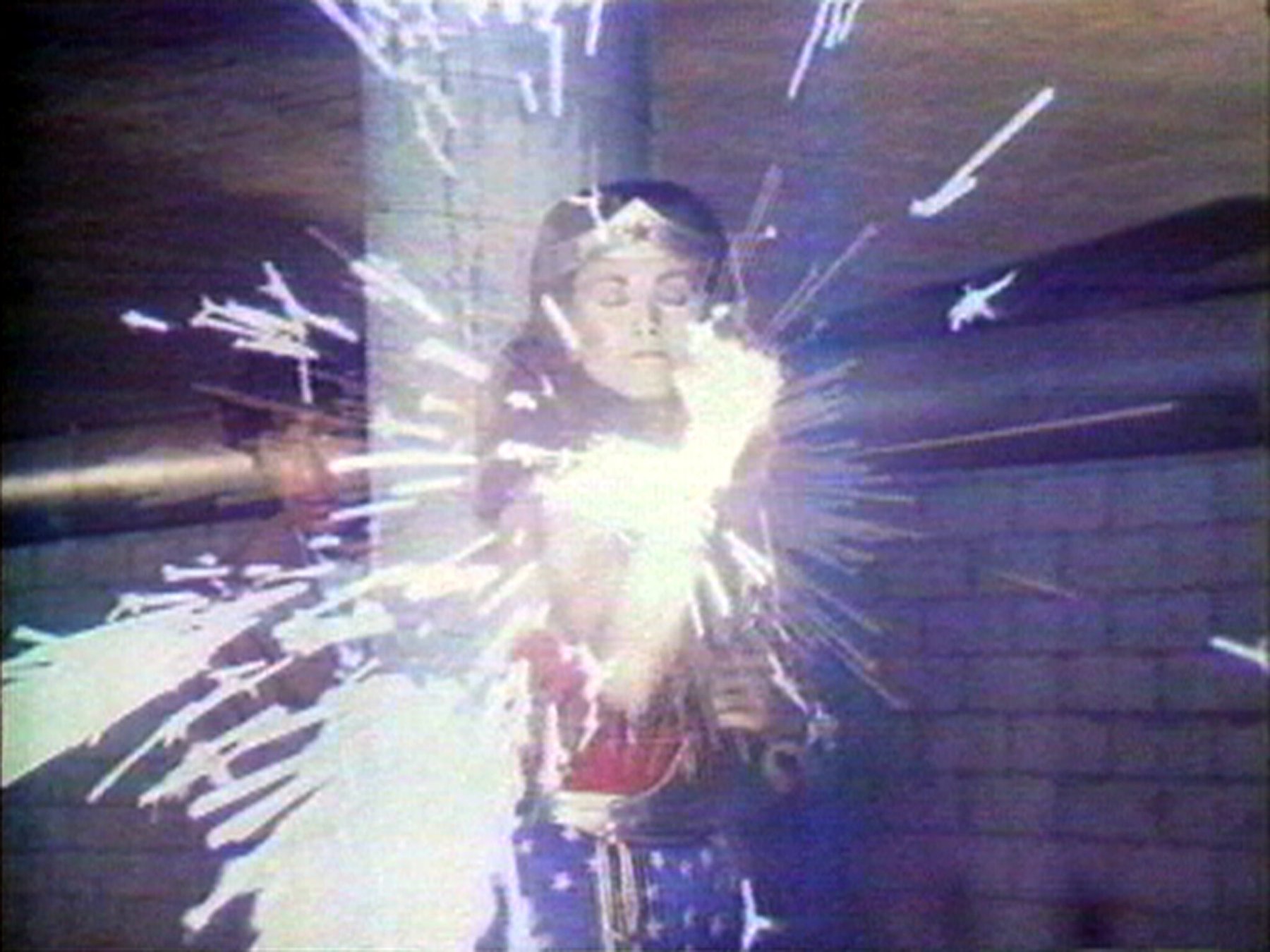
Dara Birnbaum. Technology/Transformation: Wonder Woman.
Repeat it long enough and the magic shows its frame.
Whitney Museum of American Art · Whitney Museum of American Art
A few seconds of television, repeated
In the late 1970s Wonder Woman was a familiar series on American television. Every episode had a moment people waited for: the lead character spins, a burst of light flares, and she becomes the superhero in stars and stripes.
In 1978 and 1979 Dara Birnbaum took that footage and re-edited it. The result is a colour video with sound, five minutes and fifty seconds long, shown on a loop. It opens with bursts of fire. Then the transformation, again and again. Then dizzy spinning, bullets bouncing off a bracelet, a scene in a hall of mirrors.
No narration. No supporting cast. The story of an entire episode is stripped away, leaving only the frame.
Birnbaum described the edit as a stutter-step progression of extended moments of transformation. In her account, once the story is reduced to running, spinning and saving a man, the underlying theme can surface.
Words scrolling on the screen
In the later part the video turns to text. The screen shows the lyrics of Wonder Woman in Discoland by The Wonderland Disco Band, a disco tie-in to the character. The lines appear one after another while the music plays.
This matters. The superhero does not only live in the series. She is sold again as a song, a toy, an advertisement. Each time she changes form she carries an idea of a woman with her: strong but alluring, powerful but at someone's service.
Birnbaum does not comment in words. She places the pieces side by side and lets viewers read. Once the lyrics stand bare on screen, without the beat to shield them, lines that sounded cheerful reveal what they actually say.
Using television to speak about television
Birnbaum was among the first artists to use footage from mass television as her material. The approach would later be called appropriation: taking someone else's image and placing it in a new frame so it says something else.
To do it she needed editing equipment that artists rarely had access to. The technical work involved people at the Nova Scotia College of Art and Design in Canada. Editing videotape then was far slower and harder than today. Every repetition was a real cut.
The result is short, harsh, almost violent in rhythm. It is not beautiful in television's sense. It is like someone with a remote rewinding one scene until the scene loses all its magic.
Why that spin remains
Technology/Transformation: Wonder Woman is now in the collection of the Whitney Museum of American Art in New York. The museum has shown it in major exhibitions such as America Is Hard to See in 2015 and, earlier, Television Delivers People.
What keeps it standing is the way it teaches us to look. After the video it is hard to watch an on-screen transformation the same way. We begin to see the cut, the placed light, the body arranged to serve a gaze.
In the same years other women artists were putting familiar roles under the lens, like Martha Rosler with her kitchen and her alphabet of utensils. Rosler used her own body. Birnbaum used the body of an image that already existed. Both asked one thing: who decided what a woman should look like?
Today, when images are cut, looped and shared millions of times a day, Birnbaum's method looks almost prophetic. She showed that repetition is never innocent.


Contemporary Art