
Essays · Contemporary Art
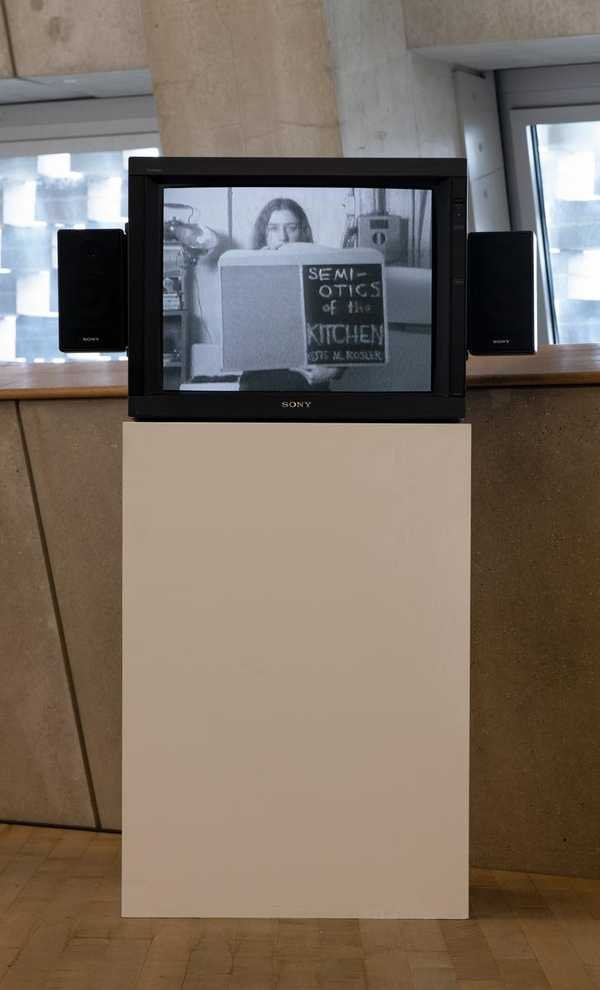
Martha Rosler. Semiotics of the Kitchen.
Each utensil is a letter. The gesture says what the letter won't.
Tate · Tate
A cooking lesson with no dish
In 1975 Martha Rosler set up a small kitchen in front of a camera. A table, a few utensils, an apron. Black and white, with sound, about six minutes long. Everything looks like an afternoon cooking show.
Then she begins. She puts on the apron, looks straight into the lens, picks up the first utensil and says its name. Then the next. Then the next. The order follows the alphabet, starting from A.
No recipe. No ingredients. No dish is ever made.
Instead there is gesture. Rosler does not use the tools as they are meant to be used. She swings, stabs, bangs, flings. A ladle scoops at empty air and throws its nothing out of frame. A knife slashes the space in front of her. Each movement is short and decisive, and they grow harder as she goes.
The kitchen's alphabet
The title states the method. Semiotics is the study of how signs produce meaning. A word, an image, an object can all be signs. In the kitchen those signs had long been fixed: the bowl is for mixing, the grater for grating, the knife for cutting. And the person using them, in the familiar picture of the time, was a woman.
Rosler takes the whole system and bends it slightly. The names are right. The order is right. Only the gesture is wrong. That wrongness brings up what lay quietly in the kitchen all along: a role handed to women without anyone asking whether they wanted it.
In Rosler's own description, the viewer is watching a reversed Julia Child, the most famous television cook in America at the time. The domestic meaning of the tools is replaced by another vocabulary, one of frustration and rage.
One of her lines is often repeated: when the woman speaks, she names her own oppression. In the video, naming is the only action. Rosler does not explain or complain. She reads the alphabet in an even voice, with uneven hands.
Video as a cheap, close tool
By the mid 1970s portable video had just become accessible to artists. It was cheaper than film, could be watched straight away, needed no lab. Many women artists used it to work with their own bodies and daily lives, outside institutions that had not opened their doors to them.
Semiotics of the Kitchen borrows television's own grammar to speak against television. A fixed camera, a host in the centre, tools presented one by one. Viewers recognise the format at once, and because they recognise it, they see exactly where it breaks.
The image is rough, the light flat, the sound echoing in a small room. Nothing is polished. The roughness is part of the work: it keeps its distance from the gloss of the cooking programmes it mimics.
Why those six minutes remain
Half a century later, Semiotics of the Kitchen is still screened in museums and belongs to the collection of Tate in London. It is often cited as one of the clearest feminist videos of the 1970s, and as proof that a small gesture can carry a large question.
What keeps it alive is not the anger. The anger in the video is very contained. What lasts is the structure: an alphabet everyone knows, a kitchen everyone knows, and one person refusing to use them the way she was taught. Other artists would later return to the kitchen as a site of power, as in Carrie Mae Weems's kitchen table.
Viewers today may not remember Julia Child. But they still know what a kitchen is, who usually stands in it, and whether those hours are counted. Rosler's question has not aged, because the kitchen has changed less than we like to think.
Contemporary Art