
Essays · Photography
Carrie Mae Weems. Kitchen Table Series.
One table stays still, and a whole life passes across it.
The Bell Gallery, Brown University · The Bell Gallery, Brown University
One table, one lamp
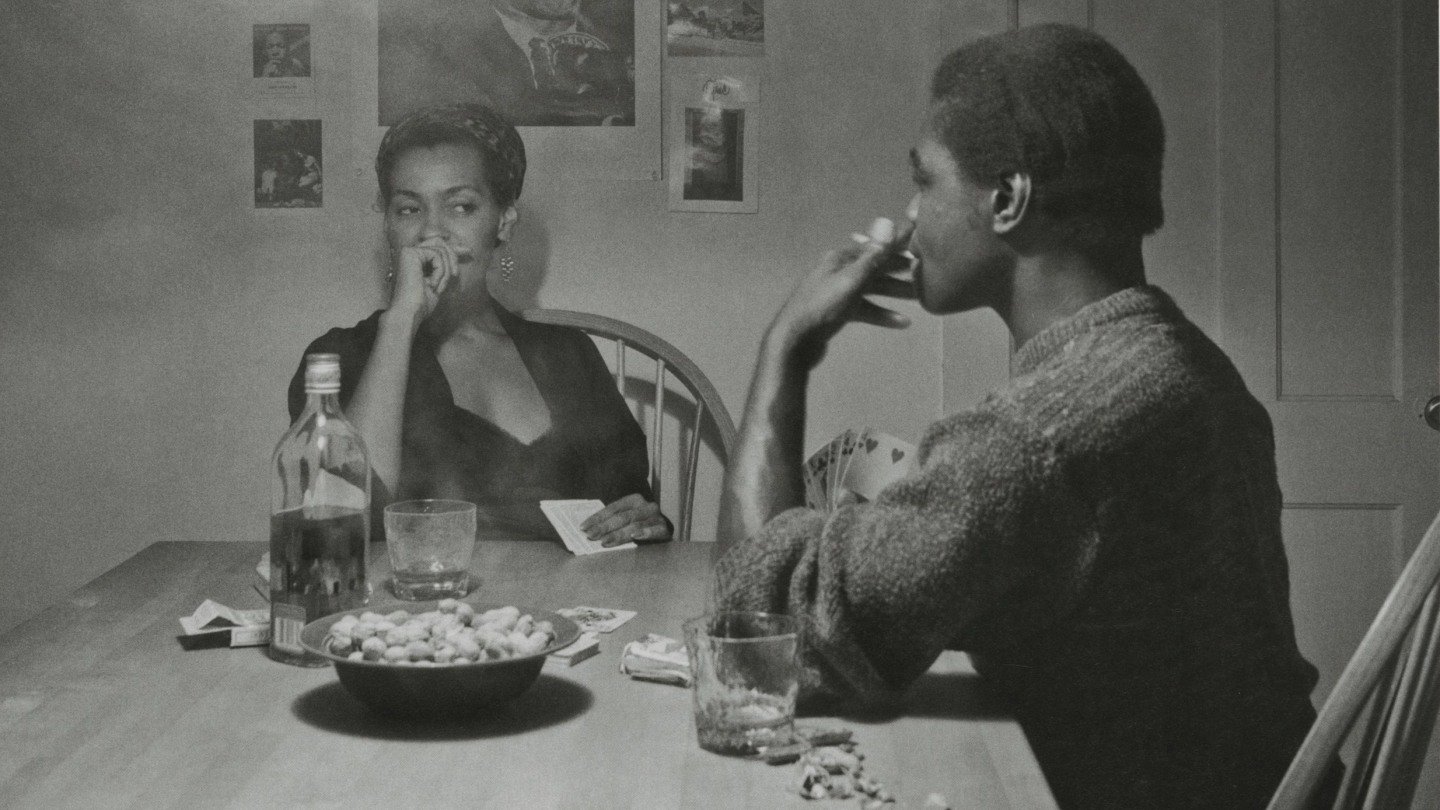
A plain wooden table. Above it, a hanging lamp throws down a pool of light, and the rest falls into darkness. The camera sits at the end of the table, looking straight along the wood. That angle never changes.
This is the setting of Kitchen Table Series, which Carrie Mae Weems made over 1989 and 1990. It consists of 20 black and white photographs and 14 accompanying text panels. It was first shown in 1990 and has since become one of the most discussed works of late twentieth century American photography.
Weems made it in her own kitchen, around her own table, while teaching photography at Hampshire College in Amherst, Massachusetts. She worked late at night and early in the morning, whenever she could find the time.
The woman at the head of the table
The central figure is a woman, played by Weems herself. But these are not self portraits in the usual sense. The woman is and is not the artist. She is a constructed character, both personal and shaped like many other women.
Around the table she lives through several relationships. She laughs with friends. She studies with her daughter. She shares a drink with the woman next door. There is a man in her life, and there are moments when she sits alone. Each scene is a chapter.
Nothing is accidental. The light of the hanging lamp is carefully set. The objects on the table are chosen and placed with intent, each carrying its own meaning in the scene. So are the poses. And the images follow a clear storyline, like scenes of a play on a single stage.
The text panels push the story further. They mix the artist's voice with lines from popular songs and fragments of popular culture. The woman becomes more than an individual. She is a figure shaped by the whole culture around her.
The kitchen as a place of power
The kitchen is usually seen as private space, women's space, set apart from public life. Kitchen Table Series breaks that separation. Its themes are race, class, gender, friendship, love, loss, power and motherhood. All of them unfold around a dining table at home.
When a Black woman places herself at the centre of the frame, at the head of the table, looking straight at the camera, that is already a statement. In the history of photography and painting, that seat has rarely been hers. Weems does not explain it. She simply builds it, scene after scene.
What gives the series its weight is its ordinariness. No great events. Only evenings, conversations, quarrels and reconciliations. Yet within those small things, the large questions of who holds power, who waits and who is heard come into view.
Why the table remains
More than thirty years later, Kitchen Table Series is still regularly shown. The Bell Gallery at Brown University presented it from 11 November to 21 December 2017. The National Gallery of Art in Washington holds a set of 20 platinum and palladium prints with 14 screenprinted text panels, printed in 2003 from the 1990 series. Later generations of artists working on identity keep returning to this table.
A domestic table also appears in the still lifes of Laura Letinsky, but there the people have gone, leaving crumbs and half empty glasses. With Weems it is the reverse. People are always present. The table is where they face each other.
Kitchen Table Series reminds us that the largest things in life are often said in the smallest places. A kitchen. A lamp. A chair pulled out and pushed back in.


Photography