
Essays · Photography
Laura Letinsky. Hardly More Than Ever.
The meal ends, and the table begins to speak.
The Renaissance Society · The Renaissance Society
The table after the guests have gone
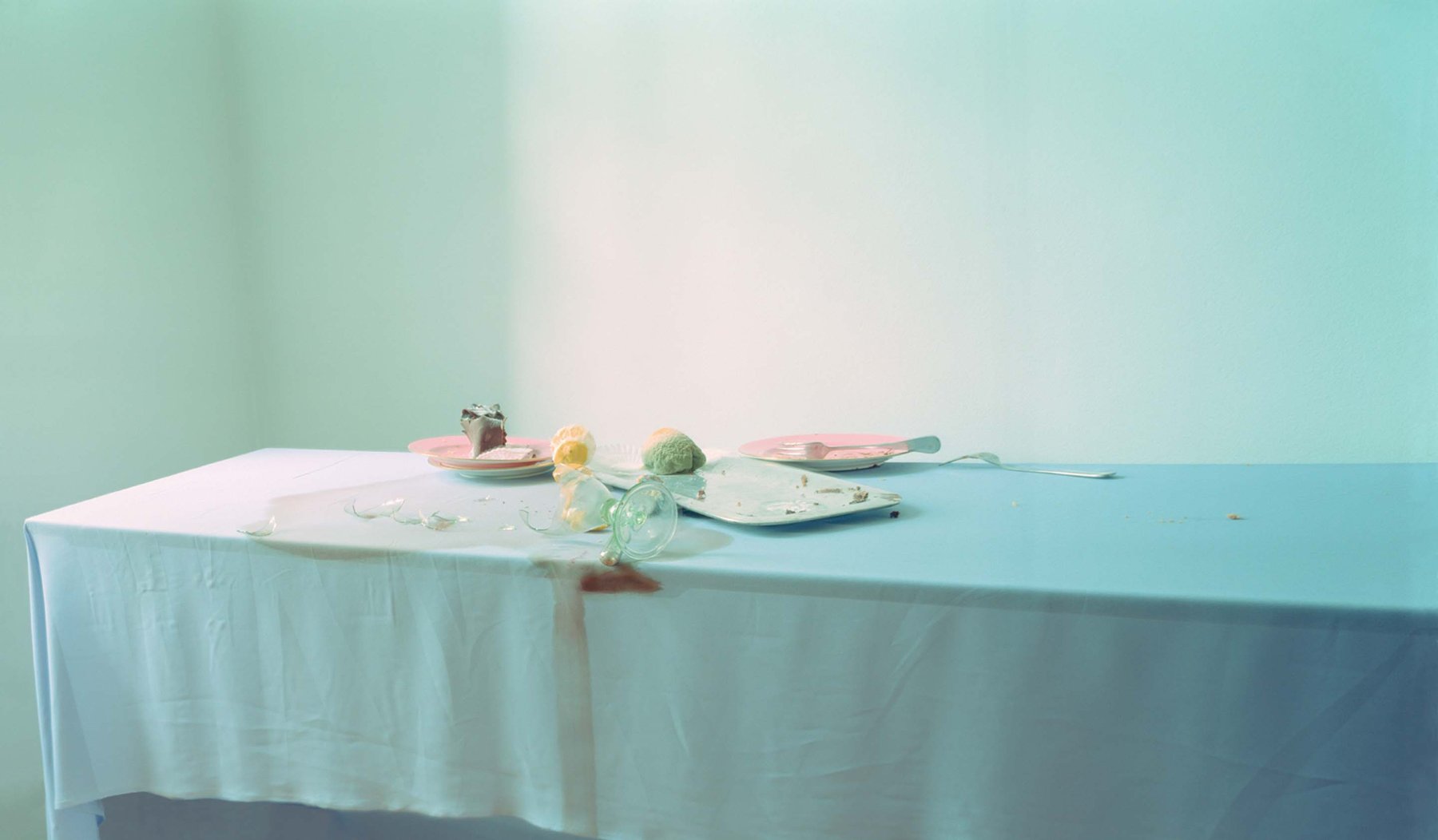
A creased tablecloth with a stain spreading. A few plates still streaked with sauce. Breadcrumbs along the edge. A fruit gone past ripe, its skin starting to wrinkle. A flower slumped in a glass. No one is sitting there any more.
This is the familiar scene in the still lifes Laura Letinsky made between 1997 and 2004. In 2004 the series was shown in Hardly More Than Ever, Photographs 1997 to 2004 at The Renaissance Society at the University of Chicago, from 7 March to 18 April. The same year saw the first catalogue of her still lifes, with an essay by the art historian Hanneke Grootenboer.
The Chicago show also included portraits of couples in their bedrooms, Letinsky's earlier body of work. Side by side, the two groups share one subject: the shared life of people at home, while they are there and after they have left.
Still lifes built with care
At first glance these tables look abandoned. They are not accidental. Letinsky arranges every detail: where the cup sits, the angle of the knife, the gap between two plates. The mess in the picture is a calculated mess.
She worked with slow film and long exposures. This softens outlines and deepens shadows. The light is gentle, close to a daylight already fading, and the white planes of cloth and wall often merge until the edge of the table disappears.
Critics tend to name two sources. One is the tradition of candid, unstaged photography of figures such as Walker Evans. The other is the light and atmosphere of Pre Raphaelite painting. But the clearest source lies further back: Dutch and Flemish still life painting of the seventeenth century.
Vanitas, once again
Seventeenth century Dutch painters painted crowded tables: a half peeled lemon, a tipped glass, a pie cut in two, a crab, a bunch of grapes. Inside that abundance there was always a sign of decay: a fly, a fallen petal, a bruised peach. The genre is called vanitas, a reminder that everything passes.
Letinsky keeps the structure and drops the abundance. On her tables the feast has already happened. The food has been eaten. What remains is the leftover, the part no one looks at. The title says as much: hardly anything left, and still more than ever.
There is one important difference. Vanitas paintings usually carried a moral lesson, asking viewers to think of death and vanity. Letinsky's pictures do not preach. They are gentler. They look at crumbs as at something beautiful, without blaming whoever left them.
This is also how her pictures speak about love and the quiet labour of a household. Someone cooked. Someone set the table. Someone will have to wash these plates. The table is where that work meets, and where it is forgotten fastest.
Why leftovers are worth looking at
Food pictures today are mostly taken the moment a dish leaves the kitchen, glossy and untouched. Letinsky goes the other way. She photographs what we hurry to clear. Because of this, her pictures show something a perfect food shot never does: time passing across a tabletop.
In a related line of attention to what is thrown away, the cigarette ends Irving Penn picked up from the street were also raised into still life. But Letinsky stays closer to home. She does not need to go outside. She only needs to wait for the meal to end.
Photography