
Essays · Photography
Joel Meyerowitz. Morandi's Objects.
The objects that sat for a painter all his life.
©Joel Meyerowitz · Hyperallergic
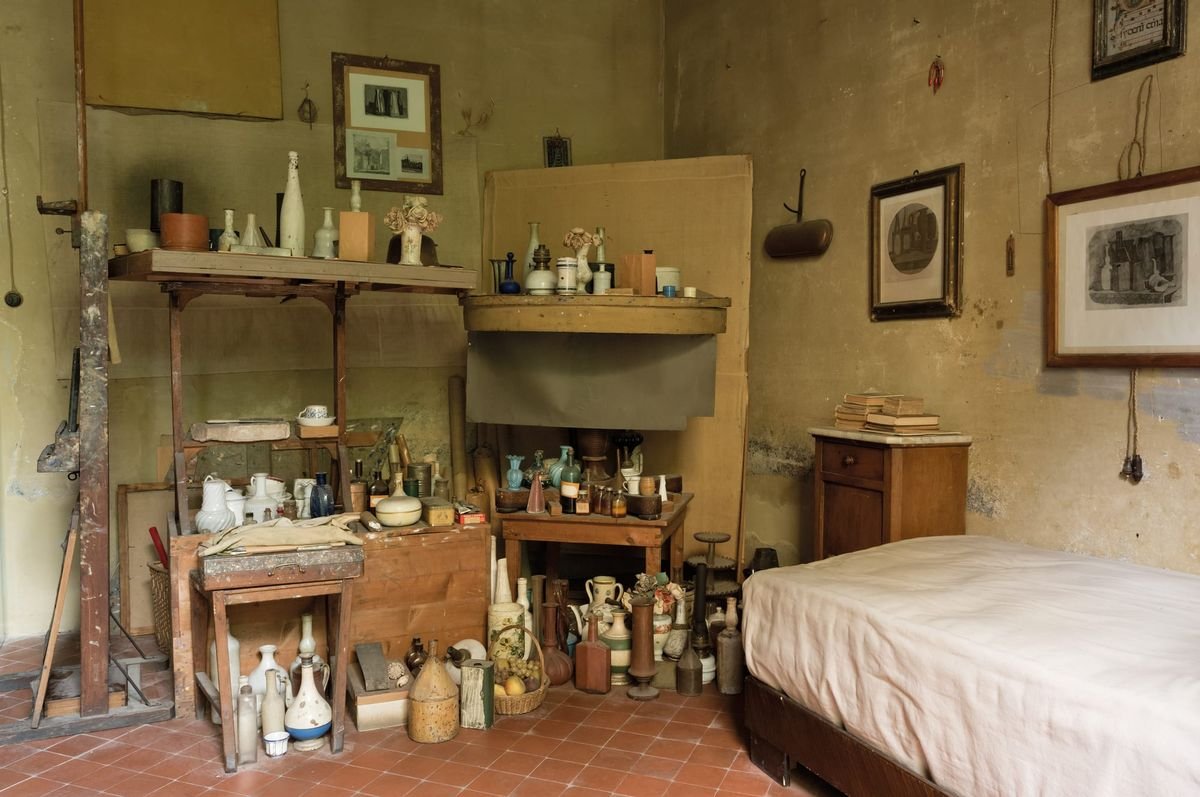
A room at 36 via Fondazza
Giorgio Morandi lived and worked almost all his life in an apartment at 36 via Fondazza, Bologna. His studio was a small room that was also his bedroom. There he painted some of the best known still lifes of twentieth century Italian art: a few bottles, a few boxes, packed together on a tabletop, their colours muted as dust.
Morandi died in 1964. The apartment was later kept as a small museum, Casa Morandi, and most of its rooms are usually closed to the public. The objects he painted are still there.
In the spring of 2015 the American photographer Joel Meyerowitz, then living in Tuscany with his wife, the writer Maggie Barrett, was allowed to work in that room. He stayed with Morandi's objects and photographed them, one at a time.
One by one, on the old tabletop
Meyerowitz's method was plain. He picked up each object, turned it in his hands, then set it down on Morandi's table, the same table still covered in the painter's marks. He brought no lamps. The light was the warm natural light of the room, the same source that cast the shadows in Morandi's paintings.
The list of objects is longer than one might expect. Vases, shells, bottles of pigment, silk flowers, tins, funnels, watering cans. Some 300 items. Many are dusty, chipped, their colours dulled. In the photographs they carry the muted tones of old gemstones, colours any viewer of Morandi's paintings will recognise at once. None is precious. All were looked at for a very long time.
Behind them, the old walls are peeling, the milky brown of a cortado. Meyerowitz did not tidy or wipe anything. The objects appear exactly as they had sat for decades.
He has said that while working he waited for a flicker of recognition, a sense that something in the object had come alive. That was when he pressed the shutter.
Two ways of seeing meet
Morandi did not paint objects for their value. Most were everyday things, nothing costly. He used them as geometry: circle, cylinder, box, rectangle, oval. Meyerowitz describes Morandi's arrangements as a force field in which the forms pull and push against one another.
Meyerowitz's own photography had gone another way. He is best known for colour street pictures in New York and for the coastal light of Cape Cod. In Bologna he slowed down. No crowd, no passing instant. Only a table, an object, and time. A man used to chasing instants on the street chose to sit still in a small room.
This is a meeting of painting and photography. Viewers of Morandi are used to objects already seen for them, turned into colour and line. Meyerowitz's photographs return them to being things: real dust, real cracks, bottles with real labels. And so the viewer sees more clearly how far Morandi transformed them.
The book and its expansion
Damiani published the photographs as a book in 2016. In April 2026 the same publisher released an expanded edition, Morandi's Objects: The Complete Archive of Casa Morandi, with more than 130 additional pictures and essays by Meyerowitz and Maggie Barrett.
The series can be read beside the finished tables of Laura Letinsky. Both look for beauty in the most ordinary things of a home. Letinsky photographs objects after people have finished using them. Meyerowitz photographs objects after the man who looked at them has gone.
Photography