
Essays · Photography
Dawoud Bey. Night Coming Tenderly, Black.
Darkness is both danger and shelter.
© Dawoud Bey · Whitney Museum of American Art
A railroad without rails
The Underground Railroad was not a railway. It was the name for a network of routes, houses and helpers through which enslaved Africans in the American South escaped north during the nineteenth century. Many went on to Canada, where they could live more freely.
Ohio was a key stage. From Hudson, a small town, and from Cleveland, those in flight tried to reach the shore of Lake Erie. Across the lake lay Canada. The water was the final passage.
The network had to be invisible to survive. So most of its traces were never recorded. Many houses and plots of land are only rumoured to have been part of the route. No plaques. No photographs from the time.
Photographing what no one could
Dawoud Bey was born in 1953 in New York. For decades he was known for portraits: young people, African American communities, faces looking straight out. Night Coming Tenderly, Black, made in 2017, was a turn. There are no people in it.
Bey photographed houses, fields, fences, the edges of woods and water in Hudson and Cleveland. Places that may have been part of the route. He imagined them as those in flight would have seen them: at night, looking in from the dark.
The series consists of 25 large gelatin silver prints. Bey printed them very dark. Greys and blacks fill almost the whole sheet. Forms appear only slowly, as the viewer's eyes adjust.
Forest, number 17
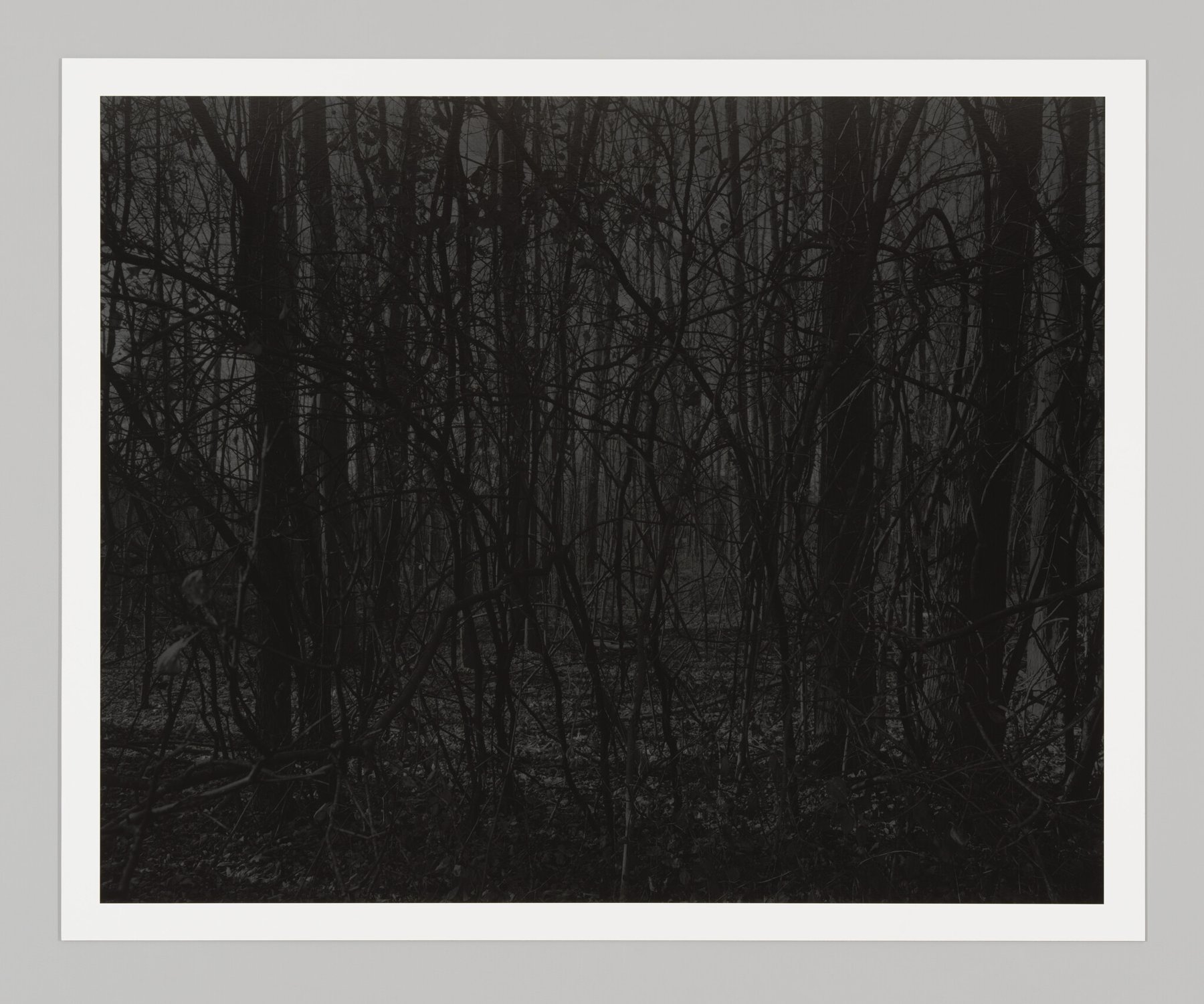
The Whitney Museum in New York holds one work from the series: Untitled #17 (Forest). The sheet is 48 × 59 inches, about 122 × 150 cm, with an image of 44 × 54 5/8 inches. It is number 4 in an edition of 6, acquired by the museum in 2020.
The picture shows a forest at night. Bare black trunks cross one another over a grey ground. No clear path. No light. The viewer stands before a print a metre and a half wide and is surrounded by that darkness.
The size is not for show. It puts the viewer in the right place: at the edge of a wood, at night, not knowing what lies ahead.
No picture in the series says which house or field sheltered whom, on which night. Bey does not try to prove anything or reconstruct events. He takes the viewer to those places, at that hour, and lets imagination do the rest. History here is told not through documents but through standing still in the dark long enough.
Tender darkness
The title comes from Langston Hughes's poem Dream Variations, written in 1926. In Hughes's poem night arrives gently, and its blackness is also the colour of the speaker. Darkness is not something to fear. It is a place of rest.
Bey sets that idea beside history. For those in flight, night was both danger and rescue. Danger because the way was hard to see and pursuers were near. Rescue because in the dark they could not be seen.
The dark, tonally rich printing is also a reply to the photographer Roy DeCarava, who pictured black life in Harlem and jazz musicians in low, grey prints where people emerge from shadow rather than being exposed by light. Bey carries that way of seeing into landscape.
Another series of the night, Trevor Paglen's The Other Night Sky, looks up to find what is hidden. Bey looks down at the ground, to find what had to hide in order to survive.
Photography