
Essays · Olfactory Art
Dieter Roth. Staple Cheese (A Race).
Time does not paint. It ferments.
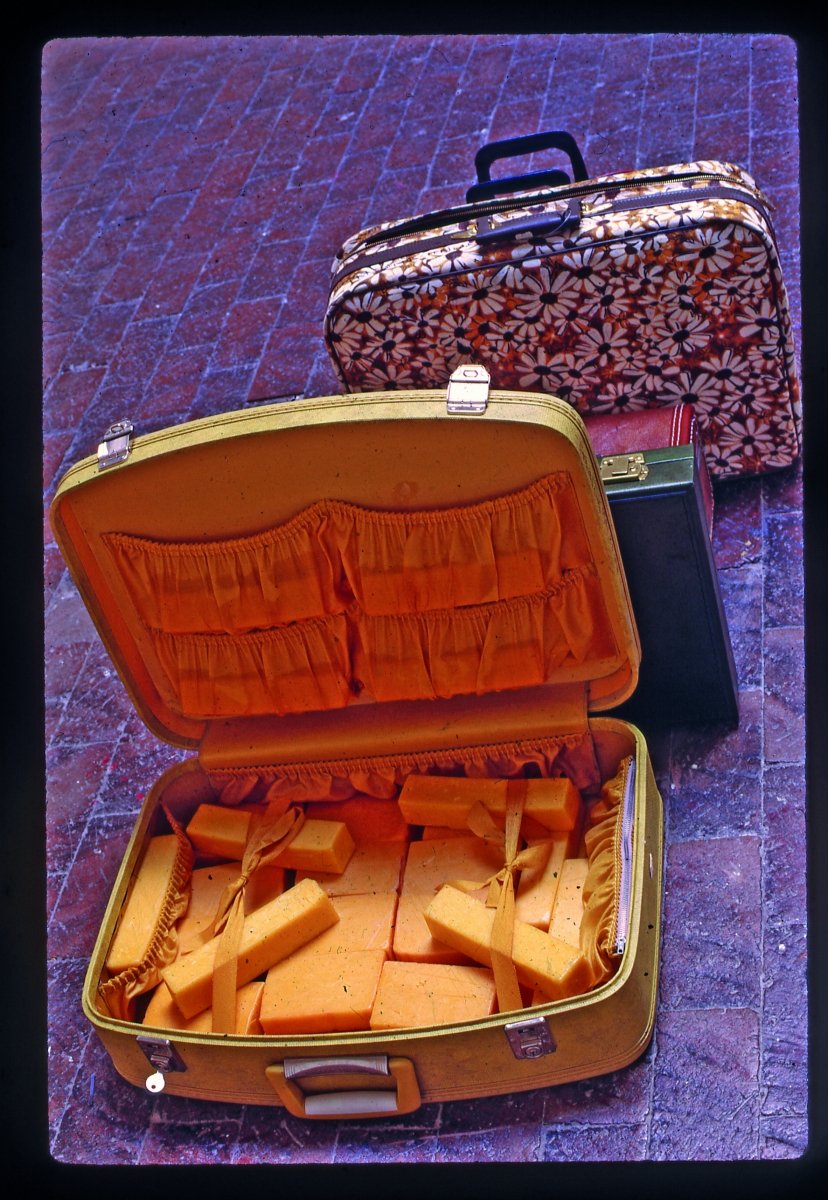
Dieter Roth, Staple Cheese (A Race), 1970, installation view, Eugenia Butler Gallery, Los Angeles (via La Belle Revue) · ArtReview
Thirty seven suitcases
In the spring of 1970, Dieter Roth made an exhibition at the Eugenia Butler Gallery in Los Angeles. The material was 37 suitcases. Each held a different kind of cheese. The suitcases were opened, set out in the gallery, and left alone for about a month.
The title was Staple Cheese (A Race). A race run not on legs but on the speed of decay: which cheese would soften, slump and seep onto the floor first.
Nobody ran the race. There was no referee. The warmth of a Los Angeles spring, the humidity, the kind of milk, the age of each cheese decided everything. Roth built the track and stepped aside.
The suitcase was not a random choice either. It belongs to travellers, to luggage, to journeys with a destination. In Roth's gallery the suitcases went nowhere. They lay open as if just set down in a station. The only thing still moving was the cheese inside: it flowed, it spread, it evaporated. Walking along the row was like walking beside a track, watching each slow runner edge toward the finish line of the floor.
This was a familiar method for him. Roth, a German born artist who lived for many years in Switzerland and Iceland, had used food as material before. He made sausages stuffed with shredded books, which he called Literaturwurst. For him spoilage was not an accident that happened to the work. It was a second author.
The smell goes out to the street
What happened was what anyone might guess. The cheese began to rot. Each kind rotted its own way, and the smells piled up in a closed room. Liquid leaked from the suitcases and spread over the floor. Flies arrived, then more flies.
According to ArtReview, city officials tried to shut the gallery down. Eugenia Butler held firm, defending the work with a simple argument: this is the life cycle. The gallery stayed open.
Roth is said to have gathered some of the dead flies and called them the exhibition's true audience. The story may be legend, but it says exactly what the work says. Visitors stayed a while and left. The flies stayed to the end.
Smell here is not a side effect. It is the part of the work that travelled farthest. The image lived inside four walls. The smell went through the door, out to the street, and reached people who never meant to see any art.
Against cleanliness
ArtReview places Staple Cheese in a line of contemporary art that confronts the ideology of cleanliness. Modernism loved white walls, spotless surfaces, rooms without smell. The museum is where objects are kept from changing.
Roth did the opposite. He brought into the white room exactly what the white room was built to exclude: rot, bacteria, insects, seepage. He did not break the walls. He let something alive spoil their silence.
The museum trade revolves around keeping objects unchanged. Roth asked: if a work changes every day, do we still need to keep it intact? And if its smell makes us want to leave, is that also a way of looking?
The question would return many times, with the flowers wilting behind glass in the work of Anya Gallaccio, with meat drying on a mannequin. But few works say it as loudly as thirty seven suitcases of cheese, over one spring month in Los Angeles.
Olfactory Art