
Essays · Olfactory Art
Reformulation. Is it still the same smell?
The name stays. The thing inside changes.
Why formulas change
People outside the trade tend to think of a famous perfume as fixed, like a painting in a museum. It is closer to a piece of music played again every year. Each production run is a new performance of the formula, with that year's materials.
Formulas change for many reasons. Some come from law: a substance is banned, restricted, or must be named on the label. Some come from supply: a failed harvest, a plant grown scarce, a supplier dropping an extract. Some come from cost. And some are simply that natural materials are never identical from one year to the next.
Not every change is large. Some are hard even for long time wearers to notice. Some make people say this bottle is no longer the one they loved. Between those ends lies a wide field, and everyone stands at a different point in it.
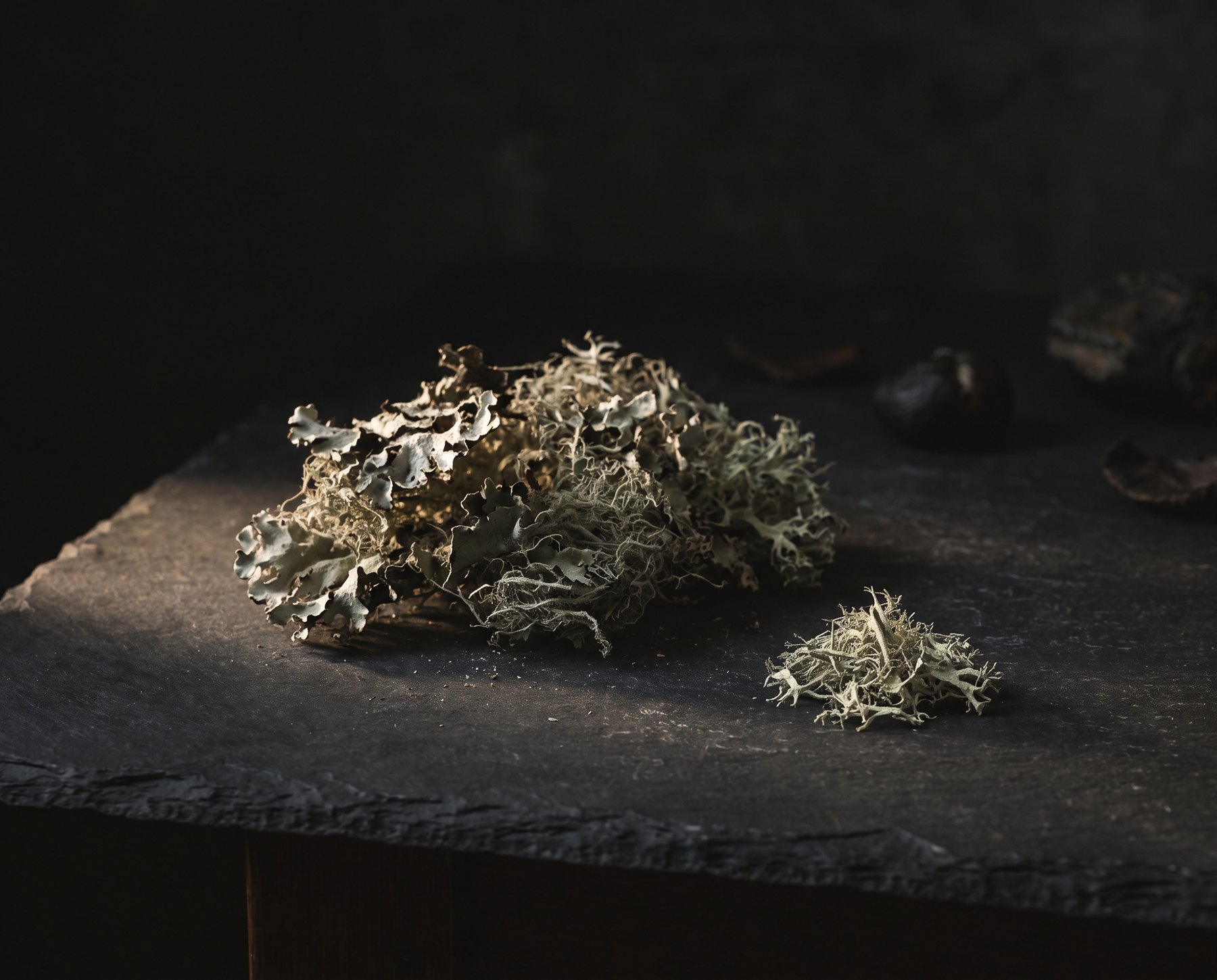
Oakmoss and atranol
Oakmoss is the clearest case. It is a classic material, damp and bitter, close to earth and bark, sitting at the base of two great perfume families, Chypre and Fougère.
On 2 August 2017 the European Commission adopted Regulation 2017/1410, prohibiting atranol and chloroatranol in cosmetics. Both occur naturally in oakmoss and treemoss extracts and are counted among the allergens behind the most skin allergy cases. From 23 August 2019 products containing them could no longer be placed on the European market; from 23 August 2021 they could no longer be made available. The standard of IFRA, the industry's international association, also requires oakmoss extracts to keep each substance below a very low limit.
The result is that oakmoss used today must be a low atranol grade, and many formulas replace part of the moss with synthetic woody and mossy molecules. The change has a sound reason. It is also why many people find that familiar bottles have shifted.
If formulas keep changing, where do the old ones go? In Versailles there is a place that answers. The Osmothèque, founded jointly by the French Society of Perfumers, the French Perfume Committee and the Paris Chamber of Commerce and Industry, describes itself as a place devoted to the memory of odours.
Its work is to catalogue existing and future scents and to find traces of great lost perfumes in order to bring them back to life. Such an archive keeps no paintings or books. It keeps things that evaporate, and so it needs constant care.
The story of Fougère Royale shows both paths at once. Houbigant's perfume, usually dated 1882, was one of the first built on synthetic coumarin. In 2010 Houbigant re-released Fougère Royale with a new formula. One name: one version in the archive, one on the shelf. Museum projects that reconstruct historical smells, such as Fleeting Scents in Colour at the Mauritshuis, walk the same line between original and remake.
The ship of Theseus in a bottle
Plutarch tells that the Athenians kept the ship of Theseus for a long time, replacing rotten planks with new ones. Philosophers asked: once every plank has been replaced, is it still the old ship?
A reformulated perfume is that ship. The bottle, the name, the label stay the same. The components inside are replaced one by one. Those who keep the name say it is still itself. Those who remember the old smell say it is not.
Penta does not think one side must be chosen. Perhaps the answer depends on how we measure sameness. Measured by name, the ship is the old one. Measured by material, it has changed. Measured by whether it still carries people across the water, the question opens in another direction.
One thing is certain: each version is the trace of the time it was made. That year's rules, that year's harvest, that year's choices. Smelling an old bottle beside a new one is smelling two moments.
Olfactory Art