
Essays · Olfactory Art
Edgar Calel. Ch'ablin nu rayb'el Chua taj ab'ej.
Stone keeps memory. Earth keeps smell.
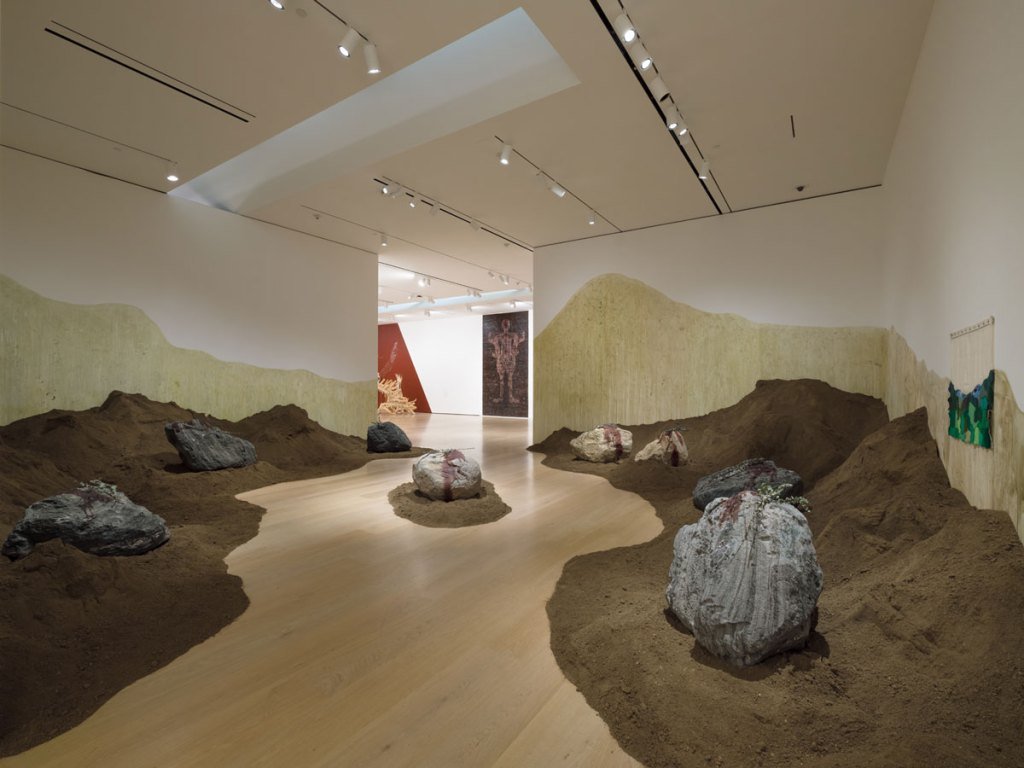
Installation view of "Several Eternities in a Day", 2026, Hammer Museum, showing an installation by Edgar Calel. Photo Jeff McLane · ARTnews
A mountain in the first gallery
In spring 2026 the Hammer Museum in Los Angeles opened Several Eternities in a Day: Form in the Age of Living Materials, on view from 5 April to 23 August. The exhibition gathered artists who work with living materials, things that change, decay, or keep transforming after the work is installed.
Visitors meet Edgar Calel first. He turned the opening gallery into a mountain landscape. Neat piles of brown earth with clear edges run along the base of the walls and lead visitors deeper inside. Among the piles sit boulders: banded sandstone and light, porous lava rock.
On the stones are offerings. Dried flowers. Dried eucalyptus. And pools of oxidised blood, turned dark. According to writing on the exhibition, the blood is the artist's own, the remains of a ceremony he performed on site.
The title is in Kaqchikel: Ch'ablin nu rayb'el Chua taj ab'ej, roughly, splashes of my desire on top of stones. It does not explain the room. It only says who left the traces, and where they lie.
The Maya Kaqchikel and the stones that remember
Edgar Calel was born in 1987 in Chi Xot, the Kaqchikel name for San Juan Comalapa, a town in the midwestern highlands of Guatemala. He still lives there. He comes from a family of Maya Kaqchikel artists and artisans. He draws, paints, installs, performs and sculpts, but each form returns to one source: the rituals and cultural heritage of the highlands where he grew up.
In the Maya Kaqchikel cosmovision, stone is not dead matter. Stones are sentient and hold the memories of ancestors. Placing an offering on a stone is therefore not decoration. It is a way of speaking with those who came before.
On the gallery walls Calel painted a mural in herbal and natural pigments. Its lines echo the shapes of the earth piles below. The two layers, real soil and painted soil, extend the mountain terrain across the room, a terrain writers on the show connect to Comalapa, the artist's hometown.
Calel has described his practice as one of sharing: sharing the landscapes of Guatemala and communal, ancestral memory, above all with Guatemalans who cannot return. Los Angeles has a large Guatemalan community. For many of them, the room at the Hammer may be the closest they come to standing on home ground.
The smell of earth after rain
What visitors register before any shape is the smell. Damp humus gives off a strong, familiar odour, like the ground just after rain. It fills the room and follows people along the path between the mounds.
Museums rarely allow smell. Air is filtered, humidity held steady, everything cleaned so the work does not change. Calel brings in exactly what museums usually keep out: soil, blood, dry leaves, moisture. These materials keep changing through the run of the show. The blood darkens. The leaves dry further. The earth settles.
That is why the work fits the exhibition's theme. It is not a fixed image. It is a place still happening, slowly, over months. Smell is the clearest proof: it exists only while the material is alive.
Like Otobong Nkanga's wall, which holds materials history would rather forget, Calel's mounds hold a memory that distance has blurred. Visitors need no Kaqchikel. They only need to walk slowly between the mounds and let the nose lead. The stones remain. The soil breathes. The ceremony is over, but its traces are not.

Olfactory Art