
Essays · Olfactory Art
Otobong Nkanga. Anamnesis.
The smell of a commodity outlasts its label.
Art in America · Art in America
A crack in a white wall
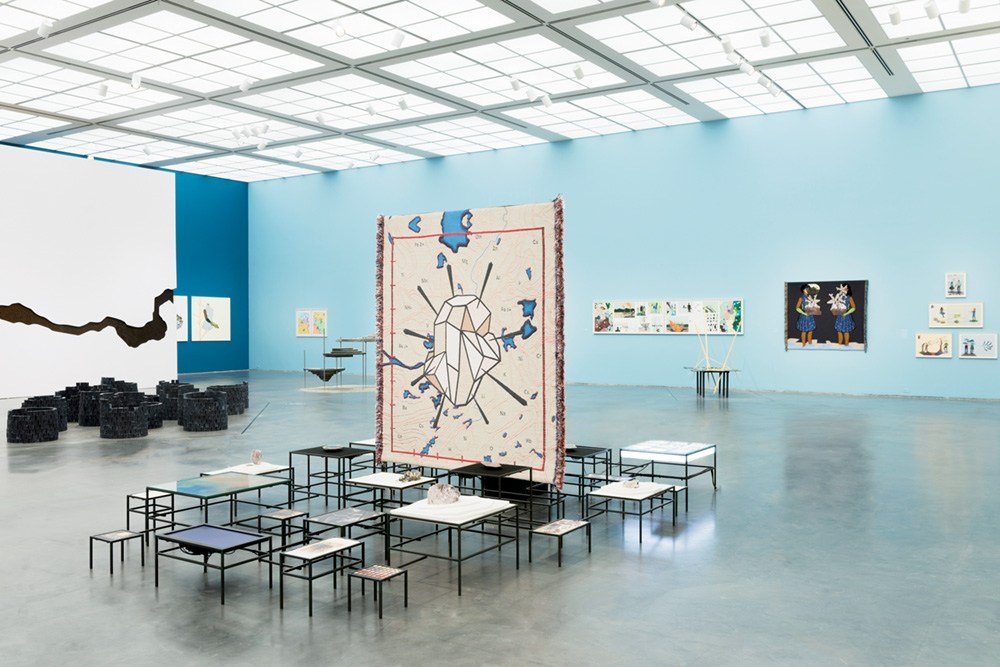
In 2018 the Museum of Contemporary Art Chicago opened Otobong Nkanga: To Dig a Hole That Collapses Again. It ran from 31 March to 2 September in the Bergman Family Gallery, curated by Omar Kholeif. It was a major solo exhibition of Nkanga's work in the United States.
Among the rooms stood a white wall. Along it ran a fissure, not straight like a cut but rough, as if the wall had really broken. Nkanga packed the fissure with material: coffee, tea, peat, tobacco, cacao and spice.
The colour inside the crack was uneven. It moved gradually from dark to light, from the near black of coffee and peat to paler tones. From a distance it read as a band of colour across the wall. Up close it became a band of smell.
The work is called Anamnesis. In ancient Greek the word means recollection, calling back something once known and then forgotten. There was no long label. Only the wall, the fissure, and what lay inside it.
Things that passed through many ports
Each material in the wall has a history longer than the cup or cigarette in anyone's hand. Coffee, tea, cacao, tobacco, spices such as clove: these are the commodities that built trading empires. They were grown in one place and consumed in another, and the distance between the two was filled with plantations, merchant ships and the labour of a great many people.
Nkanga was born in 1974 in Kano, Nigeria, and lives in Antwerp, Belgium. Much of her work turns on one question: how are soil, minerals and crops taken out of a land, where do they go, and what is left behind? She draws, weaves tapestries, builds installations, performs. The Chicago show also included The Weight of Scars, In Pursuit of Bling: The Transformation, Infinite Yield and Carved to Flow, a soap project she began in 2017.
Anamnesis belongs to the same line of thought, but it travels through the nose. Instead of picturing extraction, Nkanga sets the goods themselves into the wall. You do not need to know trade history to recognise coffee. Once you have, the question arrives by itself: why are these things lying in a crack?
When a museum has a smell
Art museums usually have no smell. White walls, clean floors, conditioned air. The neutrality is deliberate; it wants each work to stand alone.
Nkanga breaks it in a very small way. She sprays nothing into the room. She simply lets the materials sit in the wall and give off their own smell. Coffee smells of coffee. Tobacco smells of tobacco. Peat smells of damp earth and old smoke. Nothing is built in a laboratory.
So the smell in the room does not hold still. It shifts with temperature, humidity, the number of people passing. The materials dry and fade over the months. The work ages with the exhibition.
Smell also changes how the visitor stands. Before a painting, one steps back to see. Before Anamnesis, one steps in, leans close, breathes. The visitor's body becomes part of how the work is read.
Remembering through the nose
What Nkanga offers is not a story but a way of remembering. Colonial history lives in books, figures, maps, and those can be folded up and put away. Smell is harder to fold. Every morning millions of people make coffee or tea without a thought for where it came from.
Anamnesis ties that familiar smell to a crack. After leaving the room, the visitor still drinks coffee as before. But some morning the smell in the cup may call back the white wall split in two. That is when the work does what its name says.
The fissure is not sealed. It is filled. Nkanga does not propose erasing the wound; she asks us to look at it, and smell it, directly. The same concern runs through another work by Nkanga, where material and land are again set side by side.
Olfactory Art