
Essays · Olfactory Art
Otobong Nkanga. Beacon: Prominence.
Fire passes. The smell stays.
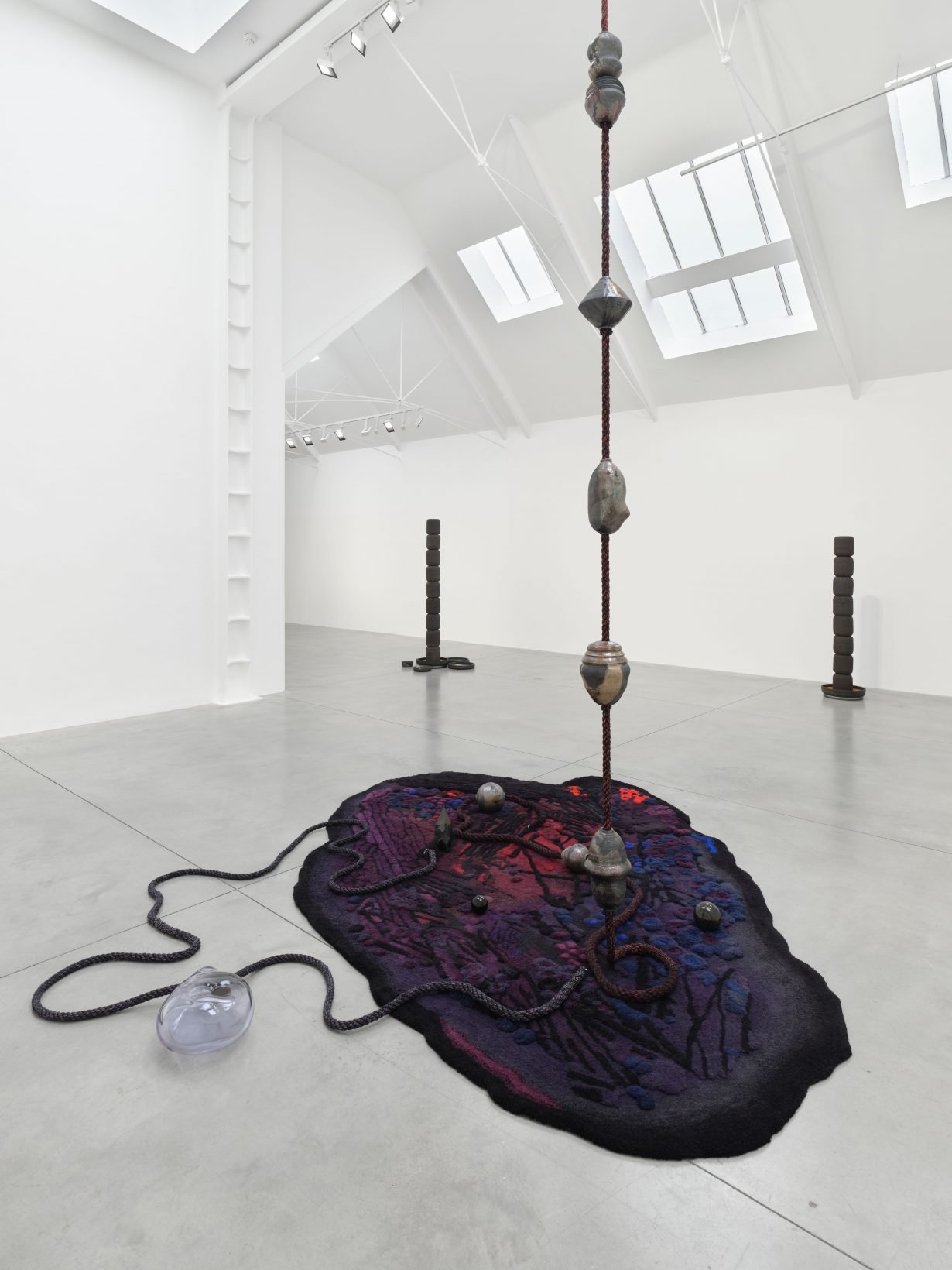
We Come from Fire and Return to Fire, 2024 (installation view). © the artist. Courtesy Lisson Gallery, London · ArtReview
Three beacons
In summer 2024, Lisson Gallery in London opened We Come from Fire and Return to Fire by the Nigerian artist Otobong Nkanga. It was her first solo show at the gallery, running from 24 May to 3 August.
The room held three works titled Beacon, all from 2024. Each is a tall ceramic form resembling a scorched palm trunk. The surfaces are black, cracked, carbonised. From a distance they look like what remains of a forest after a great fire.
A beacon is a fire lit high to send a signal far away. Here the fire has gone out. What remains is the trunk, and the message must be read from the burn itself.
At the foot of each form Nkanga placed vessels of steel and ceramic. In Beacon: Prominence they hold dried medicinal plants, among them lavender.
Offerings at the base
The placement suggests offerings. The vessels are not on plinths. They sit on the floor, close to the burnt trunk, like something brought to remember or to ask.
From a distance a visitor sees only a black mass and a few small objects. Only up close does the smell arrive. Dried lavender is not strong; it does not fill the room. It stays in a small circle around the base.
Lavender and other medicinal plants have long been gathered, dried and stored across many cultures. They belong to the care of bodies, to houses, to linen cupboards. Placing them at the foot of a burnt tree, Nkanga sets two things side by side: destruction and care.
No text explains the relation. The work lets the visitor stand between the black form and the smell of dried leaves, and connect them alone.
Earth, mineral and fire
Other works widen the story. The title piece is a hand braided rope threaded with smoked raku beads, descending from the ceiling onto a hand tufted rug in ashy blue, purple and volcanic red. Stones such as shungite and tourmaline rest on the rug.
Sunburst is a textile over three metres long, with a circle like a sun or an atom and branching lines like empty roads across a landscape. In the basement, under red light, is the sound work Wetin You Go Do? Oya Na, with several voices in Nigerian Pidgin. Its title means: what are you going to do? It's time.
Nkanga has long worked with land and what people take out of it: minerals, stone, metal. Her work often asks the cost of that extraction, for the land and for those who live on it. In this show the question gains another material: fire, the wildfires drawing ever closer to daily life.
Sound is another strand of her practice; Wetin You Go Do? is the work to spend more time with those voices.
A small smell among the ash
What makes Beacon: Prominence memorable is scale. The ceramic form is large, black, heavy. The smell is small, light, close. On one side, a disaster visible from across the room. On the other, something only those who bend down will notice.
The work does not promise that the plants will save the forest. It only places them there. One can read it as hope, as memorial, or as a reminder that burnt ground can still grow again.
Nkanga does not choose one reading. She lets the smell do its part: entering the visitor quietly, and staying longer than the image of the black trunk.
Olfactory Art