
Essays · Olfactory Art
Edmond Roudnitska. Perfume as an art.
A garden as a place to observe.
Cabris: a garden as a place to observe
Cabris is a small hill village in the Alpes Maritimes, looking down over the flower growing land around Grasse. Around 1948 Edmond Roudnitska moved there. He set up a workroom and made a garden.
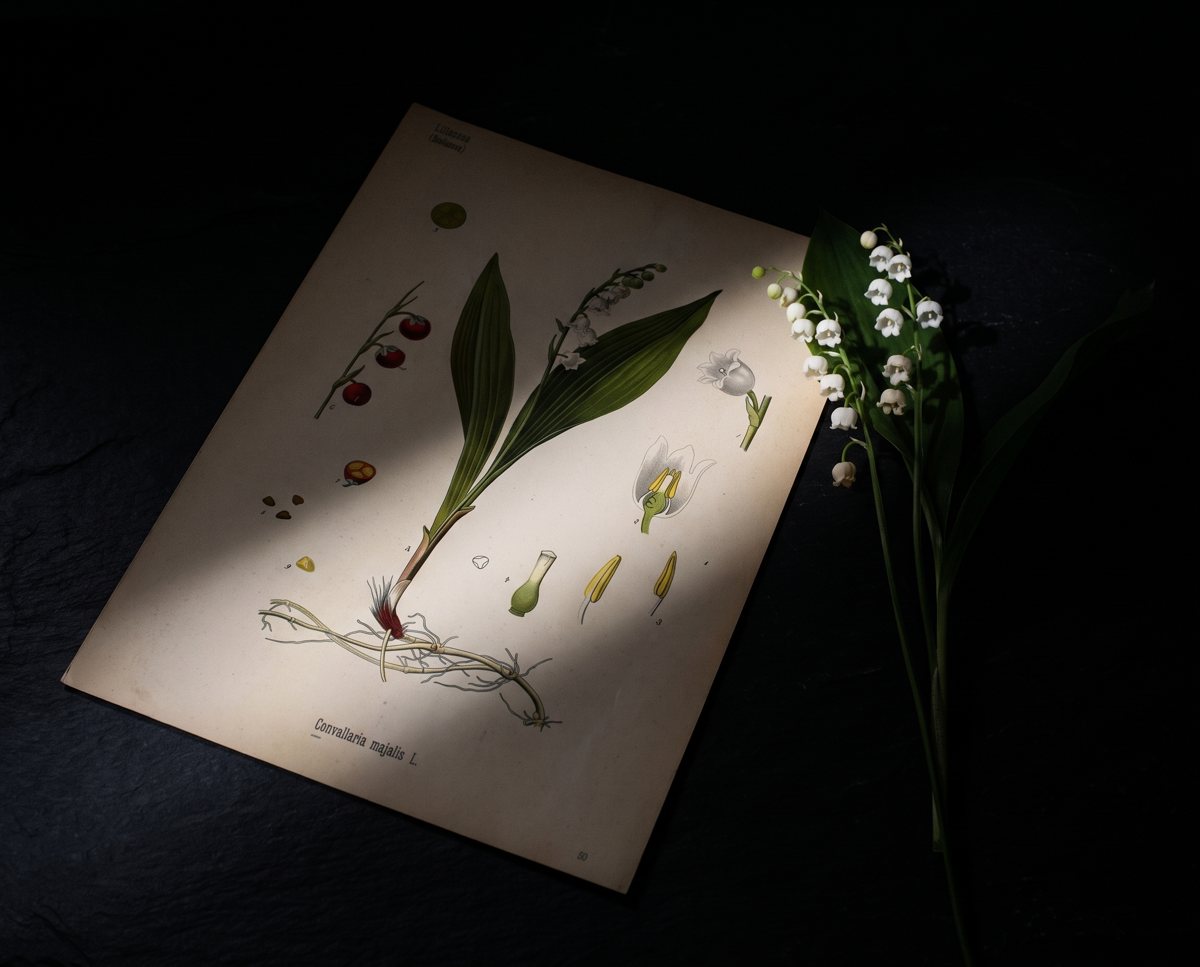
The garden was not for looking at. It was a place for testing. He planted lily of the valley, the small white bell shaped flower of spring. For anyone making smells, lily of the valley has one peculiarity: it yields no oil. There is no way to distil or extract its smell for use. Every lily of the valley in a bottle is rebuilt, from other materials, by memory and by the maker's senses.
Roudnitska chose not to rely on memory. He grew the flower so the real thing would be beside him. Each time he tried a formula, he held it up against the lily in bloom. But the lily flowers only briefly each year. So his work was tied to the plant's calendar: a few weeks a year for comparing, then a wait until the next spring.
The method says something. For Roudnitska, the maker of smells was first of all an observer. A formula had to answer to a real thing.
Diorissimo and Eau Sauvage: two exercises in restraint
Those lily seasons led to Diorissimo, launched in 1956 for the house of Christian Dior. The context: post war perfumes tended to be heavy, full of musk, amber and powder. Roudnitska wanted something lighter. According to his son Michel Roudnitska, speaking to Nez magazine, the Diorissimo formula was notably short compared with those of its time.
Michel also describes a mutual respect between Roudnitska and Christian Dior. Dior visited Cabris when he came south. Diorissimo was accepted fairly quickly, without many rounds of revision.
Ten years later, in 1966, Roudnitska made Eau Sauvage for Dior. It is a cologne, the light citrus form that goes back to the eighteenth century. He rewrote it with a material new at the time: Hedione, a molecule Firmenich found through research on jasmine, which gives a sense of brightness and space. Eau Sauvage is usually cited as the first commercial perfume to use Hedione at a significant level.
Two different smells, one floral, one citrus. Both go the same way: take away, and let the thing breathe.
A perfumer writing about aesthetics
Roudnitska did not only make smells. He wrote. In 1977 the publisher PUF printed his L'Esthétique en question, a book on aesthetics. In 1980 he wrote the volume Le Parfum in the same publisher's short Que sais je? series.
His point was direct: a smell can be a work, and should be judged as one. The maker has form, choices, intentions. The person smelling can learn to perceive those things, as a viewer learns to look at a painting.
At the time this was not a common view. Perfume was seen as the business of houses, tied to commerce and fashion. A perfumer writing about aesthetics was placing his craft in a different conversation. In an Osmothèque lecture he was introduced as a perfumer who was both aesthete and philosopher.
Smell as a work: what Roudnitska left
Decades later his questions remain. Museums began to show smells. Perfumers' names began to appear next to fashion houses. Artists work with smell as a material, with no bottle and no label.
Not all of that came from him. But he was among the first to say, in writing, that smell deserves to be looked at this closely.
What Penta remembers most is still the garden. Penta pictures a man standing among lilies of the valley, holding a paper strip, raising it to his nose, bending to smell the flower, raising the strip again. A few weeks each year. The work begins with being willing to look at a thing until one understands it.
Olfactory Art