
Essays · Olfactory Art
Ernest Daltroff. Smoke on a glove.
Smoke passes; the object keeps it.
Caron, 1904: a small perfume house in Paris
Caron began in Paris in 1904. Its founder was Ernest Daltroff. Caron's history page today describes him as very open minded, of boundless curiosity, and says he came to perfume through a love of flowers.
Beside him was Félicie Wanpouille, whom the house credits with an extraordinary intuition. The two worked together. In Caron's own telling, the house is the work of both.
In the early years Caron made powders as well as perfumes. In 1908 came Pompon Poudre, a rice powder scented with Bulgarian rose. In 1911, Narcisse Noir, which the house calls its first great success. In 1916, in the middle of the First World War, N'Aimez que Moi, rose and cedarwood.
It was a small house, not attached to a couture label, with no clothing collection behind it. Perfume was its main work.
Tabac Blond, 1919: tobacco and leather
In 1919, a year after the war ended, Caron launched Tabac Blond. The name means blond tobacco, the light coloured, milder leaf as opposed to dark tobacco.
According to the house, Daltroff made it as a tribute to the new women of the time, the ones English called flappers: short hair, short skirts, smoking in public. After the war, a woman lighting a cigarette in a crowded room became a sign. It said the old era was over.
Caron describes Tabac Blond as an ambivalent accord of leather and carnation, and calls it the first leather scent. That is the house's claim and should be read as such. What is clearer is the direction: Daltroff did not bottle a flower to hide the smoke. He bottled the world around the cigarette.
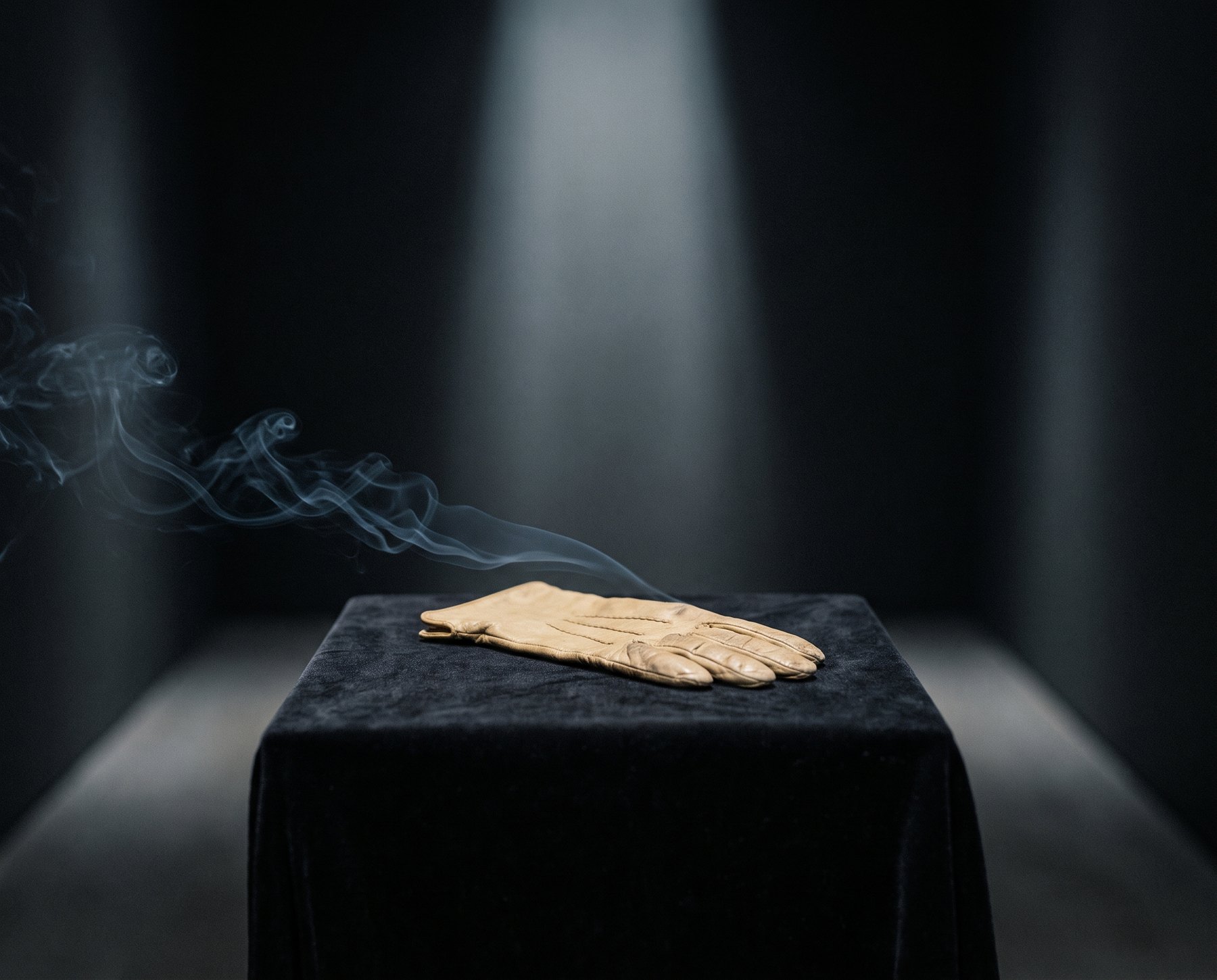
Penta notices the leather. Women then wore gloves. A leather glove holding a cigarette every day would keep smoke in its grain. No record says Daltroff was thinking of the glove. But the smell he made, warm leather beside dry tobacco, is closer to that glove than to any other object.
Narcisse Noir, En Avion and the smells of Caron
After Tabac Blond, Caron kept making smells tied to particular people of their time. In 1932, En Avion was composed for the aviator Hélène Boucher. In 1933, Fleurs de Rocaille, a floral with aldehydes. In 1934, Pour un Homme, lavender and vanilla, which the house calls the first men's perfume.
Seen as a list, a method appears. Each smell starts from a person or a gesture: a woman smoking, a woman flying, a man. The smell does not describe the person. It describes the air around them.
In the early 1980s Caron was also, by its own account, the first house to let customers refill bottles in store. A small detail, in the same spirit: a bottle is an object to keep, not to throw away.
Smoke on cloth: an object keeps a trace of a person
Smoke is a strange thing. It has no fixed shape, does not stay still, disperses quickly. But it clings. It settles in curtains, in hair, in coats, in books kept near the fire.
So we often recognise that someone smoked not while they are smoking but afterwards, through the things they leave. A scarf. A notebook. A pair of gloves. The object becomes a witness.
Tabac Blond was made more than a hundred years ago. The women it was made for are gone. But the smell of leather and tobacco still holds one of their gestures: the gloved hand, the cigarette, the room. That is what Penta looks for in every smell. Not the beauty of the thing, but the trace a person left on it.
Olfactory Art