
Essays · Photography
Lisa Oppenheim. Smoke.
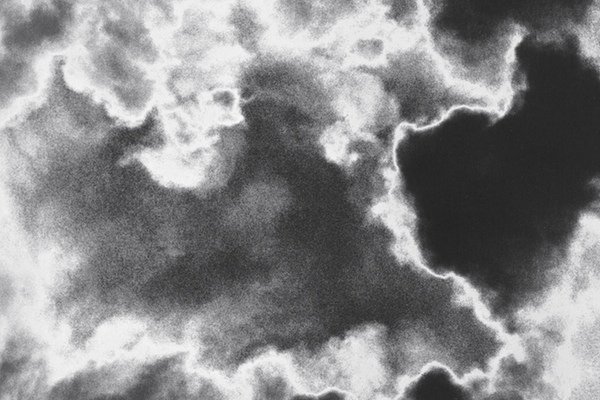
Smoke printed by the fire that made it.
Aperture · Aperture
Smoke in the archive
Lisa Oppenheim works with photographs that already exist. She searches archives, the press, images others made long ago, and puts them through a new process. For Smoke, made in 2011 and 2012, she looked for photographs of fires.
The sources span nearly a century. A picture of an oil field explosion in 1913. Aerial surveillance images from the Second World War. Journalists' photographs of the 2011 riots in north London.
Oppenheim did not keep these images whole. She isolated one detail: the smoke. Buildings, people, ground were left behind. What remained were grey forms rising, with no sign of where they came from, what year, what disaster.
Cut from their context, the smoke of a war and the smoke of an industrial accident look almost alike. Both billow, spread, thin at the edges. Oppenheim sets them side by side like specimens of one species. The question of cause steps back. What remains is the shape of something disappearing, and the question of how to hold it on paper.
Printed by matchlight
The isolated sections were turned into digital internegatives. Then the process returned to the darkroom. But instead of an enlarger lamp, Oppenheim exposed the paper with real flame: matches, a kitchen torch.
Firelight is uneven. It flickers, it is hot, it is hard to predict. In the process the images were solarised, some tones reversing, leaving shining silver areas beside deep blacks. The final prints look almost metallic.
Writing about Oppenheim in Aperture in 2013, Brian Sholis compared these prints to polished silver outtakes from Alfred Stieglitz's Equivalents, the famous cloud pictures of the early twentieth century. Her smoke does resemble cloud. But Stieglitz's clouds were sky, and her smoke is the trace of something burning on the ground.
What matters is the loop. Smoke comes from fire. A photograph records the smoke. Then fire is used to print that photograph. The image and the material that makes it become one.
The right kind of light
Smoke does not stand alone. It belongs to a sequence of works around one question: if a photograph is made of light, what happens when it is printed with the very light it records?
In 2010, for Lunagrams, she used nineteenth century glass plate negatives of the moon by John and Henry Draper, and exposed copies under moonlight in the matching lunar phase. In 2011, for Heliograms, she took a photograph of the sun made on 8 July 1876 and exposed it to sunlight at different times through the year. Her schedule was irregular, so the exposures were too, and that irregularity became part of the work.
Moon prints moon. Sun prints sun. Fire prints smoke. Each time Oppenheim returns an image to its own source of light. The Aperture piece describes her aim as recovering the magic of the photographic process, something easily forgotten once images are everywhere.
Looking at a Smoke print, we do not know which fire produced it. But we know one thing for sure: the paper in front of us was once very close to a flame.
Photography