
Essays · Olfactory Art
Peter de Cupere. Smoke Cloud.
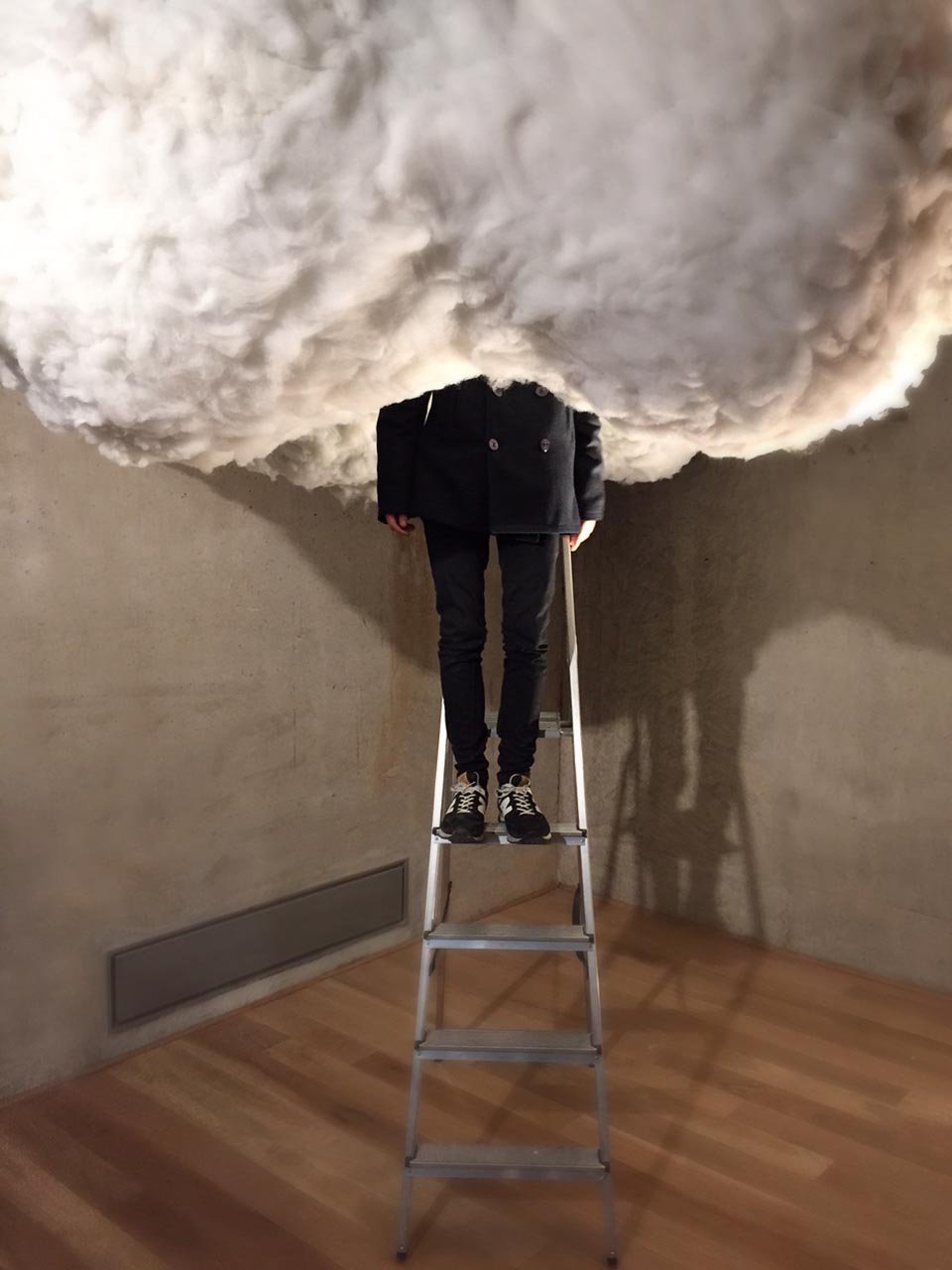
Inside the white cloud is the smell of the street.
© Peter de Cupere · Peter de Cupere (official artist site)
A cloud with a ladder
Smoke Cloud is an installation by Peter de Cupere, a Belgian artist who has worked with smell for more than twenty years. The work dates from 2013. Its form is almost childlike: a white cloud hanging in a gallery.
But the cloud is not only for looking. Beneath it stands a ladder. Visitors are invited to climb and push their head through an opening in the middle of the cloud. Once inside, they are surrounded by white and by a smell they did not expect: polluted air, car exhaust.
That is the whole mechanism. A gentle image outside. A familiar, unpleasant smell inside. You have to climb up to find out.
The climb matters. No one is forced to smell anything. Visitors step in willingly, and only then discover what they stepped into. Curiosity takes them up. The smell brings them back to earth.
The smell changes with the city
Smoke Cloud has travelled. In 2015 it was part of The Importance of Being… at the Museo de Arte Contemporáneo in Buenos Aires, from 17 July to 12 September, a show of some forty Belgian artists across disciplines, introducing Belgian contemporary art to South America. The exhibition then moved on to Rio de Janeiro from late 2015 into early 2016.
According to accounts of the work, the cloud has also been shown in other South American cities and in the Netherlands, and De Cupere adjusts the intensity of the smell to each place. In the Netherlands it is the filtered exhaust of newer cars. In Havana, where old American cars still fill the streets, it is far heavier.
That detail changes how the work reads. Smoke Cloud does not carry a generic smell of pollution. It carries the pollution of the place where it hangs. Visitors in each city meet the air they just walked through on the way to the museum, only denser, and shut inside a white shape.
So the cloud is not an abstract symbol of the environment. It is a sample. A slice of local air, set at nose height.
What we no longer smell
Exhaust is one of the most familiar smells of city life. So familiar we barely register it. The nose adapts fast. After a few minutes outside, the smell sinks into the background and stops being information.
Smoke Cloud turns it back into information. By placing it where no one expects it, inside a white cloud in a clean gallery, the work makes visitors smell again what they had stopped noticing. As the work is usually described, the aim is to wake people up to a problem they live with every day and no longer see.
The cloud is no accident either. We link clouds to clean sky, water, lightness. In many cities, the cloud overhead may also be smoke, dust, haze mixed with exhaust. The work does not need to explain this. It offers a cloud and a nose.
Smoke Cloud proposes no solution. No charts, no slogans. It ends when the visitor pulls their head out, climbs down, and finds the air in the room somehow different. Perhaps the air has not changed. Only their nose, for a few minutes, has been given its attention back.
Olfactory Art