
Essays · Photography
Mike Mandel and Larry Sultan. Evidence.
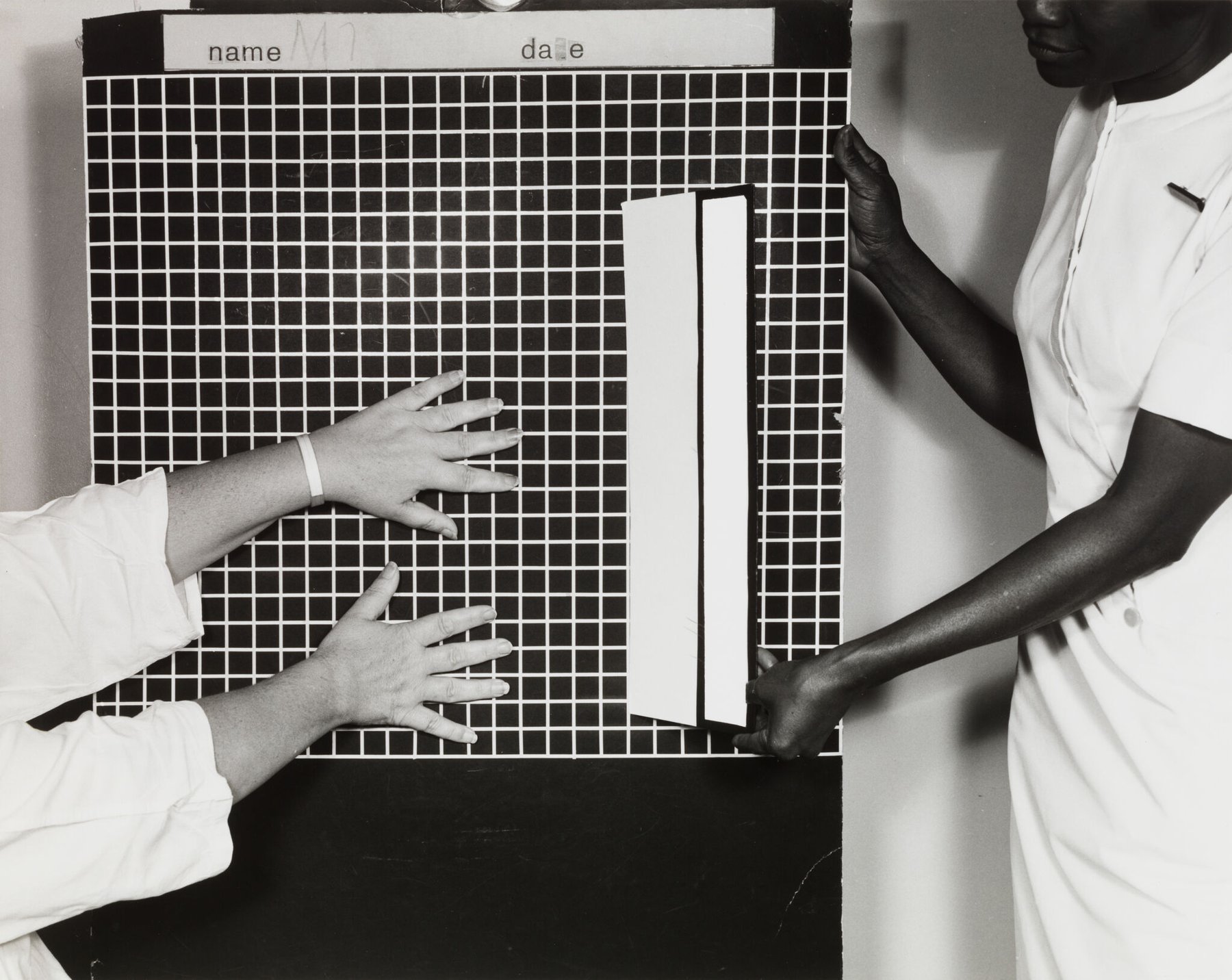
Remove the caption, and evidence becomes a question.
© Mike Mandel and Estate of Larry Sultan · SFMOMA
Two people in the archives
In the mid 1970s, two young California photographers, Mike Mandel and Larry Sultan, began approaching a long list of government agencies, universities and companies across the United States. They asked to see their photo files. Not art photographs, but working pictures: images made to record an experiment, a scene, a machine test.
The places they reached read like a map of technical America at the time: the Jet Propulsion Laboratory, the San Jose Police Department, the United States Department of the Interior, the General Atomic Company, and many other institutes and businesses. They went through an enormous mass of images, box by box, file by file.
From that, they chose 59. In 1977 those 59 pictures became the book Evidence, shown the same year at the San Francisco Museum of Modern Art. SFMOMA later acquired prints from the project, including gelatin silver prints of 8 by 10 inches, which entered the collection in 1993.
Not a single caption
Mandel and Sultan's most important decision was a subtraction. They removed every caption. No source, no date, no purpose. The reader turns the pages and sees only pictures.
And the pictures are strange. People in work clothes stand beside equipment of no obvious use. Objects are placed in odd positions. Empty outdoor scenes carry the marks of some intervention we cannot guess. Each once had a plain explanation in its original file. Taken out of the file, they look like scenes from a dream, or a play without words.
This is what makes Evidence so compelling. These images were made to be strictly objective. Whoever took them was not thinking of composition or feeling, only of recording. Yet removed from context, that very objectivity produces the most surreal effect.
The sequence helps. Mandel and Sultan placed the pictures so that they suggest connections that do not exist. A machine on the left page seems to watch a person on the right. The reader starts to build a story, knowing there is none.
Evidence of what
The title carries a little irony. Evidence is supposed to prove something specific. Here it has lost the thing it was meant to prove. It proves only that someone, somewhere, stood before a scene and pressed the shutter.
In that way the work asks a large question about photography: does the meaning of a picture live in the image or in the words beside it? If removing a few lines of text can turn a document into a riddle, perhaps much of what we think we see is really what we are told.
Evidence also belongs to a wider current of 1970s art, when many artists turned to found photographs and existing material instead of taking their own. The artist was no longer necessarily the maker of images. He could be the one who selects, arranges and questions images that already exist.
Why this small book is still remembered
Nearly half a century later, Evidence is still often named among the most important and most puzzling photobooks. It contains no picture taken by its authors and not one line of explanation. Yet it changed how many people look at a documentary photograph.
A few years later, Larry Sultan turned to a much closer archive: the home movies and albums of his own parents, in Pictures from Home. Evidence makes strangers mysterious. Pictures from Home makes family strange. The materials could not be more different, but the doubt is the same: how truthfully does a picture speak.
Evidence does not answer. It leaves 59 scenes, each one a question printed on paper.
Photography