
Essays · Photography
Larry Sultan. Pictures from Home.
A family photo is a story everyone agrees to tell.
© Estate of Larry Sultan · SFMOMA
A son comes home
In the early 1980s, Larry Sultan began a project that sounds simple: photographing his parents. They lived in Southern California, first in the suburbs of Los Angeles, later in a house near Palm Springs. Sultan travelled up and down the California coast, staying a few days each time, camera in hand.
The project ran from 1983 to 1992. It became the series Pictures from Home and a book of the same name, published in 1992. In the book, Sultan's large colour photographs sit beside stills from old home movies, fragments of conversation, his own writing and family memorabilia.
The subject is his parents and their pursuit of the American dream in suburban houses: lawn, pool, carpeted living room, television. The deeper subject is family photography itself. How a family tells itself in pictures, and what is left outside the frame.
The mother poses
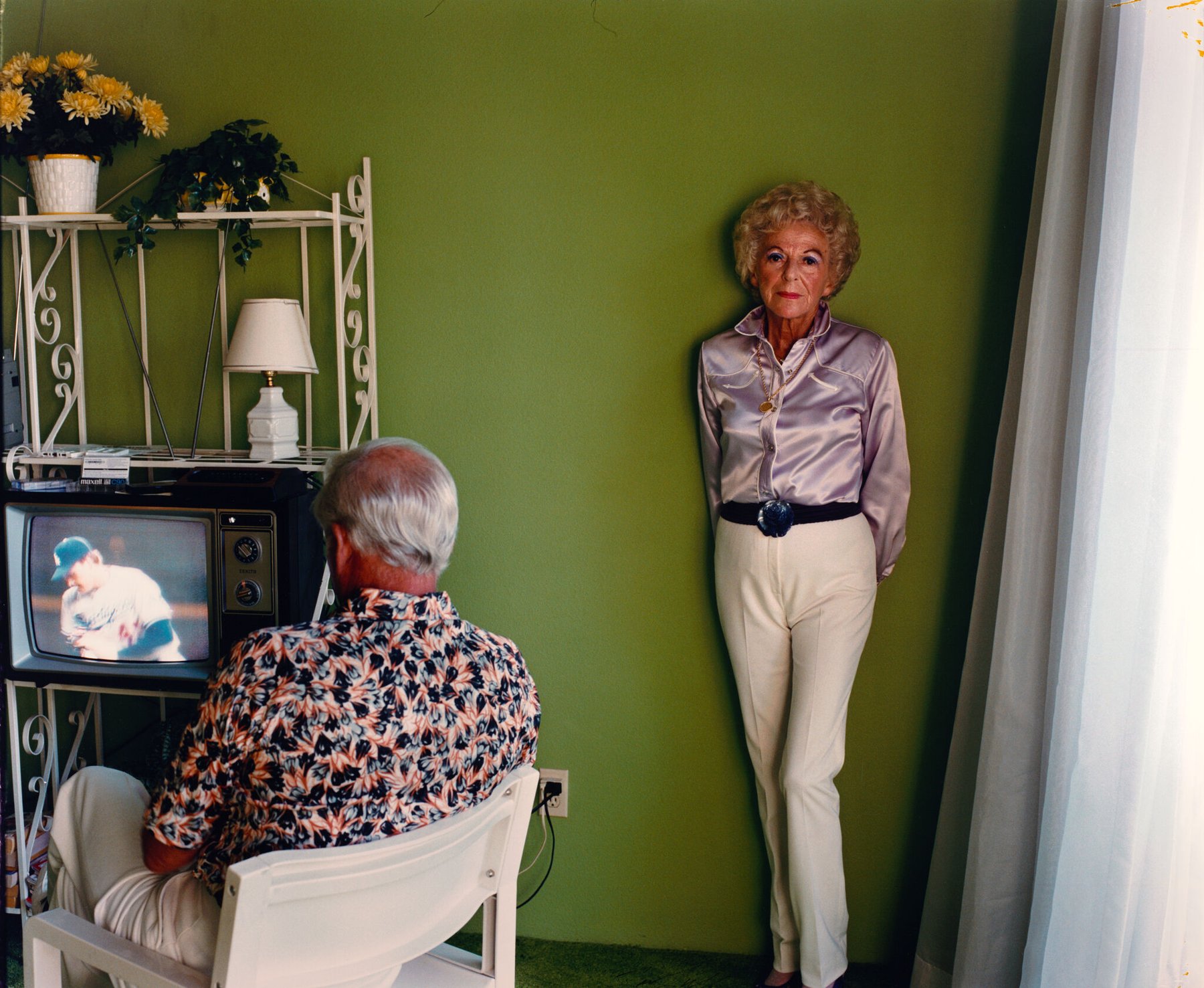
The San Francisco Museum of Modern Art holds one image from the series: My Mother Posing for Me, 1984, a chromogenic print about 72 by 87 centimetres.
The title says almost everything. A mother is posing for her son. It is not a moment caught but a moment arranged, and both people know it. The picture records two things at once: a woman in her own home, and her self awareness before the lens.
Sultan did not hide the staging. He described working with his parents as a way to break down the line between reality and fiction, between private and public. His pictures stand between the two: not quite document, not quite theatre.
At first glance they show an ordinary family. The longer one looks, the more unease appears. A hand placed a little stiffly. A gaze that drifts away. A gap between two people standing side by side. The real story passes through these small details.
Two layers of time
The most striking part of Pictures from Home is the stills from home movies. They were shot when the children were small: birthdays, holidays, afternoons in the yard. Everyone smiles at the camera. Everything is bright.
Beside those frames, the photographs Sultan took decades later have another tone. His parents have aged. The house is quieter. The father, now retired, has more time at home than ever and seems unsure what to do with it.
The two layers talk to each other. The home movie is the story the family wanted to tell about itself. Sultan's photograph is the story the son sees on his return. Neither is simply true. Both are constructions.
Then there is a third layer: the parents' own voices. In the book they comment on their son's pictures, and they do not always like how they are shown. The work keeps those disagreements. It is less a portrait of parents than a record of a conversation about who gets to tell the story.
Why this album matters
Family photography is usually seen as private and amateur, not the stuff of museums. Sultan took exactly that material and showed how complex it is. Every family album is a small myth, built from what is chosen to be photographed and what is chosen to be forgotten.
Earlier, Sultan and Mike Mandel had made Evidence, a book assembled from archive photographs of scientific agencies and police, shown without captions. The two projects move in opposite directions. Evidence takes pictures of strangers and makes them mysterious. Pictures from Home takes the closest people and makes them strange. Both ask what a photograph really proves.
Pictures from Home gives no firm answer. The picture proves that one afternoon, in a living room in California, a mother stood still for her son. The rest the viewer fills in.
Photography