
Essays · Olfactory Art
Lily of the valley. A flower that yields nothing.
To know it, you have to stand beside it.
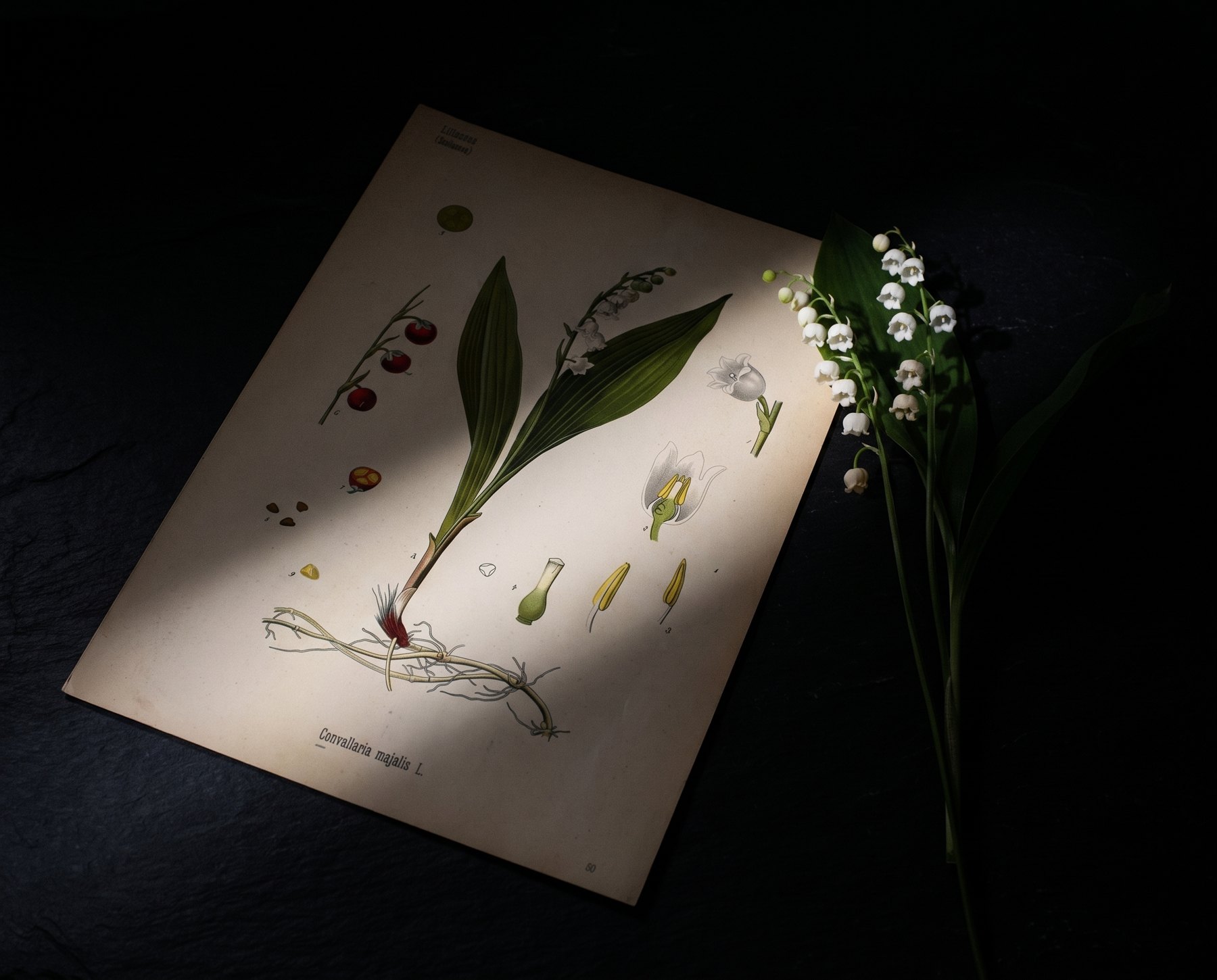
A flower that yields nothing
Lily of the valley, Convallaria majalis, is a small plant of temperate woodland floors. Each stem carries a row of white bell flowers bowing toward the ground. It blooms in late spring, for a few weeks, and then stops.
Its smell is easy to recognise: cool, clean, a touch of new leaf, a touch of honey. Stand near a patch and you notice it at once. But extract the flower and almost nothing comes out. There is too little scent material, and what can be taken does not hold the smell the nose finds in the garden. No lily of the valley extract of any importance exists in trade.
Perfumers have long known this. G. W. Septimus Piesse, in the 1857 edition of The Art of Perfumery, gives no method for extracting it. He gives an imitation instead: extracts of tuberose, jasmine, orange flower, vanilla, cassie and rose, with a few drops of almond oil. One flower painted with seven others.
That is where every lily of the valley in a bottle begins: with an absence, and an effort to fill it.
Rebuilt from molecules
When organic chemistry entered perfumery, lily of the valley was among the first flowers rebuilt from molecules. Hydroxycitronellal, made from citronellal by adding water across the molecule, is one of the oldest synthetic muguet materials. It smells soft, sweet and slightly green, close to lily of the valley and linden blossom.
Others followed. Givaudan's Lilial, clean and a little powdery. IFF's Lyral, soft and long lasting. They were cheap and stable and went into countless products, from perfume to detergent. For decades much of the lily of the valley people smelled in daily life came from these two molecules.
None of them was extracted from the flower. They are brushstrokes, chosen because they resembled it, kept because they were convenient.
Diorissimo: a flower painted again
In 1956 Dior launched Diorissimo, composed by Edmond Roudnitska. It speaks almost only of lily of the valley, the flower Christian Dior loved. Roudnitska had no lily of the valley oil to work with. He had to build the flower from other things, so that the wearer would believe they stood in a garden.
Diorissimo is often named among the finest lilies of the valley ever made. What stands out is that its beauty is entirely constructed. Not one drop came from the flower. It is like a portrait so close to life that the viewer forgets the sitter was never in the room.
This is part of the craft: when a thing will not be carried away, you learn to look at it very closely, and then rebuild.
When the rebuilt smell must change too
The story did not stop with the first drawing. The European Union banned Lyral from cosmetics because of high rates of contact allergy, with a final deadline in 2021. Lilial was classified as toxic for reproduction and banned from cosmetics in the EU from 1 March 2022 under Regulation (EU) 2021/1902.
So the reconstruction of a flower that cannot be extracted had to be reconstructed again. Perfumers turned to other molecules such as Florol, Mayol and newer materials. The lily of the valley in a bottle today differs from the one of twenty years ago, while the flower in the garden has not changed.
There is a quiet irony here. The real flower stays the same. Only the portraits keep changing. Each generation of noses grows up with a different lily of the valley, and each believes it is the smell of the flower.
The patch in the shade still blooms a few weeks a year, with no need to be painted.
Olfactory Art