
Essays · Olfactory Art
Eduardo Paolozzi. Astute sizing up perfume trends.
When a scent becomes a figure on a chart.
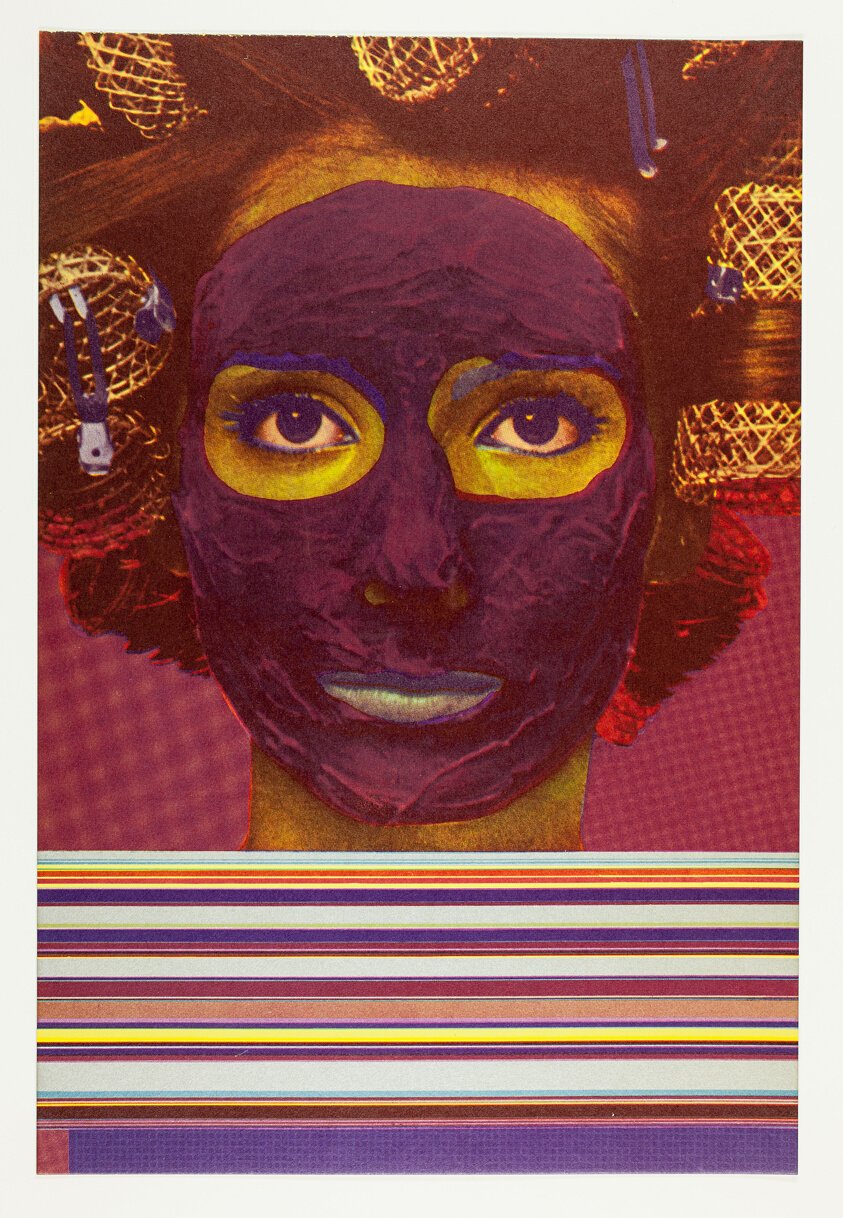
The Art Institute of Chicago, Elizabeth Gott Templeton Endowment · The Art Institute of Chicago
One sheet among fifty six
Astute sizing up perfume trends is one sheet from General Dynamic F.U.N., a print portfolio Eduardo Paolozzi made between about 1965 and 1970. Editions Alecto in London published it in 1970: 56 photolithographs and screenprints in a box, in an edition of 350. It was the second volume of a larger project called Moonstrips Empire News.
According to the Art Institute of Chicago, this sheet is a photolithograph on paper, 38 by 25.4 cm, printed by Richard Davis in London. The format is small, close to a magazine page. That is no accident: much of Paolozzi's material came from magazine pages.
Many sheets in the set carry long, odd titles, like lines cut from some other text. Studies in Human Salvage. More Power to Everybody. Decency and Decorum in Production. Becoming is Meaning like Nothing is Going. Astute sizing up perfume trends sits in that row like a business item that wandered into a poem.
The portfolio title is a pun as well. General Dynamic recalls General Dynamics, the company that built the F 111 fighter used in the Vietnam War. F.U.N. is capitalised and punctuated like a military acronym. Pleasure and the war machine share one line of type.
Collaging the mass world
Eduardo Paolozzi was born in 1924 in Leith, Scotland, to an Italian family, and died in 2005. He was a sculptor, and also one of the people who opened the way for British pop art. In the early 1950s he belonged to the Independent Group in London, artists and critics drawn to advertising, science fiction, machines and American popular culture.
From early on his method was collage. He gathered images from magazines, comics, technical manuals and packaging, then put them together. Not to mock any single picture, but to show how a whole system of images was working.
General Dynamic F.U.N. pushes that method to a dense pitch. The sheets set geometric blocks beside familiar emblems and diagrams that look drawn by a computer. The viewer faces a stream of information that does not stop, like flipping through a stack of magazines very fast.
Photolithography let Paolozzi bring photographs and existing printed matter straight into the work. The print does not pretend to be a drawing. It admits it is a product of the press, related to the very advertisements it borrows from.
Perfume in the boardroom
Why perfume? By the late 1960s, perfume was a large industry, sold more through pictures than through smell. People often met a bottle on the printed page before they met it on skin. Advertising spoke of faces, cities, a desired life. The scent itself could not be printed.
Paolozzi's title takes this one step further. Not just the advertisement, but the counting behind it: someone sitting and sizing up trends, predicting what people will want to smell next season. Scent becomes a curve on a chart.
The print does not say whether this is good or bad. Paolozzi rarely preached. He simply placed the phrase among machine parts and emblems, beside sheets about war, production, and people as salvage. Seen in that company, measuring perfume trends looks as strange as everything else in the set.
What stays is a question that is still open. Smell is the sense closest to the body, the hardest to share, the hardest to record. Yet it is spoken of mostly through pictures and numbers. In 1960, cinema had tried to bring smell into the theatre by machine. Paolozzi adds no smell to his print. He only shows the distance between a scent and everything said about it.
Olfactory Art