
Essays · Modern Art
Edvard Munch. The Scream.
A scream without a sound.
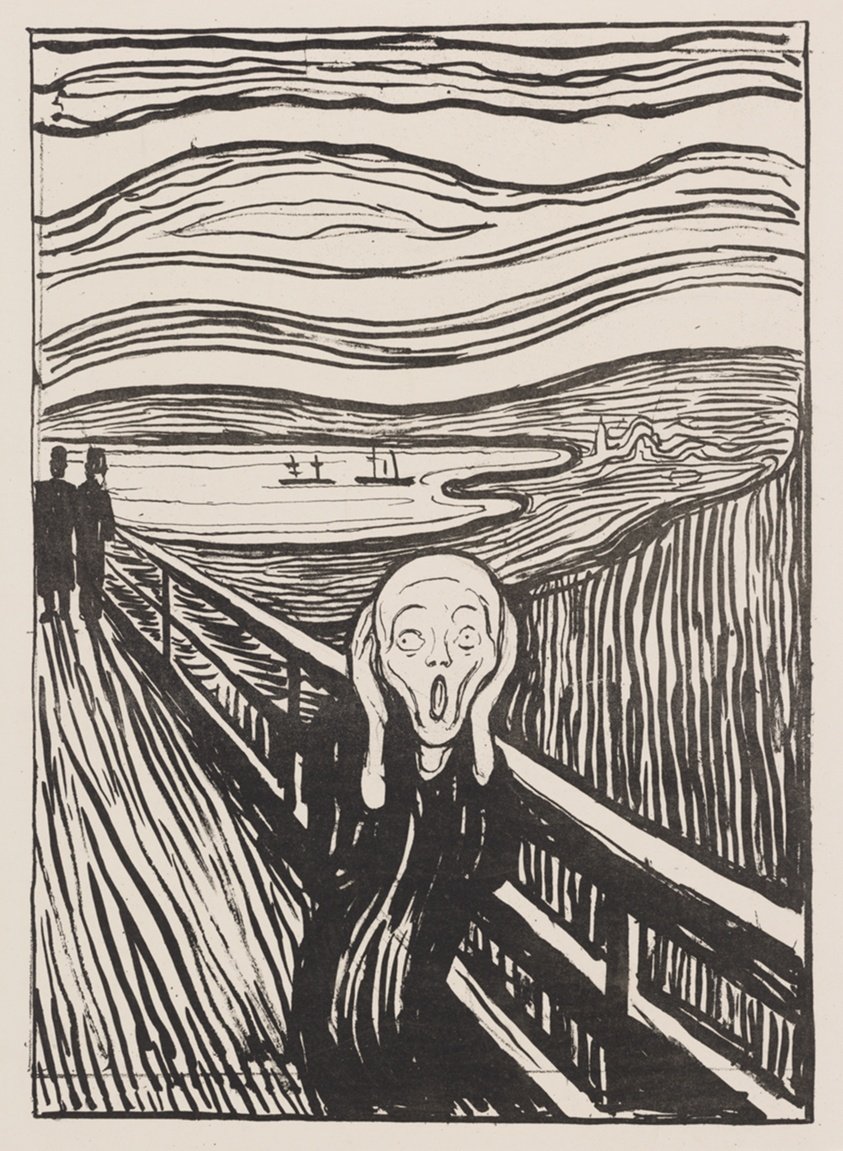
Edvard Munch, The Scream. The Art Institute of Chicago, Clarence Buckingham Collection · Public domain
A board, an evening
The Scream, Skrik in Norwegian, was made by Edvard Munch in 1893. He did not use canvas. He worked in tempera and oil crayon on a sheet of cardboard, 91 centimetres high and 73.5 wide. The materials dry quickly and keep the direction of the hand. Up close, the sky is not a flat red but bands of orange, yellow and red running side by side, bending.
The composition is simple. A road with a railing runs diagonally from the left. To the right lie the fjord and dark blue hills. In the foreground a thin, almost hairless figure presses both hands to its cheeks, mouth open in a round. Behind it, two other people walk on, as if nothing were happening.
Lower left is the signature E. Munch 1893. Upper left is a line in pencil, in Norwegian, saying roughly that the picture could only have been painted by a madman. On the back of the board is another sketch.
The Nasjonalmuseet in Oslo records a German title as well, Verzweiflung, despair. The work was first shown in Berlin, at a gallery on Unter den Linden, in the year it was made.
An image made again and again
The Scream did not come from nowhere. In 1892 Munch painted Sick Mood at Sunset. Despair. The same road, the same railing, the same sky. A year later he pushed the figure into the foreground, turned its face to the viewer, and the image became something else entirely.
He did not stop there. According to the museum, there are two painted versions: the 1893 board in Oslo and another from 1910 or later, now at the Munch Museum. There are two pastels, one undated but thought to be around 1893, one signed and dated 1895. In 1895 Munch also made a black and white lithograph.
The lithograph matters in its own way. It let the image leave a single board and enter books, newspapers, other people's walls. The scream began to have copies. Each differs a little in colour and line; the gesture of the hands stays.
Munch kept returning to his own images. This is also where modern art changes how a picture is read: no longer a window onto the world, but the trace of an inner state. For him a picture was never quite finished. It was a feeling to be made again until it was said right.
The pencil line
The line in the upper corner was long a small puzzle. At first it was taken as Munch's own. By 2008 most researchers thought someone else had added it later.
In 2020 the museum examined the board with infrared light and analysed the handwriting. The conclusion returned to the first idea: the painter wrote it himself. A man writing on his own work that only a madman could have made it. Irony, perhaps. Self defence against criticism he had heard, perhaps. No one can say.
What is certain is that the line is so faint most visitors never see it. It is not part of the famous image. But it is part of the object: a board someone once wrote on in pencil, on a certain day, in a certain mood.
A work kept close
The board entered Norway's national collection in 1910, a gift from the collector Olaf Schou. Since then it has hardly left Oslo. In 1994 it was stolen from the museum and recovered the same year. Its last loan abroad was in 1993, to an exhibition in Japan.
Tempera and crayon on board are sensitive to light and humidity, so the painting is kept as a fragile thing, even while its image appears on countless shirts, mugs and posters.
It is a quiet paradox. The image is everywhere. The object is single, in one room in Oslo, with its dry colour, its faint pencil and its sketch turned to the wall. The scream has travelled far. The board stays where it is.
Modern Art