
Essays · Photography
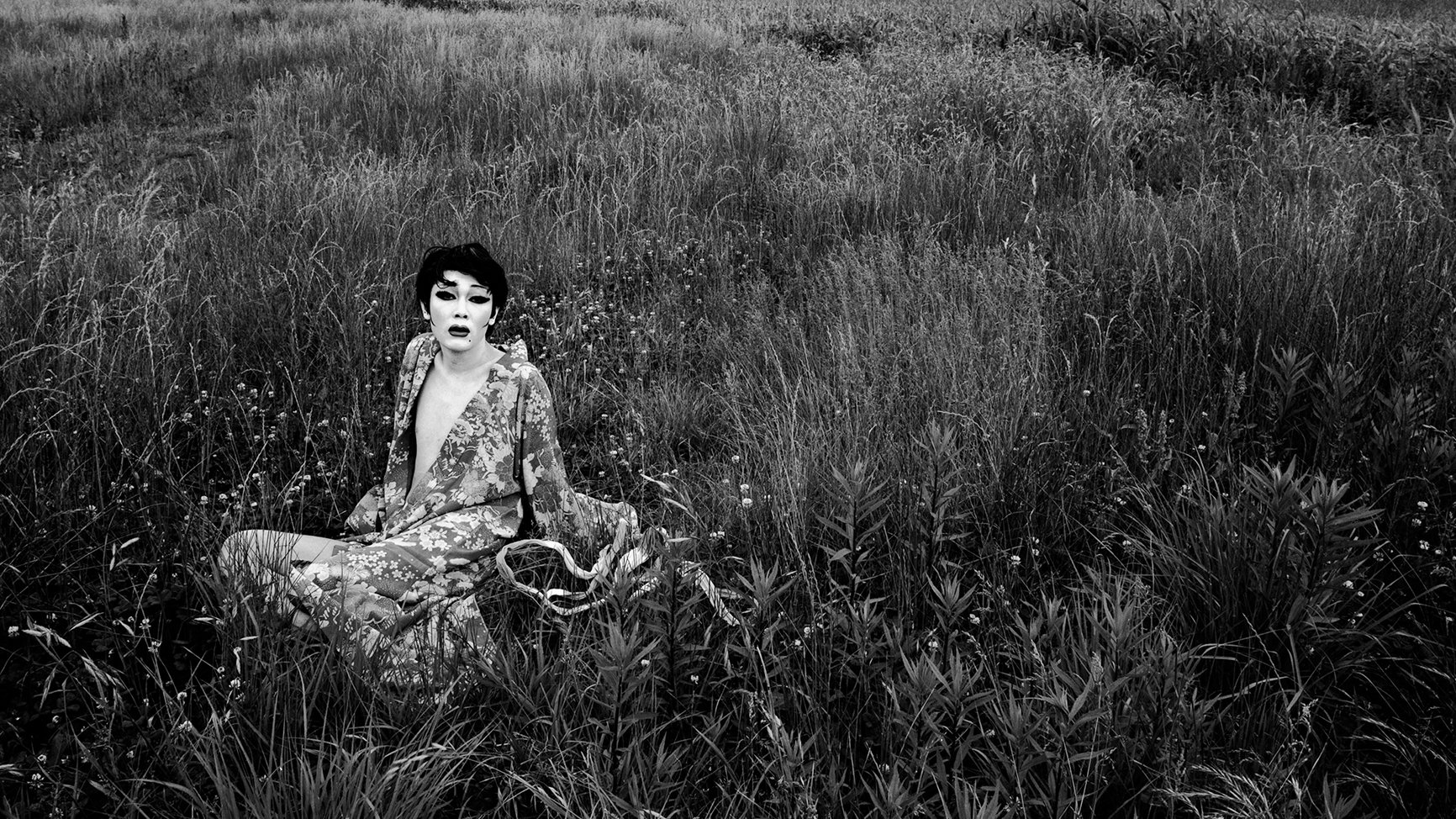
Eikoh Hosoe. Kamaitachi.
The place that frightened us as children never leaves.
© the artist and courtesy Akio Nagasawa Gallery · Aperture
A weasel riding the wind
Folk tales from northeastern Japan tell of a creature called the kamaitachi. It looks like a weasel, rides on whirlwinds, moves too fast to be seen, and has sharp claws. Those it passes only find out afterwards, when they notice a cut on their skin.
Eikoh Hosoe was born in 1933. During the Second World War, as a child, he was evacuated to the Tohoku countryside. The kamaitachi stories belonged to those years: wide fields, strong wind, and a fear with no shape.
More than twenty years later Hosoe went back. This time he did not go alone. He took a camera, and a dancer.
There is a paradox in the idea. How do you photograph something the legend says no one can see? Hosoe did not try to show the weasel. He photographed what surrounds it: wind, fields, people running, people afraid. The creature appears through how everything else reacts, the way we only know the wind by how the grass bends.
Hijikata in the fields
Tatsumi Hijikata was one of the founders of butoh, the dance form born in postwar Japan: slow, contorted, close to the ground, set against the polished beauty of Western dance. Hosoe and Hijikata had worked together before. Kamaitachi was their second major collaboration in book form.
From 1965 to 1968 the two worked in rural Tohoku, mainly in Akita, and in Tokyo as well. Hijikata did not play the weasel. He became something stranger: a man sprinting across rice fields, leaping against the sky, hiding behind a farmhouse wall, slipping in among the villagers. He was the creature, the child afraid of it, and the wind.
Hosoe shot from unfamiliar angles: very low, steeply tilted, sometimes running himself as he pressed the shutter. The frame lurches. The horizon slips. The pictures do not tell a story in order. They feel like fragments of memory surfacing without warning.
Villagers stood and watched. Decades later, elderly people in the area still remembered the shoot: a strange man from Tokyo running all over the village fields.
A book opened page by page
In 1969 the series became the book Kamaitachi, published in Tokyo by Gendai Shicho Sha, with a first edition of one thousand copies. The book itself is part of the work: each image is folded inside a blue sheet that has to be opened before the picture appears. Looking becomes a slow ritual.
The book earned Hosoe an Art Encouragement Prize from the Japanese Ministry of Education. It sits beside his earlier Man and Woman of 1960 and Ordeal by Roses of 1961, made with the writer Yukio Mishima, within the years when Japanese photography sought its own language after the war. In 1959 Hosoe had also cofounded Vivo, six experimental photographers sharing one office in Ginza.
At the same time Daido Moriyama, once Hosoe's assistant, was heading elsewhere: streets, stray dogs, coarse grain, as in Stray Dog, Misawa. Different ways of seeing, one shared question: what postwar Japan looked like from the inside.
Kamaitachi answers by returning to childhood. Not a gentle childhood. A childhood of wind, open fields, and an animal no one ever saw.
Photography