
Essays · Contemporary Art
El Anatsui. Behind the Red Moon.
Each bottle top carries a route.
Tate Modern · Tate Modern
A sail at the top of the ramp
On 10 October 2023, visitors entering the Turbine Hall at Tate Modern met a vast hanging at the top of the ramp. It billowed toward the doors like a sail in wind, filling almost the full height and width of the hall. At its centre was a red circle flecked with gold, surrounded by deep crimson. Visitors walked down the ramp directly beneath it.
This was the first act of Behind the Red Moon, El Anatsui's Hyundai Commission, on view until 14 April 2024. Tate describes it as an artwork in three acts: The Red Moon, The World, The Wall.
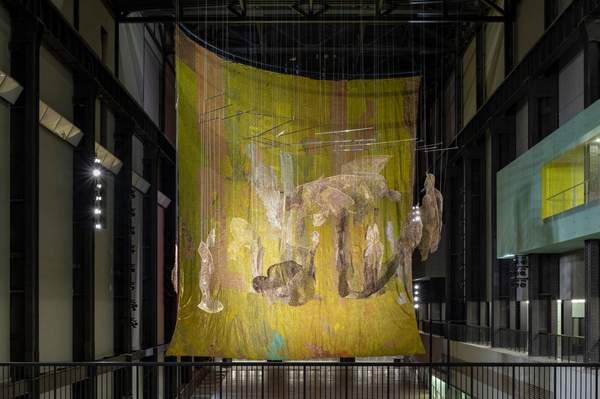
The material is thousands of liquor bottle tops and metal fragments, crumpled, crushed and joined by hand with copper wire. Small sheets become large sheets, large sheets become vast fields of colour, shape and line. For all their size they stay supple; they fold and change shape.
Anatsui said the Turbine Hall reminded him of a ship. He was thinking about motion, and about the idea of a red sail.
Moon, ship, ocean
The sail points to a specific history. During the transatlantic slave trade, African people were sold and exchanged for gold, sugar, spirits and other goods, then shipped across the ocean to the Americas. Many were forced to work on sugar plantations that fed the alcohol industry. Later, spirits made in the Caribbean were shipped to Europe, and from Europe to West Africa.
The bottle tops in the work were sourced in Nigeria. They belong to a present day trade whose routes were drawn in colonial times. Tate quotes Anatsui describing them as the material that was there at the beginning of contact between two continents.
The red circle is a blood moon, the moon seen during an eclipse. Eighteenth century sailors sometimes steered by it. The moon also pulls the tides. A body in the sky, an invisible force, and ships carrying people who would not return.
The second act hangs before the bridge. Many separate layers, like a group of figures suspended in motion. From one spot on the bridge the fragments align into a single circle: the Earth. The figures are made from the thin seals inside bottle tops, wired into a semi transparent net. Anatsui has said that breaking is not destruction but a necessity for reforming.
The wall and the sugar
The third act is a black wall rising from floor to ceiling. At its base, metal swells up like breaking waves and rocky peaks. Walk behind it and the other face shimmers silver, covered in a many coloured mosaic.
Anatsui traces the wall to the old story of the earthen wall of Notsie, in present day Togo, built by King Agokoli to confine his subjects. The Ewe people rose up, tore it down and escaped. Yet he also speaks of walls as attempts to hide things, which provoke curiosity, and curiosity carries the imagination to the other side.
One remark turns the work back on the building itself. Anatsui recalls that Tate and Lyle sugar was the only brand used in his childhood in the Gold Coast, and that he came to understand the sugar industry grew out of the transatlantic trade. The Tate on the sugar bag and the Tate over the museum door share a root: Henry Tate, the sugar merchant who founded the gallery.
The non fixed form
El Anatsui was born in 1944 in Anyako, Ghana. He lives and works between Tema in Ghana and Nsukka in Nigeria. In his studio dozens of assistants stitch and assemble the sheets by hand. Connections form gradually between material, shape and colour, rather than following a fixed plan.
Anatsui calls this the non fixed form. A hanging can be installed differently in each place; it has no single correct shape. Each material, he says, has its properties, physical and even spiritual. A bottle top carries both: the thinness and shine of metal, and the brand names printed on it.
The method recalls another work that once covered the same hall: Ai Weiwei's Sunflower Seeds, where millions of small things made by many hands were gathered into one plane. In Anatsui's work the small things do not lie on the floor. They rise, fill the air, and can be arranged again.
Behind the Red Moon does not tell history in chronological order. It places visitors among three acts and lets them walk, pause, see the image and then the object. Tate calls it a dance between bodies and sculptures.
Contemporary Art