
Essays · Contemporary Art
Ai Weiwei. Sunflower Seeds.
Each seed is a hand.
Tate · Tate
A field in a former power station
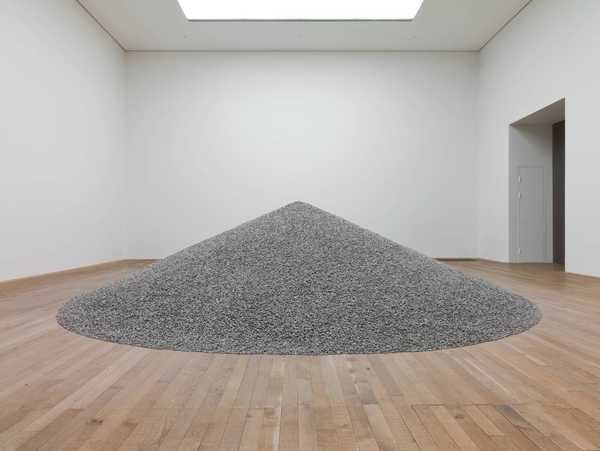
In October 2010, the Turbine Hall at Tate Modern in London, the vast space that once housed the turbines of a power station, was covered with a layer of grey grains. Seen from the balcony, it looked like gravel, or freshly ploughed ground. Only by bending down could visitors see that they were sunflower seeds.
Not real ones. Each seed was made of porcelain at life size, shaped by hand and painted stripe by stripe by hand. The total was estimated at around one hundred million.
This was Ai Weiwei's commission for The Unilever Series, on view from October 2010 to May 2011. The title is plain: Sunflower Seeds.
A city of porcelain
The seeds were made in Jingdezhen, the city in Jiangxi province that produced porcelain for Chinese imperial courts for centuries. Ai Weiwei did not use a factory. He worked with small workshops in the city, where artisans followed old stages: shaping, firing, painting, firing again.
According to Tate, around 1,600 artisans took part. Each seed passed through several pairs of hands. No two are exactly alike, though from a distance they look identical.
That is the centre of the work. A single seed is a careful object, almost a small ornament. Millions placed together, the care disappears, leaving only a grey surface. The viewer stands between two ways of seeing and cannot hold both at once.
The labour of thousands is gathered into one flat plane. The work does not hide this. It places it right under the visitor's feet.
In the same year, in Shanghai, another artist was also having Chinese workers remake a symbol by hand: Danh Vo and his copy of the Statue of Liberty, hammered from thin copper sheets. The two works are very different, yet both expose something usually hidden: behind a familiar image lie the working hours of many people whose names we never learn.
A snack and a question
In China, sunflower seeds are an everyday snack. People crack them while talking, while waiting, while watching football, and leave a pile of husks behind. They are shared, not kept.
Ai Weiwei turned the cheapest thing into the most laborious one. He also turned something eaten and discarded into something inedible that must be preserved. The distance between those two lives of a single shape is where the work asks its question: who makes things, and where does the value of a thing come from?
The work also asks about the individual and the crowd. From afar, no one is visible. Up close, each seed carries the mark of a particular hand, a particular day of work. No seed is anonymous. We simply lack the time to look at them all.
The tenth that stayed
After the exhibition, Tate acquired part of the work: roughly eight million seeds, about ten tonnes, just under a tenth of what had covered the Turbine Hall. The rest went other ways.
What is striking is that the work keeps its name even though the quantity has changed completely. Sunflower Seeds does not depend on an exact number. It depends on there being enough for each seed to vanish into the crowd, while each one stays clear enough to make a visitor bend down.
Visitors today may stand before far fewer seeds than in 2010. But the movement of the body is the same: standing upright, you see grey ground; bending down, you see a seed, a brushstroke, a person.
Contemporary Art